Web Scraping Services UK: A Buyer's Guide for 2026
Web scraping services for UK businesses: directory, seller, product and real estate scraping, how the service works, what drives the price, and what UK law allows.
By Vinay Jakhariya, Co-founder & Operation Manager · · 9 min read
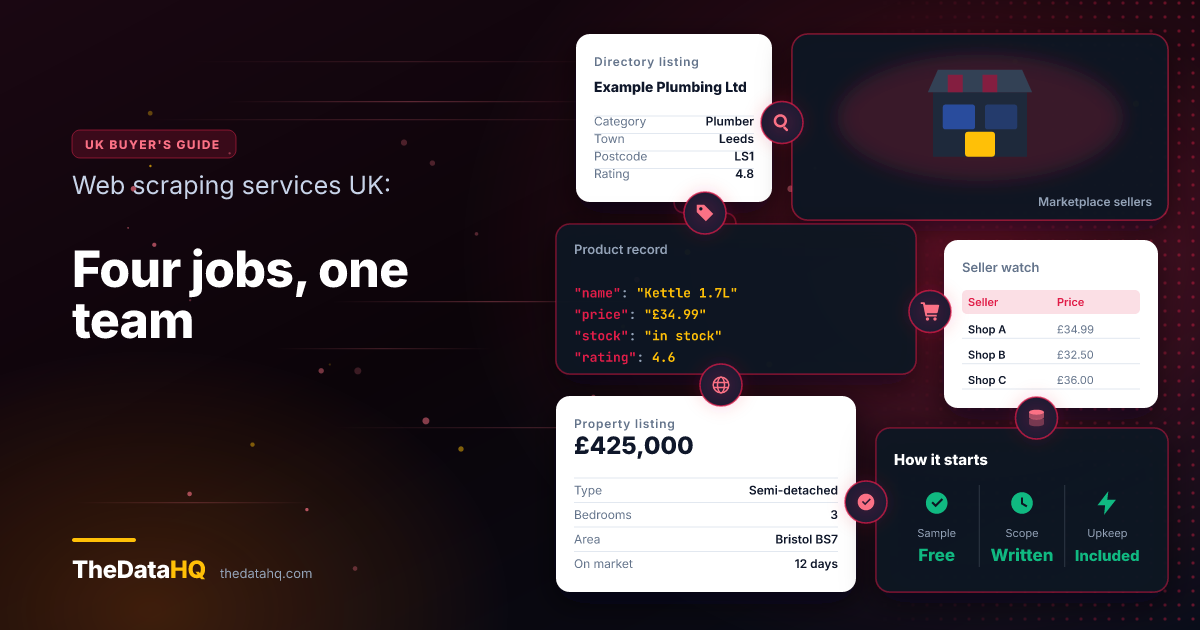
TheDataHQ provides web scraping services to UK businesses. We collect public data from the websites you care about, such as business directories, marketplace sellers, product pages and property listings. Then we clean it and deliver it as a spreadsheet, a file drop or a live feed, on whatever schedule you need. You get a free sample before you pay anything. The work is priced as a fixed project, a monthly retainer or a dedicated developer. And yes, web scraping is legal in the UK as long as the data is public, isn't personal, and is collected within a site's terms.
The rest of this guide covers what UK clients most often ask us to collect, how the service works, what drives the price, and what UK law allows.
What Are Web Scraping Services?
A web scraping service collects information from websites for you, automatically, and hands it over in a usable format. You say which sites and which details you need. The provider builds the collectors, runs them, checks the results and keeps them working.
What does a web scraping service do for you?
- Finds the data on the pages you name, however many there are
- Collects it once, or daily, weekly or near real time
- Cleans it: removes duplicates, fixes formats and fills gaps where the source allows
- Delivers it in the format your team already uses
- Maintains it when a website changes its layout, which happens often
Data scraping vs web scraping: what's the difference?
In practice, nothing that matters to a buyer. Web scraping means collecting data from websites. Data scraping is the wider term and also covers documents, PDFs and apps. Most UK providers, us included, do both. Our data extraction service handles the non-website sources.
Why Do UK Businesses Use Web Scraping Services?
Mostly because copying and pasting doesn't scale, and hiring a developer for one job rarely makes sense. The reasons we hear most from UK clients:
- Speed. A task that takes a person a week of copying takes a scraper minutes.
- Freshness. Prices, stock and listings change daily. A manual check is out of date by the time it's finished.
- Accuracy. The same fields, in the same format, every time.
- Cost. Cheaper than a full-time hire for work that comes and goes.
- No upkeep on your side. When a site changes, fixing the scraper is our job.
What Web Scraping Requirements Do We Handle for UK Clients?
We've worked with UK clients on a wide range of requirements. Four come up far more often than the rest: directory scraping, seller scraping, product scraping and real estate scraping.
What is directory scraping?
Directory scraping collects business listings from online directories and turns them into one clean list. UK clients use it to build sales territories, size a market or check their own listings.
- Business name, category and trading address
- Business phone number and website
- Opening hours, ratings and review counts
- Postcode, which makes mapping and territory planning easy
We collect at business level, not about named people. Our guide to scraping business directory data goes further into what's in a typical listing.
What is seller scraping?
Seller scraping collects information about the sellers on online marketplaces. Brands use it to find unauthorised resellers. Retailers use it to see who they're competing against on each product.
- Seller or shop name and business details shown on the listing
- Seller ratings and feedback counts
- Which products each seller lists, and at what price
- Stock levels and delivery promises
What is product scraping?
Product scraping collects product details and prices from e-commerce sites. It's the most common request we get from UK retailers, brands and distributors.
- Product names, descriptions, specifications and barcodes
- Prices, discounts and promotions
- Stock status
- Customer ratings and review counts
When the aim is to track competitors over time, this becomes price scraping. One of our e-commerce projects tracks prices across more than 200 competitor sites, refreshed daily. That's a past project result, not a promise for yours.
What is real estate scraping?
Real estate scraping collects property listings from property portals and agent websites and merges them into one daily feed. UK investors, agents and proptech firms use it to follow asking prices and stock by area.
- Asking price, price changes and time on market
- Property type, bedrooms, size and features
- Postcode and location
- Listing agent and branch
A past property project of ours covers more than 50 portals with daily updates.
What else can you scrape for a UK business?
- Job listings, to track hiring demand and salaries by region
- Reviews, to see what customers say about you and your competitors
- Travel and hotel rates, for pricing and availability checks
- Company and funding news, for investment and market research
- Large text collections, for training and testing AI models
| Requirement | Typical UK buyer | Usual schedule |
|---|---|---|
| Directory scraping | Sales and marketing teams | One-off or monthly |
| Seller scraping | Brands and marketplace sellers | Weekly |
| Product and price scraping | Retailers and distributors | Daily |
| Real estate scraping | Investors, agents, proptech | Daily |
| Job and review data | Recruiters and researchers | Daily or weekly |
Which Web Scraping Service Do You Need?
It depends on how often you need the data and how much of it. Here's how our services line up:
- A one-off dataset: a custom scrape, delivered once as a spreadsheet or file
- A regular feed: a managed service that runs on a schedule and that we maintain
- Very large volumes: enterprise web scraping, for millions of pages across many sites
- Data your software reads directly: an API, which is a link your own systems can pull fresh data from
- Prices or odds that change by the minute: real-time scraping
- Ongoing work across many projects: a dedicated scraping developer on your team
How Does Our Web Scraping Service Work?
- You tell us what you need. The sites, the fields and how often.
- We check it's collectable, legally and technically, before anything else.
- We send a free sample, so you can check the data before paying.
- We agree the scope in writing: volumes, format, schedule and price.
- We build and run it. A single straightforward site is usually running within a week.
- We deliver and maintain it. If a site changes, we fix the scraper, usually before you notice.
What formats can you get your data in?
- Excel or CSV, for spreadsheets
- JSON or XML, for developers
- Straight into your database
- Dropped into Google Drive, Amazon S3 or an SFTP folder, a secure file-transfer location
- Through an API your systems call when they need data
How quickly can you start?
Most projects start within a few days of the requirements being agreed. Large projects covering many sites take longer, and you get a schedule with the quote, not a vague estimate.
How Much Do Web Scraping Services Cost in the UK?
It depends on the job, so we quote each one after seeing the requirement. There are no hidden extras: price, scope and schedule are fixed in writing before work starts. You can see how the models work on our pricing page.
What changes the price of web scraping?
- Number of sites. Each site needs its own collector.
- Number of records. 5,000 products costs less than 5 million.
- How often it runs. Daily costs more than monthly.
- How complex the site is. Pages that load content as you scroll take more work.
- How much cleaning is needed. Matching the same product across sites is extra work.
Fixed price, retainer or dedicated developer?
| Model | Best for | How it's billed |
|---|---|---|
| Fixed price | A defined, one-off dataset | Against agreed milestones |
| Retainer | A regular feed that needs upkeep | Weekly or monthly, in advance |
| Dedicated developer | A steady stream of scraping work | Monthly |
Fixing a scraper after a site changes is included in retainers and dedicated developer work. On fixed-price projects we agree a support window at the start.
Is Web Scraping Legal in the UK?
Yes, collecting publicly available, non-personal data is generally lawful in the UK. What matters is what you collect, how you collect it and what you do with it. This is general information, not legal advice.
What UK laws apply to web scraping?
- UK GDPR and the Data Protection Act 2018 apply whenever data identifies a person, including sole traders trading under their own name.
- Database right protects a database that took real investment to build. Copying a substantial part of it can infringe that right, even when each entry is public.
- Copyright covers written content and photos, so reusing descriptions or images needs care.
- A website's terms of use are a contract, and they can forbid automated collection.
- The Computer Misuse Act 1990 makes unauthorised access an offence, which is why we never collect from behind logins.
What data won't we collect?
We turn down work that would require us to:
- Get past logins, paywalls or other access controls
- Break a website's terms of use
- Collect personal or identity information about individuals
- Collect data you have no lawful basis to hold
- Ignore a site's published crawl rules, or send more traffic than it can handle
If a request is on the wrong side of that line, we'll tell you before we start, not after.
How Do You Choose a Web Scraping Company in the UK?
Ask any provider these questions before you sign:
- Will you send a free sample of my data first?
- Who fixes the scraper when the site changes, and is that included?
- Who owns the data you collect for me?
- Will you sign an NDA and a data processing agreement, the UK GDPR contract for handling data on my behalf?
- What work do you turn down, and why?
- Can you deliver in the format my team already uses?
A provider who can't answer the last-but-one question clearly hasn't thought about UK law.
Should you hire a freelancer or a web scraping company?
A freelancer suits a single, finished job with no upkeep. A company suits anything that runs again, because someone has to fix it when a site changes and cover for holidays and sickness. Our post on running your own scraper versus buying the feed covers the trade-off in more detail.
Why Choose TheDataHQ for Web Scraping in the UK?
- Over 12 years of scraping. It's all we do.
- Experience with UK requirements: directory, seller, product and real estate scraping.
- A free sample first, so you judge the data, not the sales pitch.
- You own the data. We don't resell it or reuse it for other clients.
- NDAs and data processing agreements, signed routinely, on your paperwork if you prefer.
- Maintenance included on ongoing work.
- Clear limits. Public data only, no personal data, no getting past logins.
One thing to know up front: we're based in India, not the UK. India is four and a half to five and a half hours ahead of the UK, depending on the time of year. Our working day covers the UK morning and early afternoon, so you'll usually hear back the same day. Browse our case studies to see the kind of work we deliver.
Questions people ask about web scraping services in the UK
Is web scraping legal in the UK?
Generally yes, for publicly available data that doesn't identify people. The risks come from UK GDPR when data is personal, from database right when you copy a substantial part of a database, from a site's terms of use, and from the Computer Misuse Act if you get past a login. A careful provider checks all four before starting. This is general information, not legal advice.
How much does web scraping cost?
It depends on the number of sites, the number of records, how often the data is collected and how complex the pages are. A one-off dataset from one site is at the low end. Daily collection across hundreds of sites is at the high end. We quote each job in writing after seeing the requirement, and send a free sample first.
What is a web scraping service?
It's a company that collects data from websites for you. You name the sites and the details you need. They build the tools, run them on a schedule, clean the results and deliver them as a spreadsheet, file or live feed. They also fix the tools when a website changes, so you don't need a developer on your side.
What is web scraping used for?
In the UK, the most common uses are tracking competitor prices, building business lists from directories, checking who sells your products on marketplaces, and following property listings by area. Other uses include job market research, review tracking, travel pricing and gathering text to train AI models. Each one turns scattered web pages into a single, usable dataset.
Are there web scraping services for sales lead generation?
Yes. Directory scraping is the usual route: business names, categories, addresses, phone numbers and websites, collected into one list you can filter by postcode or sector. We work at business level, not with personal contact details of named individuals. That keeps the data useful for prospecting while staying on the right side of UK GDPR.
What are managed web scraping services?
A managed service means the provider runs everything on an ongoing basis: building the scrapers, running them on schedule, checking the data and repairing them when sites change. You just receive the data. It suits anyone who needs fresh data regularly and doesn't want to hire or manage a developer to keep it flowing.
Should I use a custom web scraping service or a scraping tool?
A ready-made tool is fine for small, simple jobs you can run yourself. A custom service makes sense when you need several sites, a large volume, a regular schedule or clean, matched data. You also get someone who fixes the scraper when a site changes. If you're unsure, a free sample shows what a custom service would deliver.
Have a UK web scraping requirement in mind? Tell us which sites and fields you need and we'll send a free sample.