Rental Market Dataset Australia: Free vs Paid Sources
Australian rent data comes from free state bond files (suburb medians, months late), ABS averages, and paid asking-rent data from PropTrack, Cotality and SQM. Which source answers which question, and how current each is.
By Vinay Jakhariya, Co-founder & Operation Manager · · 13 min read
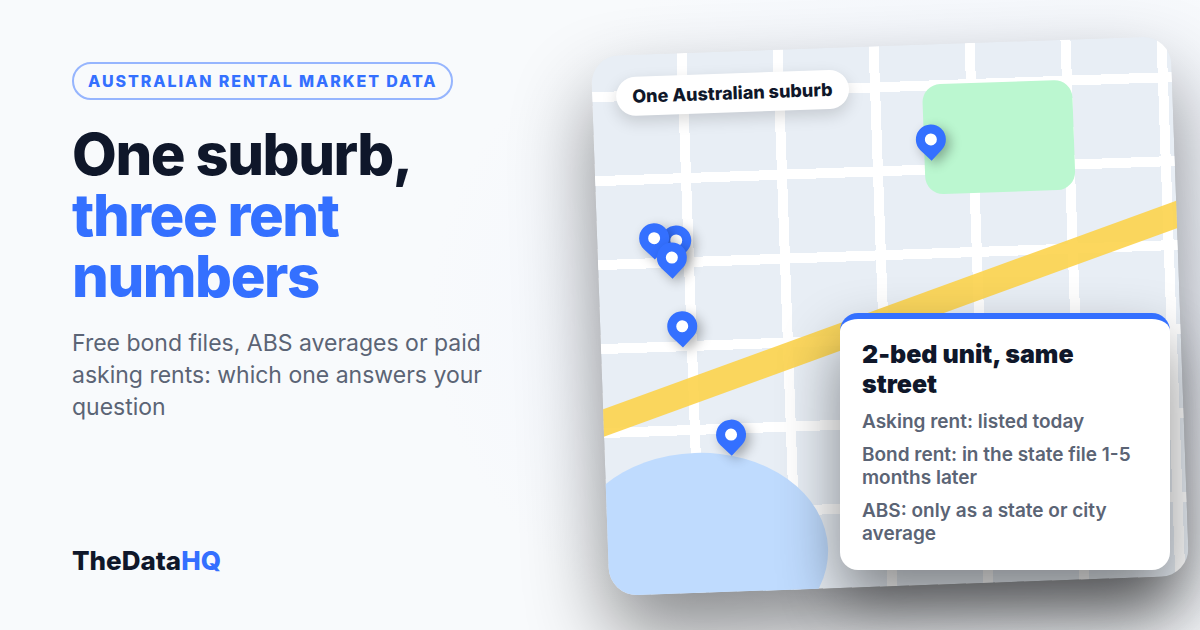
A rental market dataset for Australia comes from three types of source. State governments publish free rents by suburb or postcode from rental bond records, a few months behind. The ABS publishes free rent figures, but only as averages. Commercial providers (PropTrack, Cotality, SQM) sell asking rents from listings, priced per deal. For this week's asking rent on each listing, the data has to be collected.
This guide maps each source: what it measures, how detailed and how current it is, and what it costs to get. It then sorts them by the question you're trying to answer.
What rental market data exists in Australia?
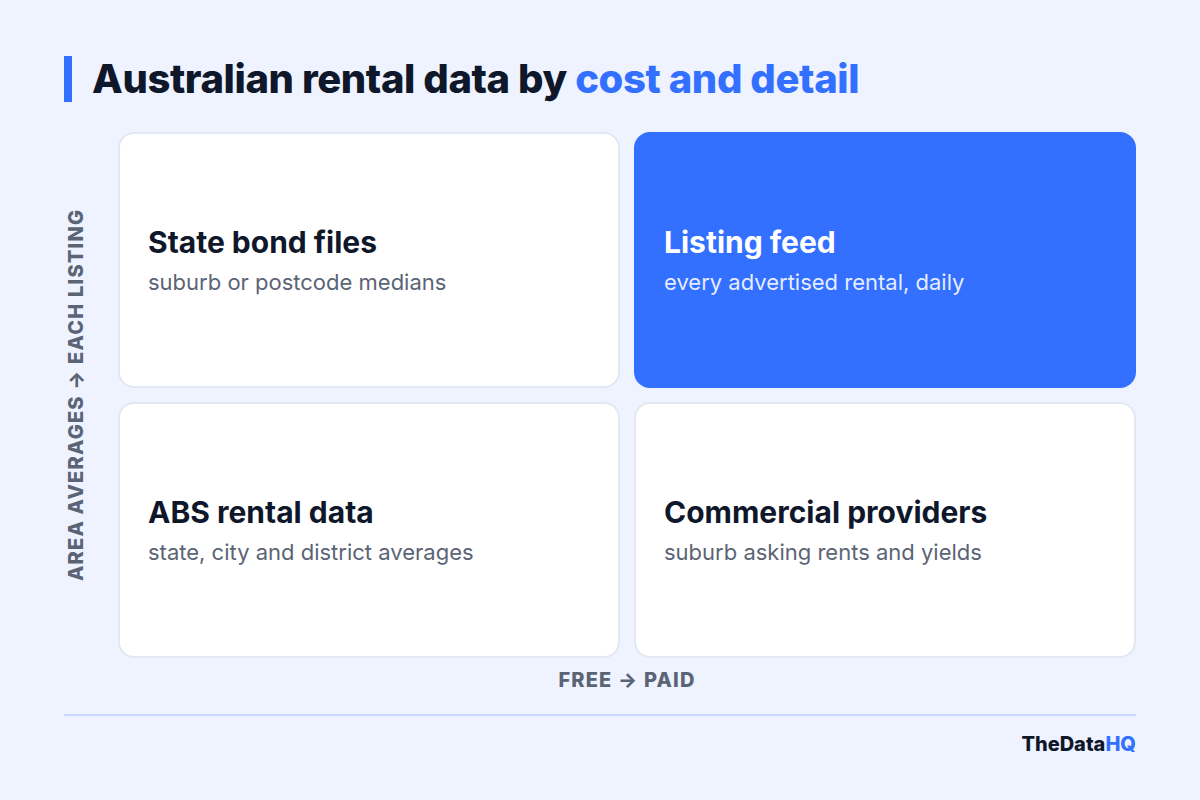
There are four groups, and they measure different things. The table gives the short version.
| Source | What it measures | Detail and freshness | Access and cost |
|---|---|---|---|
| State bond data | The rent agreed on new leases, taken from the bond the tenant lodges | Suburb or postcode; 1 to 5 months behind | Free spreadsheet downloads |
| ABS rental data | Rents paid by new and existing tenants, from property managers' records | Monthly rent index; state, city and district averages in occasional articles | Free tables, averages only |
| Commercial providers | Asking rents from listings, rent estimates, yields | Suburb or postcode; weekly to quarterly | Subscription or quote; terms limit reuse |
| Listing-level feed | Every advertised rental, with bedrooms, features and price changes | Each listing; as often as daily | Custom, quoted after a free sample |
The "1 to 5 months" is from our own check of the state download pages in November 2026. NSW had October 2026 files up; Victoria's latest suburb file covered June 2026.
Which free rental datasets can you download?
Two kinds are free: the ABS rental data and each state's bond-based rent files. They answer different questions.
ABS rental data
Since July 2022 the ABS has measured private rents for the Consumer Price Index with a dataset of about 480,000 rental properties, running monthly from June 2018 (ABS). The RBA explains that the records are entered by property managers, supplied through MRI Real Estate Software, and cover 32% of the 2021 Census rental stock (RBA Bulletin).
The CPI gives a monthly rent index. Median rents appear in occasional ABS articles, with tables as CSV or Excel, but only as averages: national, state, capital city vs regional, and city districts grouped by distance from the centre. There's no suburb or property detail.
It's still the best free view of the big picture. From April 2019 to April 2025, Western Australia's median weekly rent rose 75%, from $350 to $613, and NSW was highest at $650 as at April 2025 (ABS).
State bond data
A rental bond is the tenant's security deposit. In most states it's lodged with a government body, which records the weekly rent, the dwelling type and the bedrooms. Several states publish those records as median rents or as raw lodgements:
- Free, mostly reusable: the Victorian and WA files are under a Creative Commons licence (CC BY 4.0), which allows commercial use with credit; check each other state's terms before commercial use.
- Detailed: suburb or postcode, split by bedrooms or dwelling type.
- Accurate for new leases: it's the rent actually agreed, not the rent asked.
- Behind the market: files come out monthly or quarterly, after the lease starts.
- State by state: each state has its own format, schedule and level of detail.
Which state publishes rent data by suburb?
NSW, Victoria, Queensland, Western Australia, South Australia and Tasmania do. Each one names its file differently, so search by state.
| State | Dataset | Level | How often |
|---|---|---|---|
| NSW | Rental bond lodgements (NSW Fair Trading) | Postcode, with weekly rent, dwelling type and bedrooms | Monthly |
| Victoria | Moving annual rents by suburb (Homes Victoria) | Suburb and town, by bedrooms | Quarterly |
| Queensland | RTA median rents | Postcode, suburb and council area | Quarterly |
| Western Australia | Rental bonds data (DMIRS) | Suburb and postcode, with weekly rent; no bedrooms | Monthly |
| South Australia | Private Rent Report | Suburb, postcode and council area | Quarterly |
| Tasmania | Rental bond and rental data | Suburb, with weekly rent and bedrooms | Monthly |
NSW rental bond data
NSW Fair Trading publishes monthly bond lodgement files by postcode, with dwelling type, weekly rent and bedrooms, from January 2022 (NSW Government). These are close to raw records, so you work out the medians yourself.
Victoria: moving annual rents by suburb
Victoria publishes median rents for suburbs and towns by bedrooms, from bonds held by the Residential Tenancies Bond Authority, quarterly under CC BY 4.0 (Data Vic). They're moving annual medians: each figure covers the past 12 months, so it smooths out short swings.
Queensland, Western Australia, South Australia and Tasmania
Queensland's Residential Tenancies Authority updates a median rents workbook every quarter, by postcode, suburb and council area (RTA). Western Australia publishes every bond lodged each month, with suburb, postcode and weekly rent, under CC BY 4.0; the latest file we saw was September 2026 (National Housing Data Exchange). South Australia's Private Rent Report gives quarterly medians by suburb, postcode and council area. Tasmania publishes monthly bond records by suburb on data.gov.au (CBOS).
We didn't find an open suburb-level rent file for the ACT or the Northern Territory when we checked. For those, the commercial providers below or a listings feed fill the gap.
What do commercial rental data providers sell?
They sell asking rents from listings, usually with estimates and yields on top. None publishes a price list for data access; you get a quote (13Labs).
- PropTrack (realestate.com.au's data business): its Market API returns rent insights for a suburb, alongside listings APIs; access is through its sales team (PropTrack).
- Cotality (formerly CoreLogic): its Quarterly Rental Review uses weekly asking rents and lists the most and least expensive suburbs (Cotality).
- SQM Research: weekly rents by postcode; the site says the figures are for personal reference, and commercial use needs SQM's agreement (SQM Research).
- Domain: suburb and postcode median rent and yield, quarterly over 10 years. Through AURIN it's open only to approved researchers for non-commercial work (Research Data Australia); businesses can sign up for Domain's developer API (a direct machine-to-machine connection) themselves.
- HtAG: prices, rents, supply and demand by place through an API, by application; its prices aren't published.
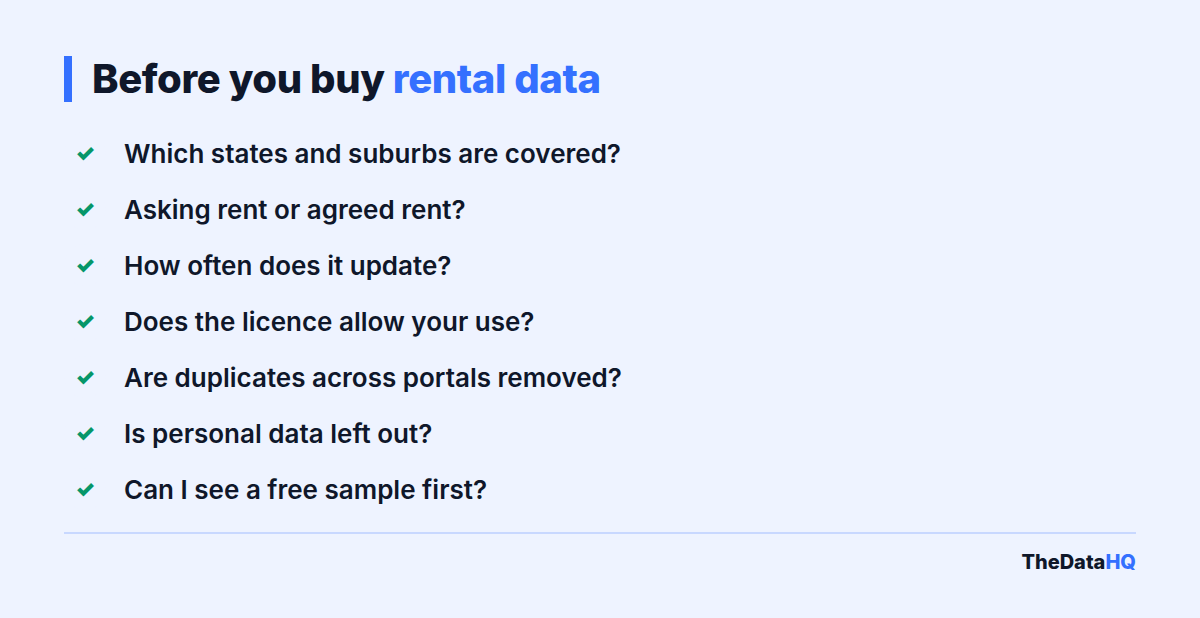
Read the licence before you buy. Domain's API terms, for example, ban reselling the data and creating derivative works from it (13Labs). A suburb median you can show on your website is a different product from one you can only use inside your team.
Asking rent vs bond-lodged rent: why don't the numbers match?
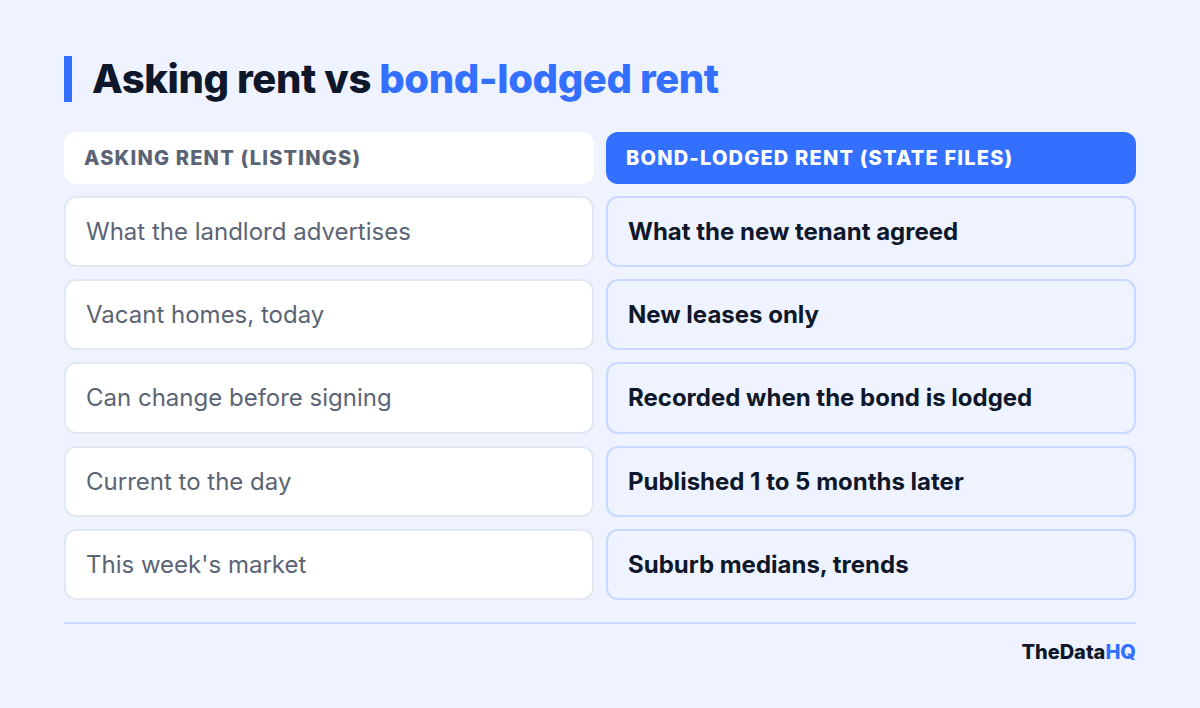
Asking rent is what a landlord advertises for a vacant property. Bond-lodged rent is what the new tenant actually agreed to pay. The two cover different moments, and the asked rent can be cut or bid up before the lease is signed.
Over time they track each other closely. From 2020 to February 2023, rents paid by new tenants rose 24%, while CoreLogic's (now Cotality's) advertised rent series rose 22% (RBA Bulletin).
The bigger gap is with existing tenants. In the year to February 2023, new tenants' rents rose 14%, which the RBA says was 9 percentage points more than the CPI rent index, which mostly reflects sitting tenants.
Which Australian rental market dataset answers which question?
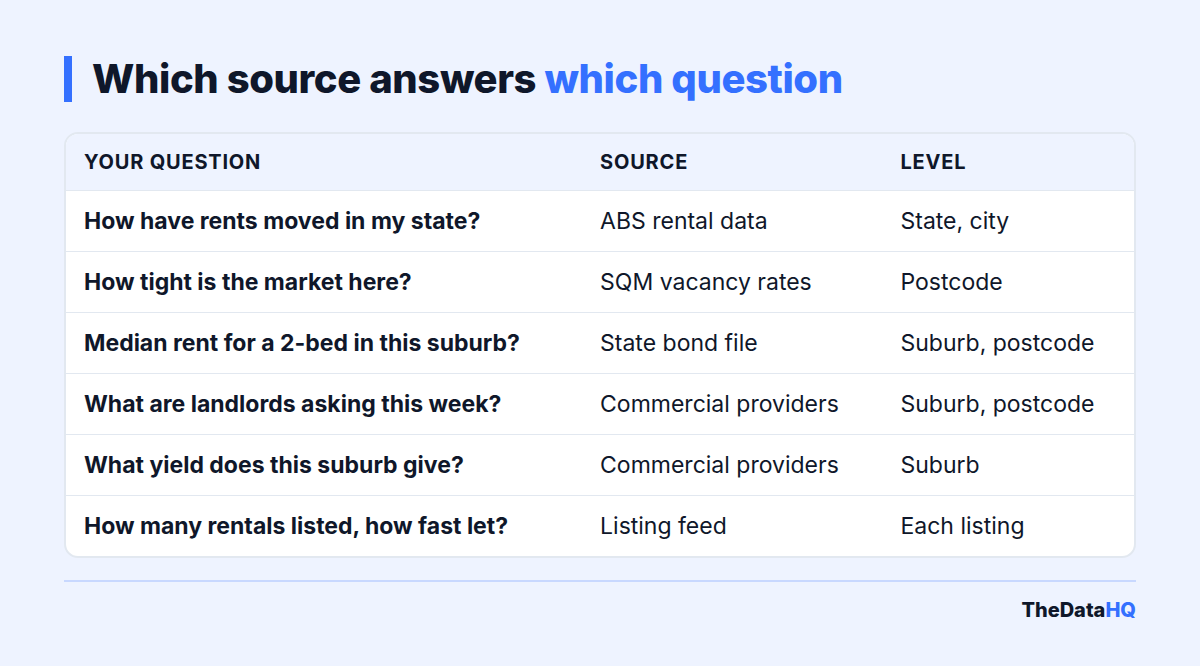
Start from the decision, then pick the source. The usual matches:
- "How have rents moved in my state or city?" ABS rental data.
- "What's the median rent for a 2-bedroom unit in this suburb?" Your state's bond file; a commercial provider for the ACT or the NT, or for bedroom detail in WA.
- "How tight is the market here?" SQM's vacancy rates by postcode.
- "What are landlords asking this week?" SQM, Cotality or PropTrack at suburb level; a listings feed for each property.
- "What gross yield does this suburb give?" Commercial providers, which pair rents with values.
- "How many rentals came on the market, and how fast did they let?" Listing-level data, collected over time.
Our guide to estimating short-term rental revenue covers the holiday-let side, which none of these long-term sources measures.
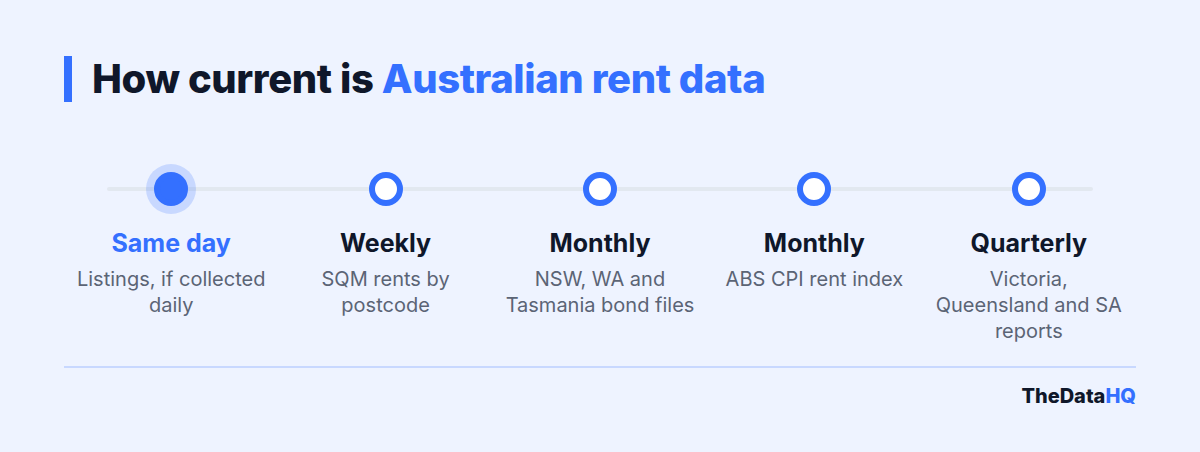
How current is each Australian rental data source?
Listings are current to the day, NSW and Tasmanian bond files to the last month, and the quarterly state reports a quarter or more behind.
- Listings: the same day, if collected daily.
- SQM weekly rents: each week; the postcode page we checked showed the week ending 12 November 2026.
- NSW, WA and Tasmania bond files: monthly; NSW had October 2026 up in mid-November.
- ABS rental data: the CPI rent index is monthly; median rent tables come in occasional articles (the latest we saw used April 2025 data).
- Victoria, Queensland and SA reports: quarterly; Victoria's latest covered June 2026.
One more lag to know about: research copies stop updating. The APM for-sale, for-rent and sold series on AURIN ends in March 2024 (AURIN), so check the last date on any dataset you find through a research portal.
When do you need listing-level rental data?
Only when the question is about individual properties or this week's market. If you need a quarterly suburb median for a report, the free state files are enough, and we'd tell you so.
Listing-level data earns its cost when you need to:
- track each rental from first listing to removal, with every price cut;
- count new supply by suburb each week;
- compare features the medians ignore, such as furnished, pets allowed or parking;
- cover the ACT or the NT at suburb level;
- load fresh data into your own database or pricing model on a schedule.
The honest limit: a listing never tells you the rent finally agreed. For that you still need the bond data, which is why serious work joins the two.
A past result: property listings from 50+ portals
We haven't run an Australian rental project yet. The closest past result is a property market intelligence feed: collectors that gather listings, pricing changes and agent details from 50+ property portals, merged into one feed updated every day (our case studies). Our guide to UK property market data shows how listings and official records fit together.
For data that has to stay current, our real-time scraping service runs on a monthly retainer and includes fixes when sites change. If you'd rather build the collector in-house, our sister company BinaryBits does that work.
Is it legal to collect rental listings data in Australia?
It can be, but "it's public" isn't the legal test. Three things apply:
- Privacy. Agent names and phone numbers, or a private landlord's details, are personal information under the Privacy Act 1988 and the Australian Privacy Principles. The simplest fix is to leave them out.
- Copyright. Australia has no separate database right like the UK's, but copyright can protect listing photos and descriptions.
- Terms of use. Portals and data providers set terms that may limit automated access or reuse. realestate.com.au's terms, for example, rule out automated access and scraping (13Labs).
We collect public pages only, within each site's rate limits and robots.txt (the file where a site says what automated visitors may read), and never behind a login. This is not legal advice; for commercial reuse, check your plans with a lawyer.
Get a free sample of Australian rental data
Send us one URL and the fields you want; we'll send back a free sample of the real output, usually around 100 rows, and quickly. No charge, no commitment. Ask for your free sample, and we'll tell you if a free government file already answers your question.
Frequently asked questions
Where can I download median rent by suburb in Australia?
From your state's rental bond body. Victoria publishes moving annual rents by suburb, Queensland's RTA publishes median rents by suburb and postcode, South Australia publishes the Private Rent Report, and Tasmania and Western Australia publish bond records by suburb. NSW publishes bond lodgements by postcode. We didn't find open suburb files for the ACT or the NT, where commercial providers fill the gap.
Is there a free Australian rental dataset?
Yes. The state bond files are free; Victoria's and WA's are under a Creative Commons licence that allows commercial use with credit, so check the other states' terms. The ABS rental data used for the Consumer Price Index is also free, but only as averages by state, city and district. Free sources don't give asking rents for each listing; those come from commercial providers or a collected feed.
What's the difference between asking rent and bond-lodged rent?
Asking rent is the price advertised for a vacant property. Bond-lodged rent is the rent the new tenant agreed, recorded when the bond is lodged with the state. Asking rents are current but can change before signing; bond rents are what was actually agreed, published one to five months later. Over 2020 to early 2023 the two moved by similar amounts, according to the RBA.
How often is Australian rental data updated?
It depends on the source. Listings change daily, SQM publishes weekly rents, and NSW, WA and Tasmania release bond files monthly. The ABS rent index is monthly, and the Victorian, Queensland and South Australian rent reports are quarterly. When we checked in November 2026, Victoria's latest suburb file covered June 2026, while NSW had October 2026 up.
Does PropTrack or Cotality sell rental data?
Yes, but neither publishes prices. PropTrack offers suburb rent insights through its Market API, with access through its sales team. Cotality, formerly CoreLogic, builds its rental figures from advertised rents and sells subscriptions and reports. Both set licence terms on how you may reuse the data, so check whether your use, such as showing figures to customers, is allowed.
Is it legal to collect rental listings data in Australia?
It can be, depending on the source, the use and the fields. A site's terms of use and copyright in photos and descriptions apply, and agent or landlord contact details are personal information under the Privacy Act 1988. Collect public pages within each site's limits, leave out personal details you don't need, and take legal advice for commercial use. This is not legal advice.