Property Market Data UK: Sources, Uses and How to Get It (2026)
UK property market data comes from official records (sold prices, months late) and live listings (asking prices, today). Which source answers which question, how late each runs, and how to join them.
By Vinay Jakhariya, Co-founder & Operation Manager · · 13 min read
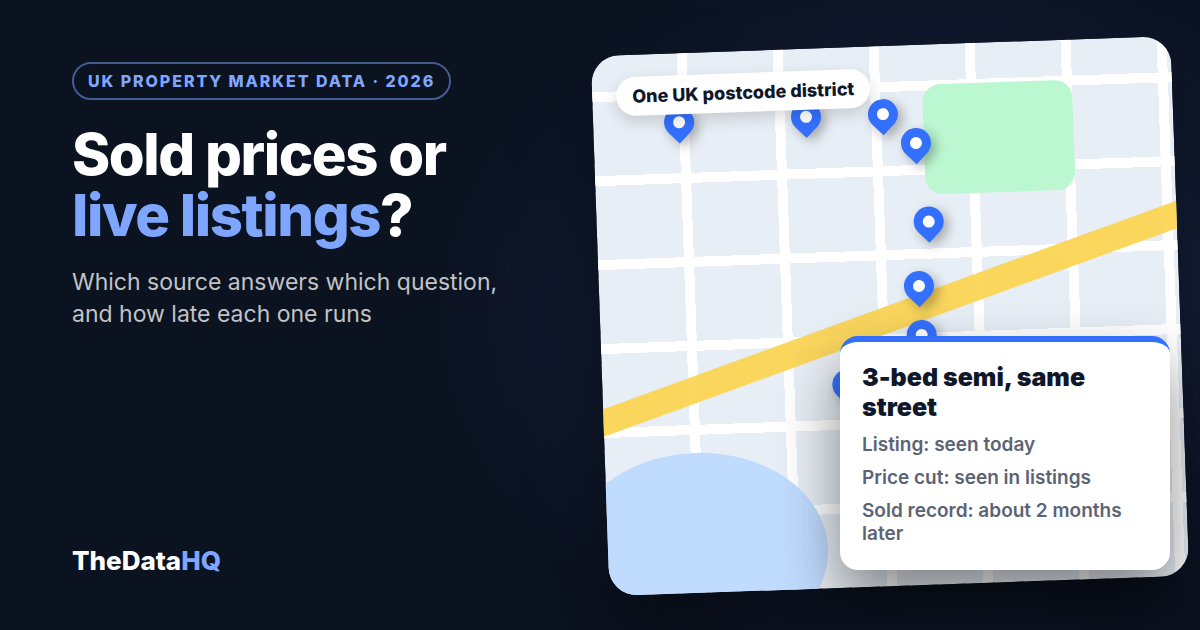
Property market data in the UK comes from two kinds of source. Official records, such as HM Land Registry's price paid data and the UK House Price Index (the official monthly average), show what homes actually sold for, but they're weeks or months behind. Live listings show asking prices, reductions and time on the market today, but not the final price. Most serious uses need both, joined by address.
This guide covers each source, how late it runs, what it costs and which questions it can answer. It also explains when it makes sense to buy a feed instead of joining the data yourself.
What is property market data?
Property market data is any information that describes homes and their prices: sold prices, asking prices, rents, property details, planning activity and how fast homes sell. It splits into two groups.
- Official records. Published by government bodies after a sale, a certificate or an application is registered. Accurate and free, but slow.
- Live listings data. What's advertised right now on property portals and estate agent websites. Current, but it shows what sellers want, not what buyers pay.
Neither group is better. They answer different questions, which is why the rest of this guide sorts them by question.
Which UK property data sources are free?
The main official sources are free to download and reuse, mostly under the Open Government Licence (a licence that allows commercial reuse with attribution).
HM Land Registry price paid data
This is the record of every residential sale for value in England and Wales lodged for registration since January 1995 (HM Land Registry). Each row gives the price, date, address, property type, new-build flag and tenure.
It has no floor area, no bedroom count and no energy rating. For those you need EPC data, joined by address.
The UK House Price Index
The UK HPI is the official monthly index of sold prices, published by HM Land Registry with the ONS. It covers the whole UK, using Registers of Scotland and Northern Ireland's Land & Property Services data alongside Land Registry records. It gives averages by area and property type, not individual sales.
Energy Performance Certificate (EPC) data
An EPC records a home's energy rating, floor area and main features, and one is needed for most sales and lets. In 2026 the bulk data moved to a new government service, Get energy performance of buildings data, which needs a GOV.UK One Login account for bulk downloads.
Planning data
The government's planning data platform brings together planning applications, conservation areas, listed buildings and more. Coverage still varies by council, so some areas need each council's own planning portal.
Scotland and Northern Ireland
Price paid data covers England and Wales only. Scottish sales are recorded by Registers of Scotland, and Northern Ireland's by Land & Property Services, each with its own data and terms.
How up to date is each UK property data source?
The short answer: listings are current to the day, official sold prices run about two months behind, and the latest official figures get revised. The table compares them.
| Source | What it tells you | How late it runs | Cost |
|---|---|---|---|
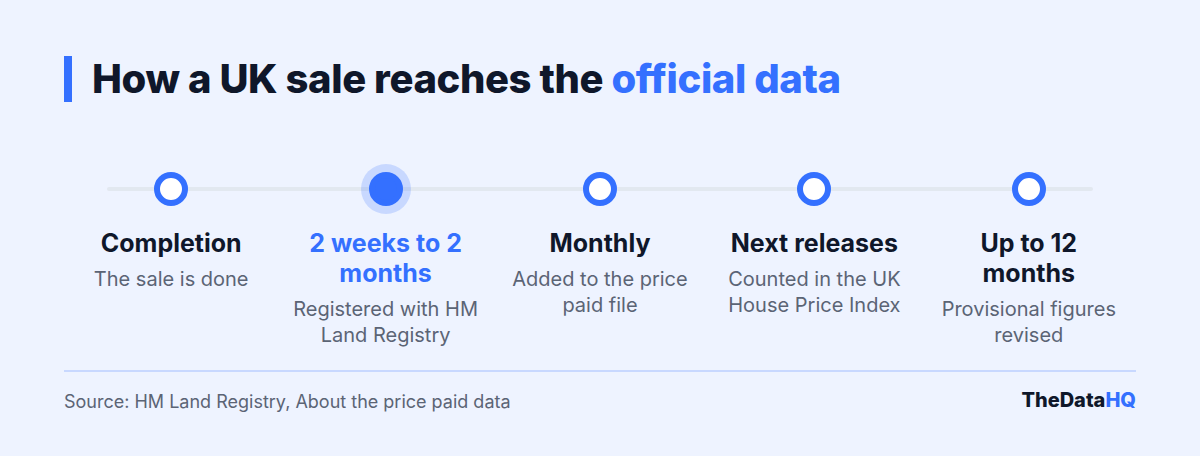
| HM Land Registry price paid | Each sold price, date and address (England and Wales) | Registration takes 2 weeks to 2 months; the latest 2 months are incomplete | Free (Open Government Licence) |
| UK House Price Index | Average sold prices by area and type, whole UK | About two months; recent months are provisional | Free |
| EPC data | Energy rating, floor area, property features | Updated as certificates are lodged | Free, with a sign-in for bulk data |
| Planning data | Applications, decisions, constraints | Varies by council | Free; coverage varies |
| Portal and agent listings | Asking prices, reductions, days on market, rents | Same day, if collected daily | Platform subscription or a custom feed |
Price paid data has a known gap: the time between a sale and its registration "typically ranges between 2 weeks and 2 months", so the two most recent months are incomplete (HM Land Registry). Any chart that shows sales volumes collapsing in the last two months is usually showing this delay, not a crash.
Here's what that delay looks like in practice. On 21 October 2026 the UK HPI reported an average UK price of £273,000 for August 2026, up 0.9% on a year earlier, as a provisional estimate (UK HPI, August 2026). Two days earlier, Rightmove had already published its asking-price figure for October.
Sold prices vs asking prices: what's the difference?
A sold price is what a buyer paid, recorded after the sale completes. An asking price is what the seller hoped for when the home went on the market. The two measure different homes, at different moments, so their averages don't match.
Rightmove put the average asking price of newly listed homes at £371,015 in October 2026, down 0.1% on a year earlier (Rightmove House Price Index). The official average sold price for August was £273,000. The gap is about mix and timing, not error: asking prices lean towards the homes being listed that month.
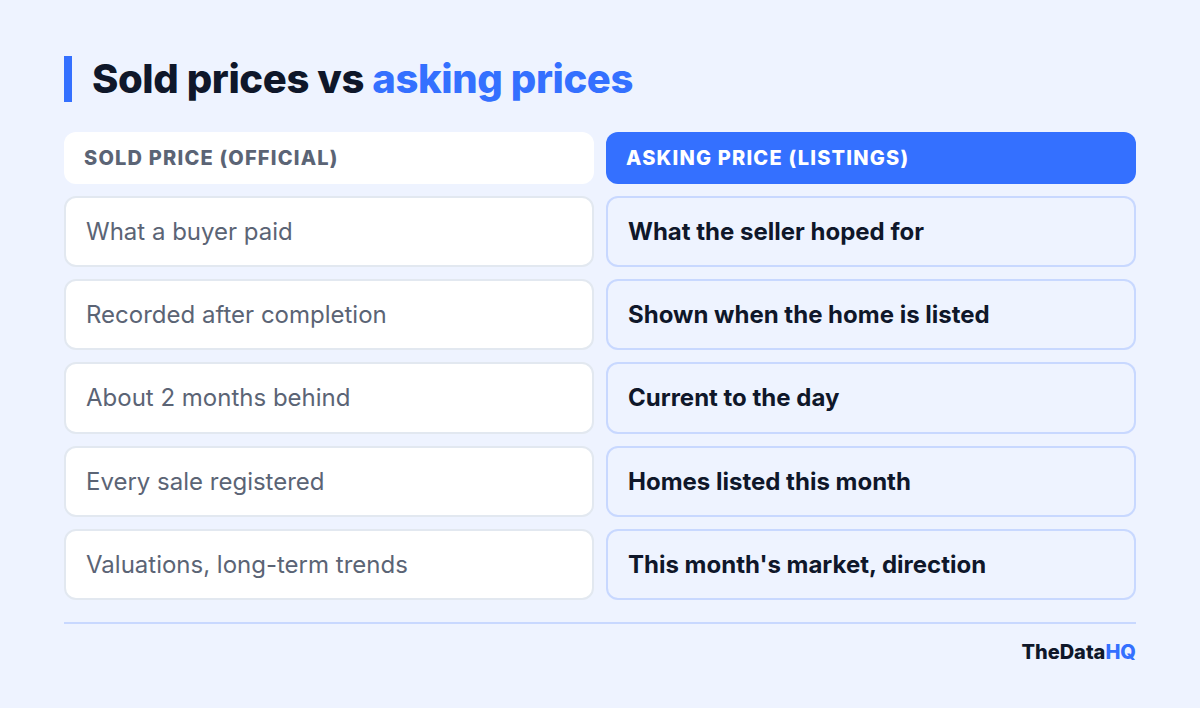
Use sold prices for valuations and long-term trends. Use asking prices for what's happening this month and where the market is heading.
What can listings data tell you that official records can't?
Listings data shows the market before the sale. When it's collected every day, the same home can be tracked from first listing to removal. That gives you:
- Price reductions: how many homes cut their price, by how much and after how long.
- Days on market: how long homes take to go under offer, by area and type.
- Supply: how many homes are for sale or to let in a postcode district this week.
- Rents: asking rents, which the sold-price records don't cover at all.
- Features: details from the description, such as a garden, parking or a period building.
The honest limit: listings data stops at "under offer" or "removed". It never tells you the final price. For that, you still wait for the official record.
Which property market data answers which question?
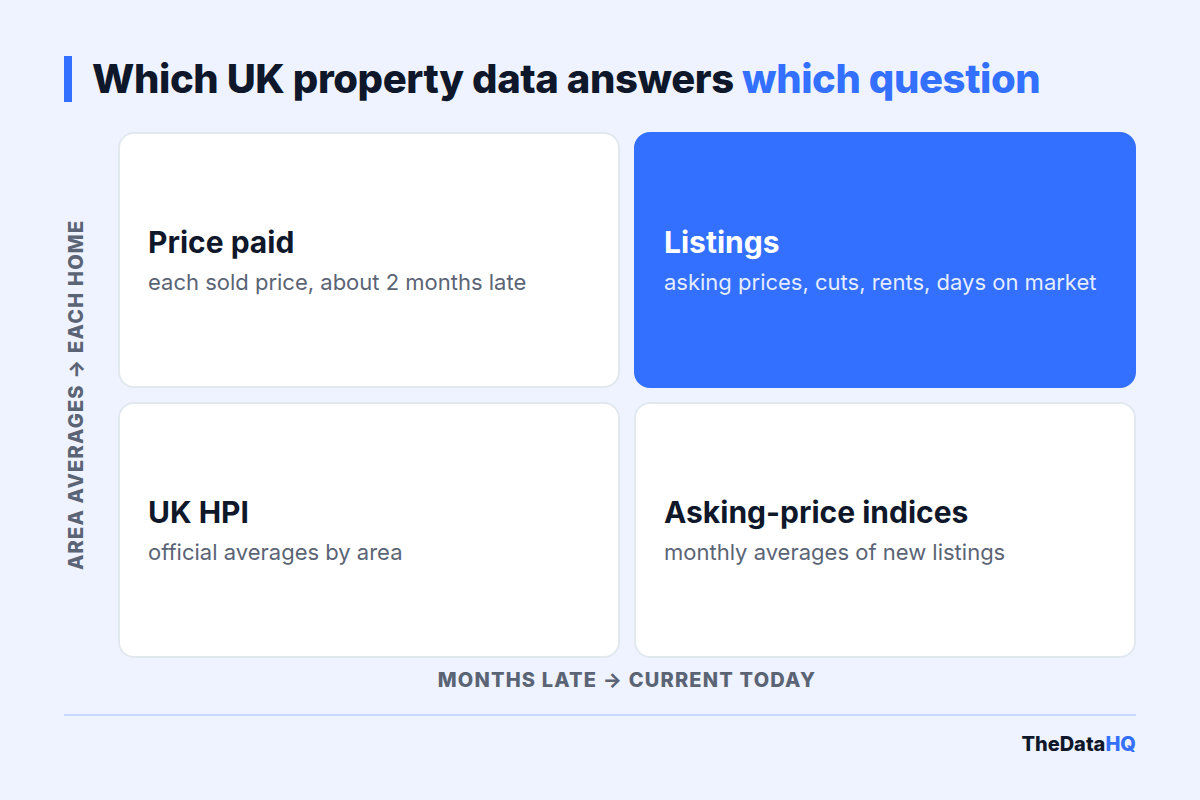
Start from the decision you're making, then pick the sources. Two things sort them: whether you need each home or area averages, and whether about two months late is good enough. EPC and planning data then add property details and new supply to either.
For investors and landlords
Sold prices from price paid data, asking rents from listings and floor area from EPC data give you yield and price per square foot by street. Listings add the reductions that hint at room to negotiate.
For lenders and valuers
Price paid comparables, matched to EPC floor areas, are the core. Listings help with the last two months, which the official data can't yet show.
For PropTech teams and agencies
Products that show "what's happening now" depend on daily listings data, with official records for history. Agencies use the same mix to spot instructions that have sat on the market too long.
How do you combine official records with listings data?
You join them by address, which is harder than it sounds. Price paid and EPC records don't share a common ID, so they're matched on the address text, and match rates vary (PropertyData). The usual steps are:
- Clean the addresses. Put flat numbers, house names and postcodes in one standard format.
- Match to a property reference. Where possible, match each address to a UPRN, the unique reference number given to every addressable place in Great Britain.
- Remove duplicate listings. The same home is often advertised on several portals and by more than one agent.
- Link each listing to its sale. When the price paid record arrives, match it to the listing to see the asking-to-sold gap.
- Keep the history. Store each day's price and status, so reductions and days on market can be worked out later.
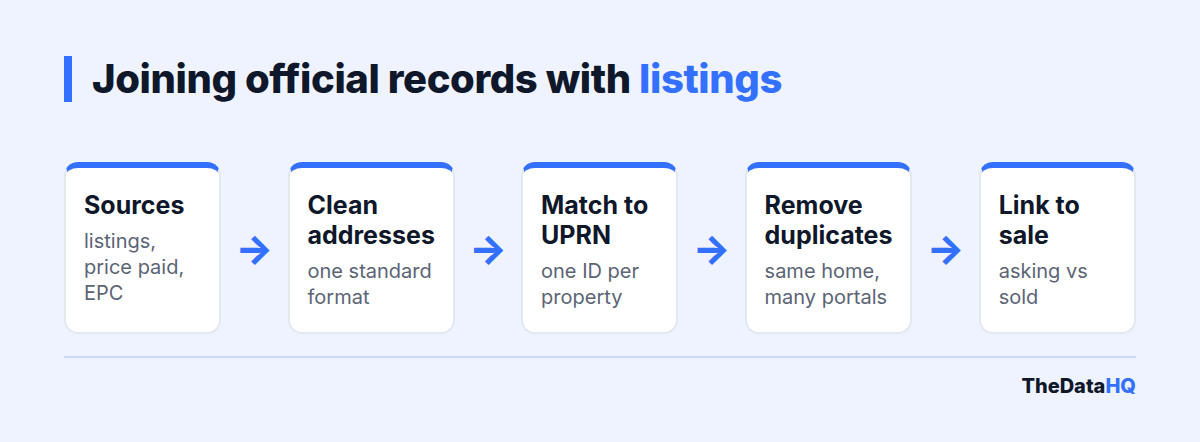
Step 3 decides the quality. If duplicates stay in, supply looks bigger than it is and average prices drift.
Is it legal to collect property listings data in the UK?
It can be, but "it's public" isn't the legal test. Three things apply to how listings are collected and reused:
- Database right. In the UK, a collection that took real investment to build can be protected under the Copyright and Rights in Databases Regulations 1997. Taking a large part of one site's database can infringe it.
- A site's terms of use, which may limit automated access or reuse.
- Data protection. Agent names and phone numbers, or a private landlord's details, are personal data under UK GDPR and the Data Protection Act 2018. You need a lawful basis to keep them (ICO guidance on legitimate interests), and the simplest fix is to leave them out.
We collect public pages only, within each site's rate limits and robots.txt (the file where a site says what automated visitors may read), and never behind a login. This is not legal advice; for commercial reuse, check your plans with a solicitor.
What mistakes do buyers of property data make?
- Reading the last two months of price paid data as a fall in sales.
- Comparing an average asking price with an average sold price as if they measured the same homes.
- Treating provisional UK HPI figures as final; they're revised over a 12-month period (UK HPI).
- Using price paid data for Scotland or Northern Ireland, which it doesn't cover.
- Counting the same home twice because it's listed on two portals.
- Keeping agent or landlord contact details you don't need.
Should you buy property market data, build it or use a platform?
It depends on how specific your question is. There are three routes:
| Route | Best for | Limits |
|---|---|---|
| Free official data | Sold-price history, area trends, reports | About two months behind; no asking prices or rents |
| Property data platform | Looking up an area or a deal in a ready-made tool | Fixed fields and sources; data stays inside the tool |
| Custom data feed | Your own sources and fields, delivered daily into your system | Takes setup; quoted after a free sample |
If all you need is a monthly trend for a report, the free data is enough, and we'd tell you so. A custom feed makes sense when you need listings joined to official records, in your own database, on your schedule.
A real example: property market intelligence
One client needed a single, current view of a property market that was split across many portals. We built collectors that gather listings, price changes and agent details, and merge them into one structured feed. As a past result, that project covers 50+ portals with daily updates (our case studies).
For data that has to stay current, our real-time scraping service runs on a monthly retainer and includes fixes when sites change. For a one-off pull, see our data extraction services. The same build-or-buy choice comes up in our guide to UK job vacancies data, and our guide to data providers for AI agents covers feeding the result into an AI tool. If you'd rather build the pipeline in-house, our sister company BinaryBits describes a property listings build.
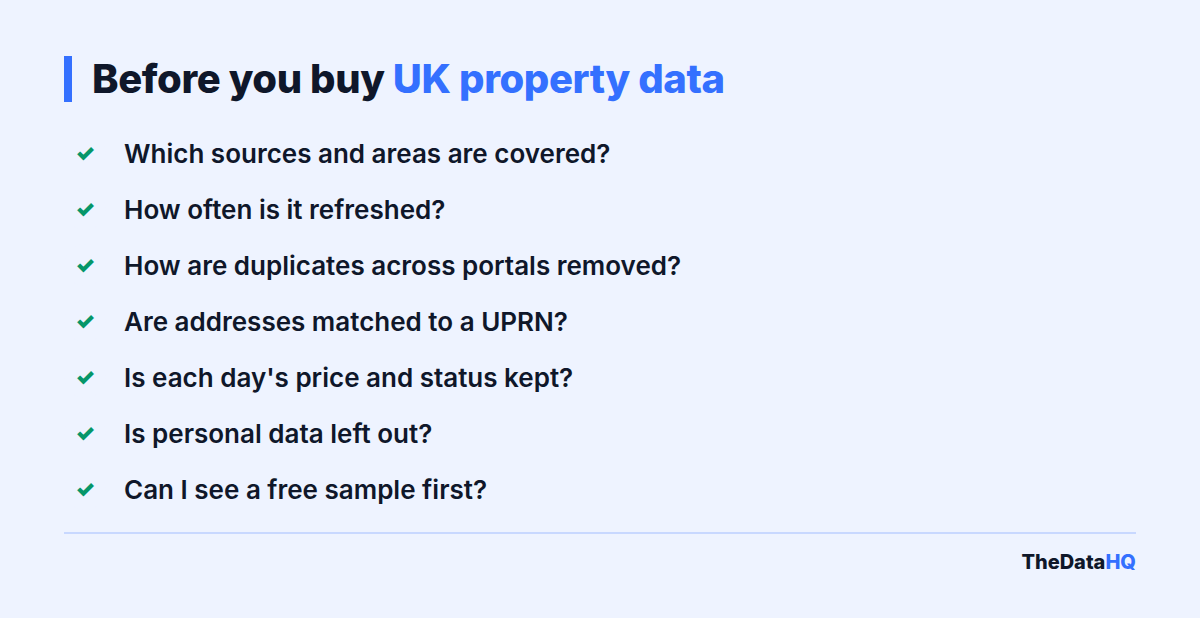
Get a free sample of UK property data
Send us one URL and the fields you want; we'll send back a free sample of the real output, usually around 100 rows, and quickly. No charge, no commitment. Ask for your free sample. We already work with UK clients, and as we're based in India, a UK morning is our afternoon.
Frequently asked questions
What is property market data?
Property market data is information about homes and their prices. In the UK it comes from official records, such as HM Land Registry price paid data, the UK House Price Index, EPC and planning data, and from live listings on property portals and agent websites. Official records show final sold prices months later; listings show asking prices, reductions, rents and days on market today.
Is Land Registry price paid data free?
Yes. HM Land Registry publishes price paid data for England and Wales free of charge under the Open Government Licence, which allows commercial and non-commercial reuse with attribution. You can download the full file back to 1995, a single year or the latest month. It covers residential sales for value that have been lodged for registration.
How up to date is Land Registry data?
It runs behind the market. HM Land Registry says the time between a sale and its registration typically ranges from 2 weeks to 2 months, and sometimes longer. The file is released monthly, and the two most recent months are incomplete. For what's happening this month, use live listings data alongside it.
How long does it take to get a property data feed?
It depends on the number of sources, the fields and how often it runs. Official downloads take minutes. A custom feed of listings joined to official records needs setup first: agreeing sources and fields, then address matching and duplicate rules. We start with a free sample on your own sources, so you see real output before agreeing a timeline.
Can I get property listings data legally in the UK?
Often, yes, but it depends on the source, the use and the fields. Database right and a site's terms apply to how listings are collected and reused, and agent or landlord contact details are personal data under UK GDPR. Collect public pages within each site's limits, leave out personal data you don't need, and take legal advice for commercial use. This is not legal advice.
Does price paid data cover Scotland and Northern Ireland?
No. HM Land Registry price paid data covers England and Wales only. Sales in Scotland are recorded by Registers of Scotland, and sales in Northern Ireland by Land & Property Services, each with its own data and terms. The UK House Price Index combines all three to give official averages for the whole UK.