Hotel Price Index by Country: What 6 Published Indexes Show
There's no single, current hotel price index by country. The World Bank's index (world = 100, 2021 data) is the only global one; the rest track price changes or cities. What each measures, and how to compare the same room.
By Chirag Jakhariya, Co-founder & CEO · · 13 min read
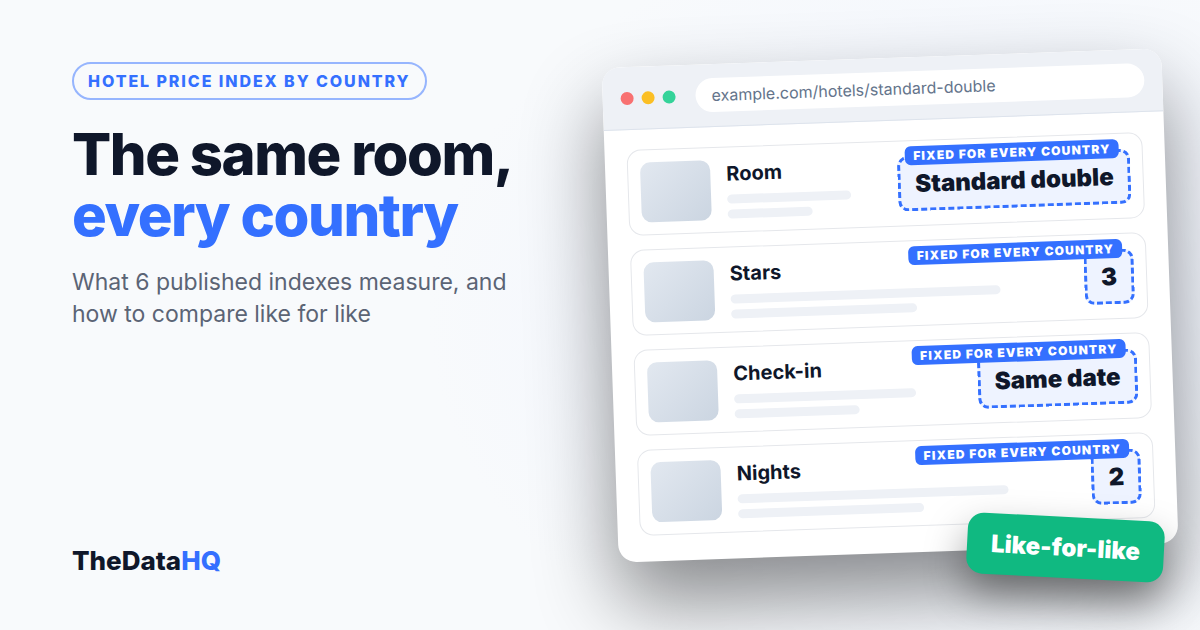
There's no single, current hotel price index by country (an index is one score that compares prices against a benchmark). The only global one is the World Bank's, from 2021 data: with the world at 100, Switzerland scores 228, the UK 131 and Laos 48. Other sources track price changes over time or rank cities, so none prices the same room in every country.
This guide compares the six sources people find when they search, what each one actually measures and how current it is. It also covers what to do when you need a like-for-like comparison for your own list of countries.
What is a hotel price index by country?
A hotel price index by country is a number that lets you compare hotel prices between countries, or within one country over time. The difference between those two jobs matters more than anything else in this guide.
- A price-level score compares countries at one moment. A score of 150 means hotels cost about 50% more than the benchmark, which is usually the world or EU average.
- A price-change score tracks one country over time. A score of 150 means prices are 50% higher than in the base year. It tells you nothing about whether that country is expensive.
- A booking-rate average reports average nightly rates paid on one booking site, usually by destination rather than country.
Most of the numbers that rank for this search are the second kind. That's why two sources can seem to disagree about the same country.
Which published hotel price indexes compare countries?
Six sources come up most often. Only the first two compare price levels between countries.
| Source | What it measures | Countries | How often |
|---|---|---|---|
| World Bank ICP: hotel and restaurant prices | Price level, world = 100 (hotels and restaurants together) | 165+ worldwide | Every few years; latest data 2021 |
| Eurostat price levels: restaurants and hotels | Price level, EU = 100 | 37 European countries | Yearly |
| Eurostat HICP: accommodation services | Price change against a base year | EU members and a few others | Monthly |
| Hotels.com Hotel Price Index | Average nightly rates and year-on-year change, by destination | Selected cities | Yearly |
| HOTEVI capital cities report | Median 3-night rates in capitals | 9 capitals | Quarterly |
| National statistics (US CPI, Spain's INE, UK ONS) | Price change within one country | One each | Monthly |
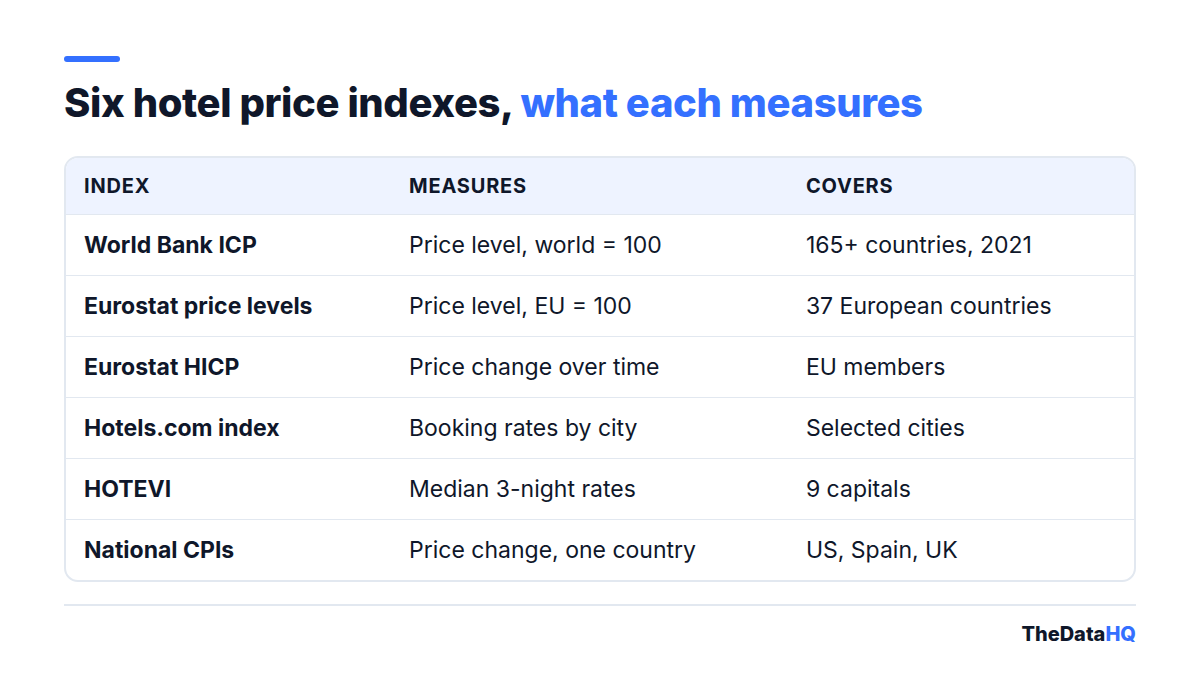
The World Bank ICP comparison
The International Comparison Program (ICP) is the World Bank's survey of prices in almost every country. Its hotel and restaurant price score sets the world average at 100, and its latest values are for 2021 (TheGlobalEconomy.com, from World Bank ICP data). It's the only true worldwide comparison, but it mixes hotels with restaurants and it's several years old.
Eurostat price levels for restaurants and hotels
Eurostat, the EU's statistics office, compares the same basket of restaurant and hotel services across 37 European countries, with the EU average at 100. In its latest figures, reported in January 2026, Switzerland scored 171, Denmark 148 (the highest in the EU) and Bulgaria 53 (the lowest in the EU) (Euronews). It's fresher than the ICP but covers Europe only.
The Hotels.com Hotel Price Index
Hotels.com's yearly report is built from its own booking data and, for 2026, a survey of 11,000 travelers. It found international 5-star stays averaged $250 a night against $370 in the US, about 23% less (Hospitality Net). It lists cities such as Phuket at $144 and New York at $332, not a country table, and star ratings mean different things in different countries.
The HOTEVI capital cities report
HOTEVI publishes median rates for a 3-night stay across 9 capital cities, from a sample of 540 hotels, under an open CC BY 4.0 licence (HOTEVI). Its 2026 second-quarter report puts Paris, London and Rome at the top. It's current and open, but it covers capitals, not whole countries.
National hotel price statistics
Most countries publish hotel prices inside their consumer price index (CPI), the official measure of inflation. In the US, the Bureau of Labor Statistics prices hotel and motel stays every month, mostly from booking websites, and measures change over time rather than price levels (BLS). Spain's statistics office runs a dedicated Hotel Price Index, which rose 6.7% in the year to September 2026, with an average daily rate of €141.6 (INE).
For the EU as a whole, Eurostat's HICP (its harmonised inflation measure) has an accommodation series for each member country (Trading Economics). It's useful for trends, but a high score only means prices rose a lot since the base year.
Which country has the most expensive hotels?
On the World Bank's comparison, Switzerland has the most expensive hotels and restaurants, at 228.44 against a world average of 100. Norway (219.56), Iceland (218.99) and Denmark (206.35) follow, all from 2021 data (TheGlobalEconomy.com).
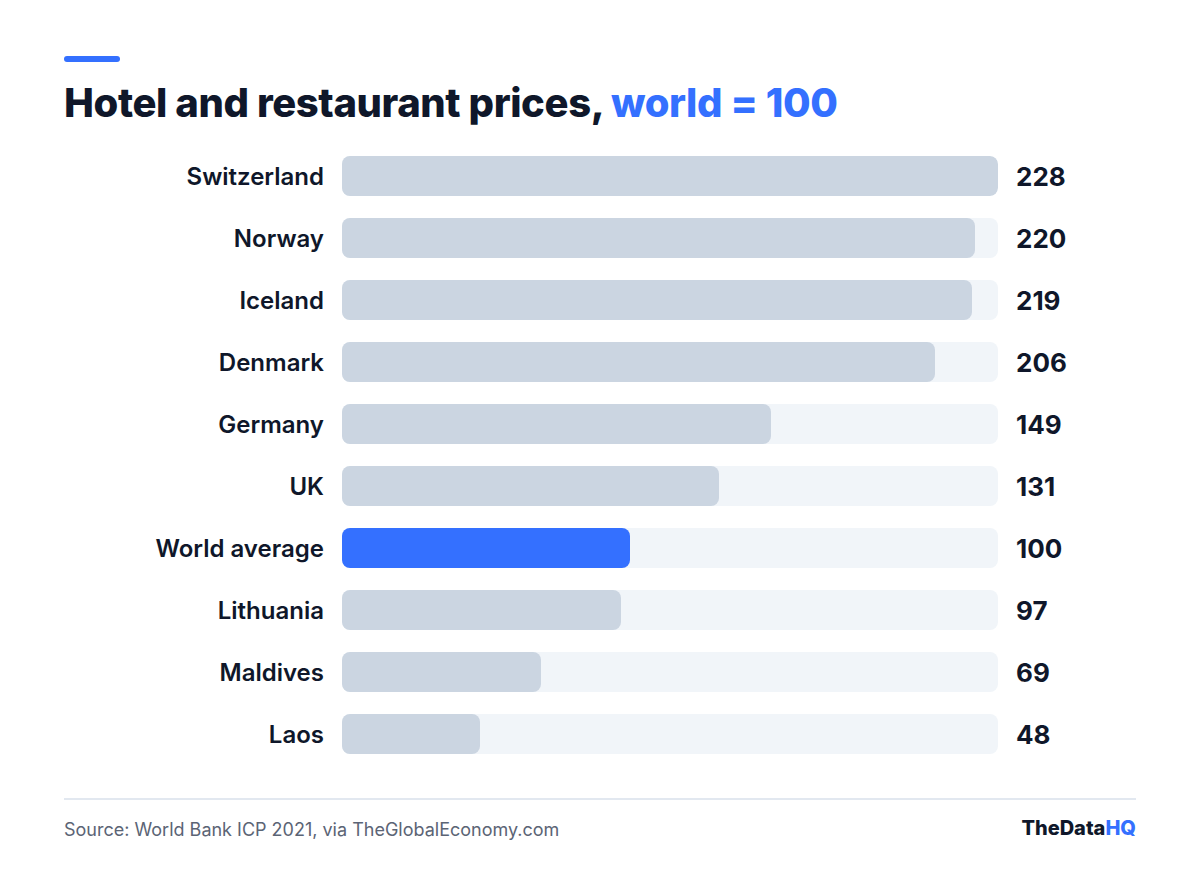
Rounded, the chart shows Switzerland 228, Norway 220, Iceland 219, Denmark 206, Germany 149, the UK 131, Lithuania 97, the Maldives 69 and Laos 48 (the UK's exact score is 131.44, Germany's 149.25). Eurostat's newer European figures agree on the order: Switzerland at 171 and Denmark at 148 against an EU average of 100.
Which countries have the cheapest hotels?
The cheapest countries in the World Bank's ranking score well under half the world average. Laos is at 47.97 and the Maldives at 68.97, while the unweighted average across 165 countries is 81.95 (TheGlobalEconomy.com).
In Europe, Eurostat puts North Macedonia lowest of the 37 countries, at 50, and Bulgaria lowest in the EU, at 53. One honest limit applies to all these rankings: they measure prices, not value. A cheap country on paper can still have expensive hotels in its capital in peak season.
Why do hotel price indexes disagree?
They disagree because each one measures a different thing. These are the six differences that cause most of the confusion.
- Level or change. A CPI score of 190 means prices rose 90% since the base year, not that the country is expensive.
- Hotels or hotels plus restaurants. The World Bank and Eurostat price levels bundle both.
- Country or city. Hotels.com and HOTEVI report cities, which run far above national averages.
- Star ratings. A 4-star hotel in one country isn't the same product as a 4-star hotel in another.
- Dates. One source uses a full year of bookings, another a two-month sample, another a single month.
- Taxes and currency. Some prices include taxes and fees and some don't, and the exchange rate on the day moves the result.
How current is each hotel price index?
The global comparison is the oldest. The World Bank's ICP runs in cycles every few years, so its 2021 figures are the latest available in late 2026. Eurostat's price levels are yearly, the Hotels.com report is yearly, HOTEVI's is quarterly, and national CPIs are monthly.
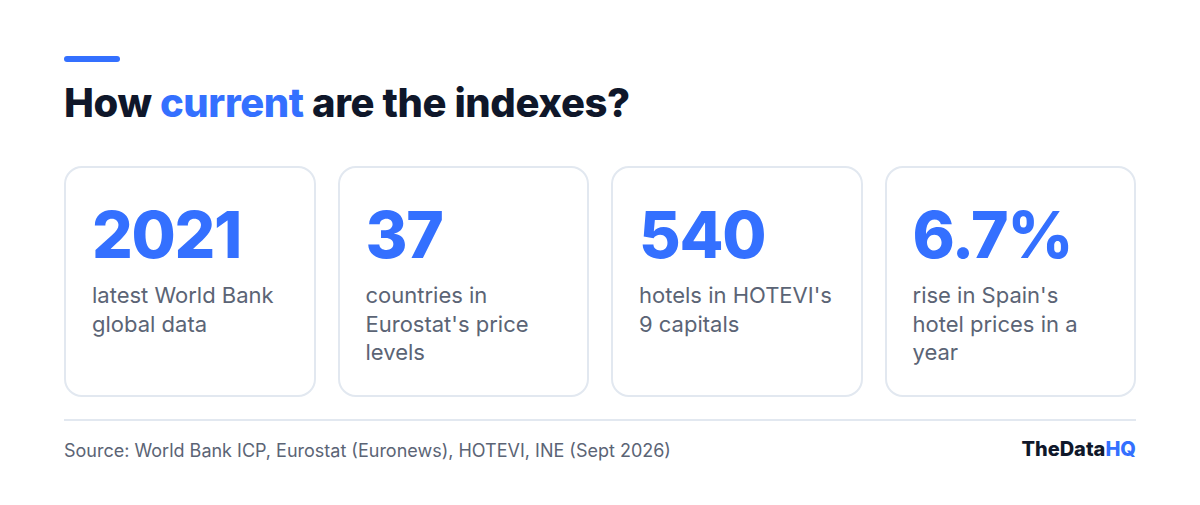
So if you need this month's prices in more than one country, no published source gives them to you. That's the gap the rest of this guide is about.
How do you compare the same hotel room across countries?
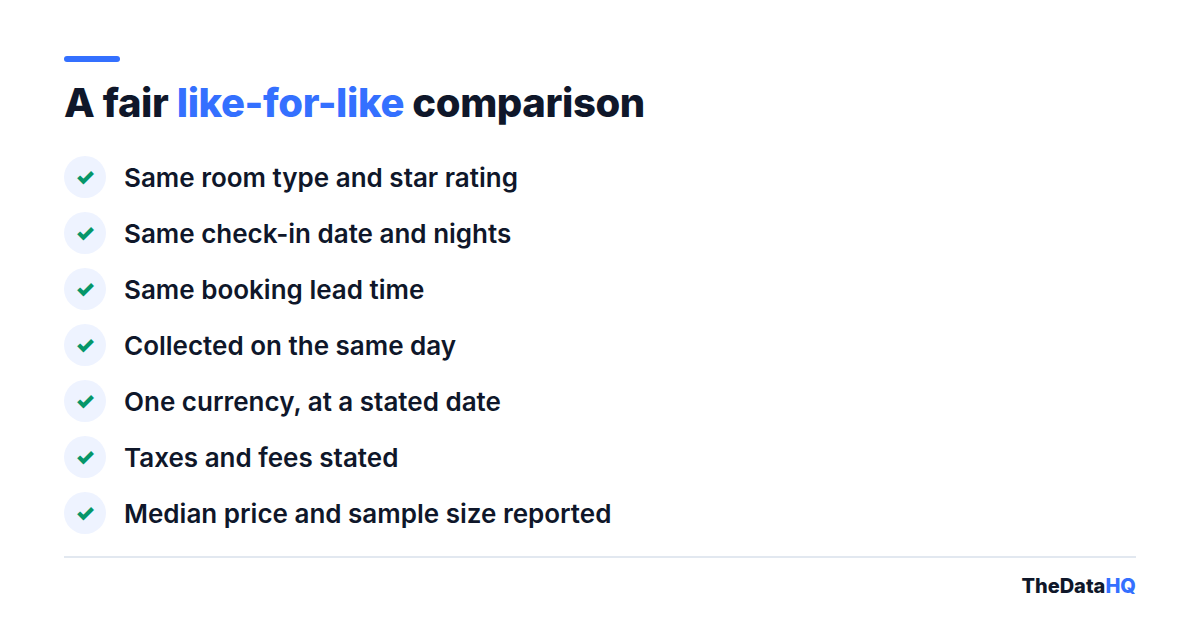
You fix every variable except the country, then collect prices from public listing pages on the same day. This is how a like-for-like comparison is usually set up.
- Pick the room. For example, a standard double room in a 3-star or 4-star hotel.
- Fix the stay. The same check-in date, the same number of nights and the same booking lead time (how far ahead you book).
- Choose the places. The capital and one or two other cities per country, so one expensive city doesn't decide the result.
- Collect on the same day. Hotel prices change daily, so every country is priced in the same window.
- Normalize. Convert to one currency at a stated date, and record whether taxes and fees are included.
- Use medians and sample sizes. Report the median price (the middle value) and how many hotels each country is based on.
What fields does a hotel price dataset need?
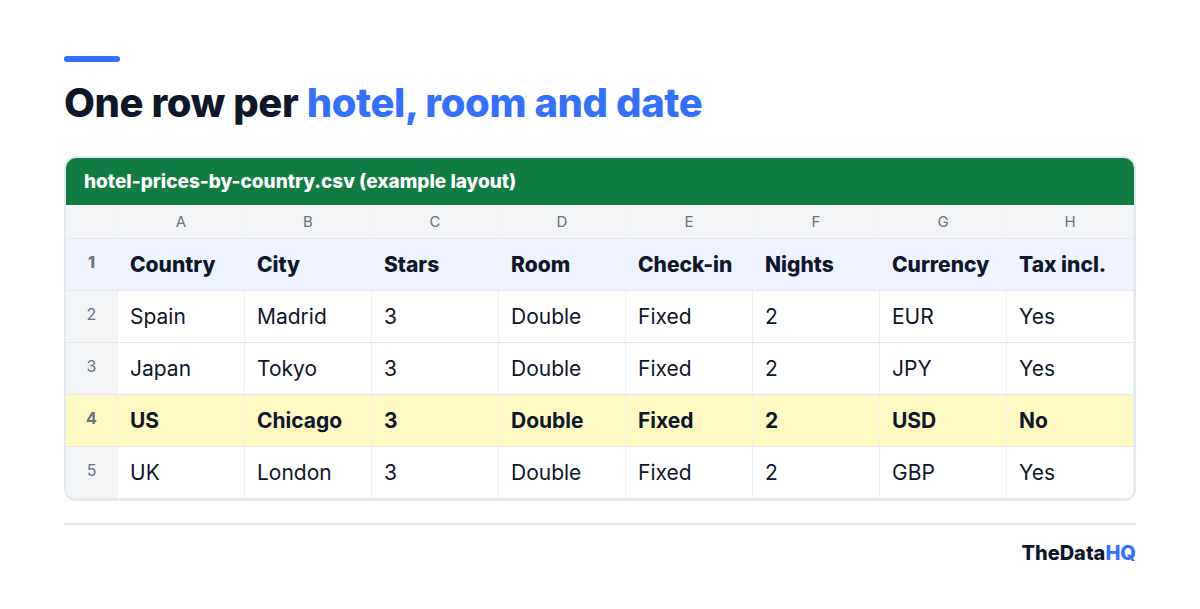
Each row is one hotel, one room and one date, so you can filter and average it any way you like. A useful dataset carries at least these fields:
- country, city and hotel name;
- star rating and room type;
- check-in date, number of nights and the date the price was captured;
- price, currency and whether taxes are included;
- whether the rate is refundable and whether breakfast is included.
How long does a hotel price collection take?
It depends on how many countries, cities and dates you need, and whether it runs once or every week. A one-off snapshot of a few countries is a small, fixed-scope job. A daily feed across dozens of countries is ongoing work, because booking sites change their pages and every change has to be fixed. We agree the timeline in writing once the scope is clear.
Should you buy hotel price data or collect it yourself?
Buy it if you want the numbers and not the upkeep. Collect it yourself if you have developers who can maintain the collection every week.
- Buy when you need a few countries on a schedule, a clean file in Excel, CSV or your database, and someone else fixing it when a site changes.
- Build when hotel pricing is your core product and you want the code in-house. If that's you, our sister company BinaryBits builds data pipelines for in-house teams.
- Use the published figures when a yearly, country-level picture is enough, such as a market-entry slide or background research.
We've collected data from more than 10,000 websites across 260+ projects. The first run is the easy part; keeping a feed working when sites change is most of the work. The same applies to retail prices, which we cover in our guide to competitor price monitoring services.
What does hotel price data by country cost?
Our prices aren't published: a project is quoted after a free sample, as a fixed price for a one-off collection or a monthly retainer for a feed (see how our pricing works). These are the things that move the price:
- the number of sites, each with its own layout;
- how often it runs, from once to every day;
- how the site is built, plain pages or pages drawn in the browser;
- volume, from thousands of prices to millions;
- the fields and the cleaning, such as currency and room-type matching;
- ongoing maintenance, included in a retainer.
For how these costs add up in a retail setting, see the cost of MAP price monitoring and our ecommerce competitor price comparison methods.
Is collecting public hotel prices legal?
Room prices shown publicly without a login are generally lower risk than personal data, because they're facts about a product, not about people. In the US, the hiQ v. LinkedIn rulings suggested that reading public pages isn't "unauthorized access" under the Computer Fraud and Abuse Act, but site terms, database rights in Europe and copyright still apply.
We collect only public pages, never behind logins, and respect rate limits and robots.txt. This is not legal advice; check your own use with a lawyer.
Need a like-for-like table for your own countries? Our price scraping service collects hotel and travel prices on the schedule you set. Send us one URL and the fields you want; we'll send back a free sample of the real output, usually around 100 rows, and quickly. No charge, no commitment.
Frequently asked questions
What is a hotel price index?
A hotel price index is a number that tracks hotel prices against a benchmark. Some compare countries at one moment, such as the World Bank's ranking with the world average at 100. Others, such as national inflation figures, track one country's prices over time against a base year. Booking sites publish a third kind: average nightly rates by destination from their own bookings.
Which country has the most expensive hotels?
Switzerland, on both main comparisons. The World Bank's 2021 figures score its hotels and restaurants at 228.44 against a world average of 100, ahead of Norway and Iceland. Eurostat's newer European figures put Switzerland at 171 against an EU average of 100, with Denmark the most expensive EU member at 148. City prices can rank differently.
Which countries have the cheapest hotels?
In the World Bank's 2021 figures, countries such as Laos (47.97) and the Maldives (68.97) score far below the world average of 100. In Europe, Eurostat puts North Macedonia lowest of 37 countries at 50 and Bulgaria lowest in the EU at 53. These scores include restaurant prices too, so treat them as a guide, not a quote.
How often is the hotel price index updated?
It depends on the source. The World Bank's global comparison runs in cycles every few years, so its latest data is from 2021. Eurostat's European price levels and the Hotels.com report are yearly, HOTEVI's capital-cities report is quarterly, and national inflation figures, such as the US CPI and Spain's Hotel Price Index, come out every month.
Why is the Hotels.com Hotel Price Index not a country ranking?
It's built from Hotels.com's own bookings and a traveler survey, and it reports cities and trends rather than national averages. The 2026 edition compared international and US 5-star rates and listed destinations such as Phuket and New York. Star ratings also differ between countries, so its figures don't line up into a fair country table.
How long does it take to build a hotel price index by country?
It depends on the number of countries, cities and dates, and whether it's a one-off or a regular feed. A single snapshot of a few countries is a small, fixed-scope job. A daily feed across many countries needs ongoing upkeep because booking pages change. We agree the timeline in writing after a free sample.
Can I get hotel price data for my own list of countries?
Yes. We collect public hotel prices for the countries, cities, room types and dates you choose, delivered as Excel, CSV, JSON or straight into your database, once or on a schedule. Send us one URL and the fields you want, and we'll return a free sample of the real output before you commit to anything.