MAP Price Monitoring Cost in 2026: Real Prices From 6 Tools
What MAP price monitoring costs in 2026: real published prices from six tools, the unit each one charges by, three worked catalogue examples and the hidden costs.
By Chirag Jakhariya, Co-founder & CEO · · 13 min read
MAP price monitoring costs from about $7 a month for a basic page monitor to $999 a month for full enforcement, based on six tools' public plans checked on October 6, 2026. Dedicated MAP tools start at $49 to $399. Your bill depends on how many products you sell, how many sellers list them and how often you check, and each tool counts those differently.
Below is the price table, the unit each vendor charges by, what three catalogue sizes would actually pay, and the costs the price pages leave out.
Key takeaways
- Dedicated MAP tools start at $49 a month for 50 Amazon products and reach $999 a month for full enforcement. A general page monitor costs $80 a year for 100 pages.
- Vendors charge by different units: products, price checks, monitored pages or Amazon listings. Compare on your own numbers, not the headline price.
- A brand with 500 products and 20 sellers checked daily needs about 300,000 price checks a month (our calculation).
- Small Amazon-only brands are well served by a low-cost tool. A managed data feed starts to make sense with many unusual dealer sites or when the data has to go into your own systems.
- Start before November. Holiday discounts are when sellers drift below MAP.
How much does MAP price monitoring cost in 2026?
On published plans, the cheapest tier of a dedicated MAP tool costs $49 to $399 a month, depending on the vendor. A general page monitor such as PageCrawl costs less but leaves the matching and evidence to you. We read every figure from the vendor's own page on October 6, 2026.
| Tool | Charges by | Plans that include MAP monitoring | Source |
|---|---|---|---|
| MAP Authority | Amazon products, then channels | $49/mo (50 Amazon products), $249 (unlimited Amazon plus seller emails), $499 (Amazon and other sites), $999 (enforcement) | MAP Authority pricing page, checked Oct 6, 2026 |
| Priceva | Price checks per month | $99/mo (35,000 checks, 30 sites), $199/mo (100,000 checks, 40 sites), Enterprise custom | Priceva MAP page, checked Oct 6, 2026 |
| Price2Spy | Monitored URLs | Basic from $157.95/mo, Premium by quote | Price2Spy blog, Jan 16, 2026 |
| Pricefy | Products (SKUs) | $189/mo (15,000 SKUs), $499/mo (25,000 SKUs); 25% less on annual billing | Pricefy pricing page, checked Oct 6, 2026 |
| Prisync | Products | Platinum only: $399, $599 or $799/mo for up to 5,000 products | Prisync pricing page, checked Oct 6, 2026 |
| PageCrawl | Monitored pages | $80 a year (100 pages, daily), $300 a year (500), $999 a year (1,000) | PageCrawl MAP guide, checked Oct 6, 2026 |
| TheDataHQ (managed feed) | Sites, volume and frequency | Quoted after a free sample | our pricing page |
These are the prices published on October 6, 2026. Vendors change their plans and prices, so the figures may be different in future; check the vendor's own page before you buy.
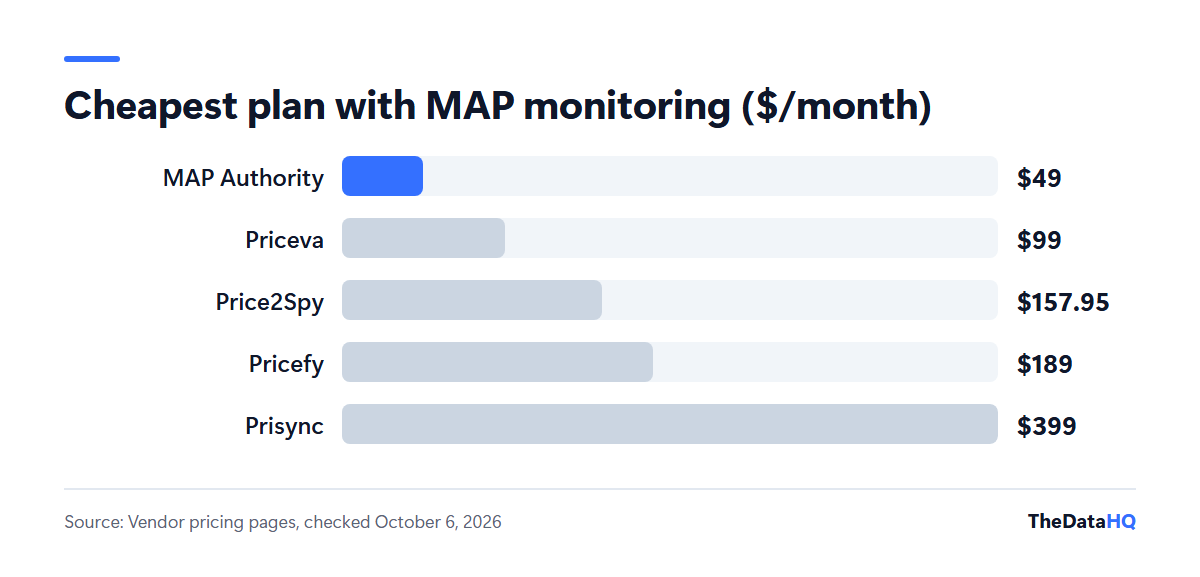
Two things stand out. Several vendors keep MAP monitoring out of their entry plans: Pricefy's $49 and $99 tiers and Prisync's $99 and $199 tiers don't include it. And the cheapest plans cap the volume hard, which matters more than the price.
What does MAP mean, and how is it different from MSRP?
MAP, the minimum advertised price, is the lowest price a brand lets its resellers show in ads and on product pages. MSRP, the manufacturer's suggested retail price, is the price the brand recommends but doesn't police.
MAP monitoring checks every seller's advertised price against your MAP and flags the ones below it. It's the brand's view of the market. If you're a retailer watching rivals' prices instead, our guide to comparing ecommerce competitor prices covers that job.
Why do MAP monitoring prices vary so much?
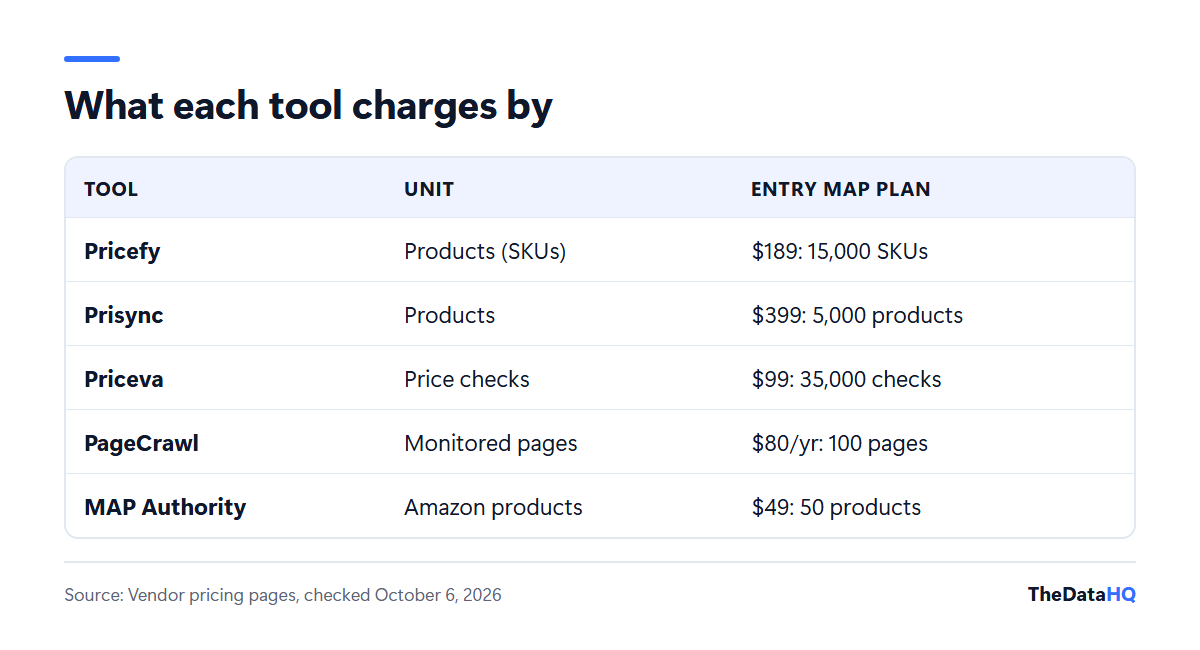
Because every vendor charges for a different unit, and your bill is the number of units you use. The headline price only tells you the entry fee.
What unit is each vendor charging for?
- Products (SKUs): Pricefy and Prisync count the products you track. Sellers per product are not the limit on paper.
- Price checks: Priceva counts every single price read. One product at one seller, checked daily, uses about 30 checks a month.
- Monitored pages: PageCrawl counts pages, so each product at each dealer site is one page.
- Amazon listings, then channels: MAP Authority's entry plans cover Amazon only; other sites start at the $499 tier.
How do sellers and check frequency multiply the bill?
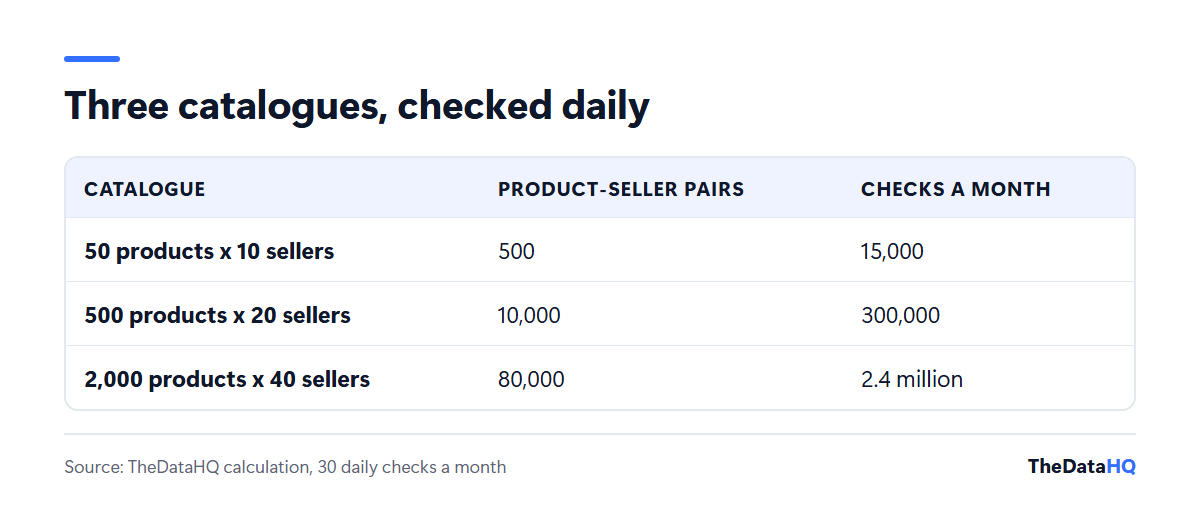
The number that drives the work is the product-seller pair: one product at one seller. Multiply products by sellers, then by checks per month.
- Count your products: 500.
- Count the sellers that list them: 20 (Amazon, Walmart and 18 dealer sites).
- Multiply: 10,000 product-seller pairs.
- Multiply by daily checks over 30 days: 300,000 price checks a month.
Check twice a day over Black Friday week and that week alone uses as many checks as two normal weeks. Any vendor charging per check or per page will feel that.
What would three real catalogues pay for MAP monitoring?
We ran three typical catalogue sizes against the published limits. These are our calculations from the vendors' public pages, not quotes; your real price depends on the sites involved.
Small brand: 50 products on Amazon
With about 10 sellers per listing, that's 500 pairs and 15,000 checks a month. MAP Authority's $49 plan covers exactly 50 Amazon products, and Priceva's $99 plan allows 35,000 checks. Expect $49 to $99 a month, or $249 if you want violation emails sent to sellers automatically.
Mid-size brand: 500 products and 20 sellers
That's 10,000 pairs and 300,000 checks a month. It's three times Priceva Pro's 100,000 checks and ten times PageCrawl's largest 1,000-page plan. On paper it fits Pricefy's $189 plan or Prisync's $399 plan, which limit products rather than checks. Expect roughly $189 to $499 a month, after you confirm every dealer site is supported.
Large brand: 2,000 products and 40 sellers
That's 80,000 pairs and 2.4 million checks a month. Check-based plans move to custom Enterprise pricing at this size; Priceva's starts above 700,000 checks. Product-based plans still look cheap on paper, so ask how many seller URLs per product they include before you trust the $189. This is where quotes, not price pages, set the cost.
What hidden costs do MAP monitoring quotes leave out?
The subscription is rarely the whole cost. These are the items buyers find after signing:
- Staff time: someone has to review alerts, check false positives and contact sellers. The tool finds violations; it doesn't resolve them.
- Product matching: sellers rename products, bundle them or list variants. Unmatched listings are violations you never see.
- Seller identification: on Amazon, many sellers share one listing. Knowing which seller is under MAP is often a higher tier.
- Evidence: a dated screenshot of the violating page is what makes a warning stick. Some plans include it, some don't.
- Extra channels: Prisync charges $100 to $200 a month per added sales channel.
- Enforcement: MAP Authority's $49 plan logs violations; automated seller emails start at $249.
- Monthly vs annual billing: Pricefy is 25% cheaper paid yearly and MAP Authority 20%, so monthly plans cost more over a year.
Is in-house MAP monitoring cheaper than buying a tool?
Rarely, once you count the upkeep. A script that reads prices is quick to write. Keeping it running when 20 dealer sites change their layouts is the real cost, and it lands on a developer's week.
| Option | What you pay | Who fixes breakages | Best for |
|---|---|---|---|
| Build in-house | Developer time plus servers | You | Teams with spare engineering time |
| MAP monitoring tool | $49 to $999 a month, published | The vendor, for supported sites | Amazon and large retailers, alerts in a dashboard |
| Managed data feed | Quoted after a free sample | The provider | Many unusual dealer sites, data into your own systems |
We compared running your own collector with buying a feed in run the scraper or buy the feed. If you do want your own team to build it, our sister company BinaryBits builds software; TheDataHQ sells the data.
When does a managed data feed beat a MAP monitoring tool?
A managed feed wins when the tool's coverage or format doesn't fit. A tool wins when your sellers are mostly on Amazon and big retailers.
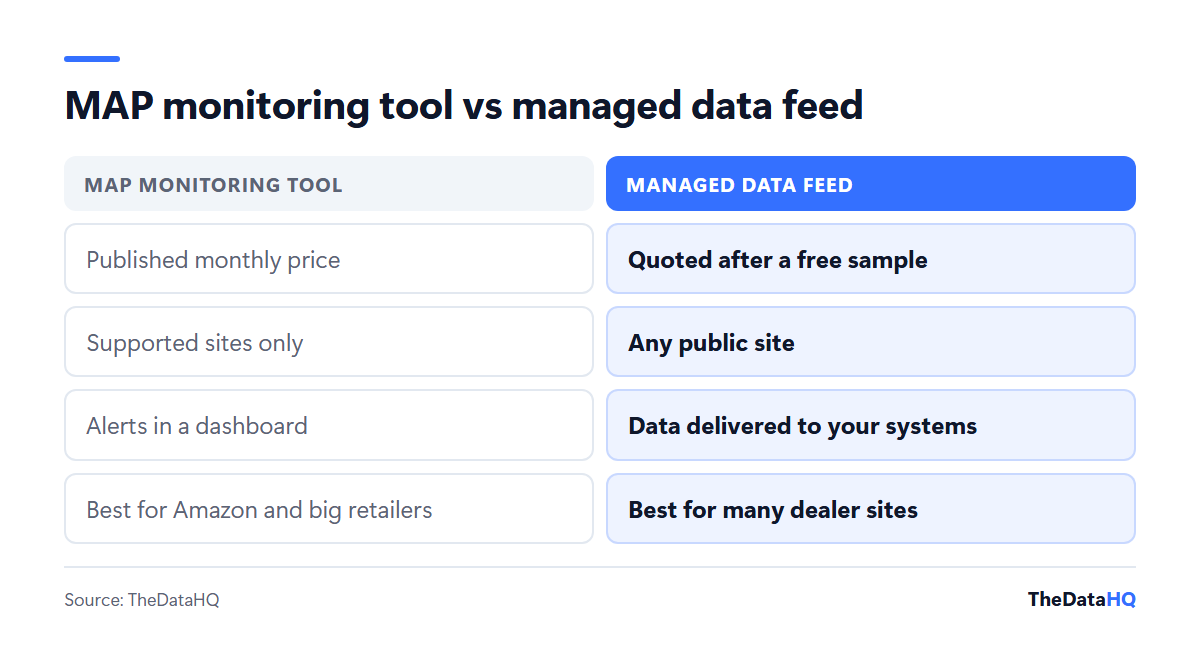
A managed feed tends to make sense when:
- Your dealers include small regional sites a tool doesn't support.
- You need the raw prices in your own database or reports, not only a dashboard.
- You want extra fields, such as stock status, promotions or the seller's shipping price.
- You track tens of thousands of product-seller pairs, where per-check pricing climbs.
Our honest limit: if you're a small brand selling 50 products on Amazon, a $49 to $249 tool is the cheaper answer and you should buy one. Our standard delivery is a data feed into your own systems; if you want violation alerts or a seller-outreach dashboard on top, we can build it custom for you. For larger catalogues, our price scraping and monitoring service builds, hosts and maintains the collection, with site-change fixes included in the retainer.
Is MAP price monitoring legal?
Reading publicly advertised prices is a normal business activity, and MAP policies themselves are generally lawful in the US when set up correctly. This is not legal advice; speak to a lawyer about your own policy.
- MAP limits the ad, not the sale. A MAP policy controls the advertised price; resellers stay free to sell at any price, as Foley & Lardner explains.
- Federal law weighs the effects. Since Leegin v. PSKS (2007), the Supreme Court judges minimum price agreements under the "rule of reason", not as automatically illegal.
- Enforce on your own. Foley advises brands to enforce MAP independently, without reseller input, and notes a 2025 ruling where cart-price restrictions were treated as resale price fixing.
- State law can be stricter. Agreements on the actual resale price remain sensitive at state level.
On the collection side, we gather public prices only, never from behind logins, and we keep to each site's rate limits and robots.txt.
When should you start MAP monitoring before Black Friday?
Start in early November, so you have a seller list and a baseline of normal prices before Thanksgiving on November 26, 2026. Discount pressure peaks in that week.
In 2025, US shoppers spent $44.2 billion online over Cyber Week, and $11.8 billion on Black Friday alone, up 9.1% on the year before, according to Adobe's holiday season report. Electronics discounts peaked at 30.9% off listed price. Deep discounts are exactly when resellers test your MAP.
- Late October: list every seller and every product URL you'll watch.
- Early November: run daily checks and fix product matches.
- Thanksgiving to Cyber Monday: check more than once a day.
- December: review the evidence and act on repeat violators.
How do you get an accurate MAP monitoring quote?
Bring your numbers, not a feature wish list. Any vendor can then price the same job, and you can compare like with like.
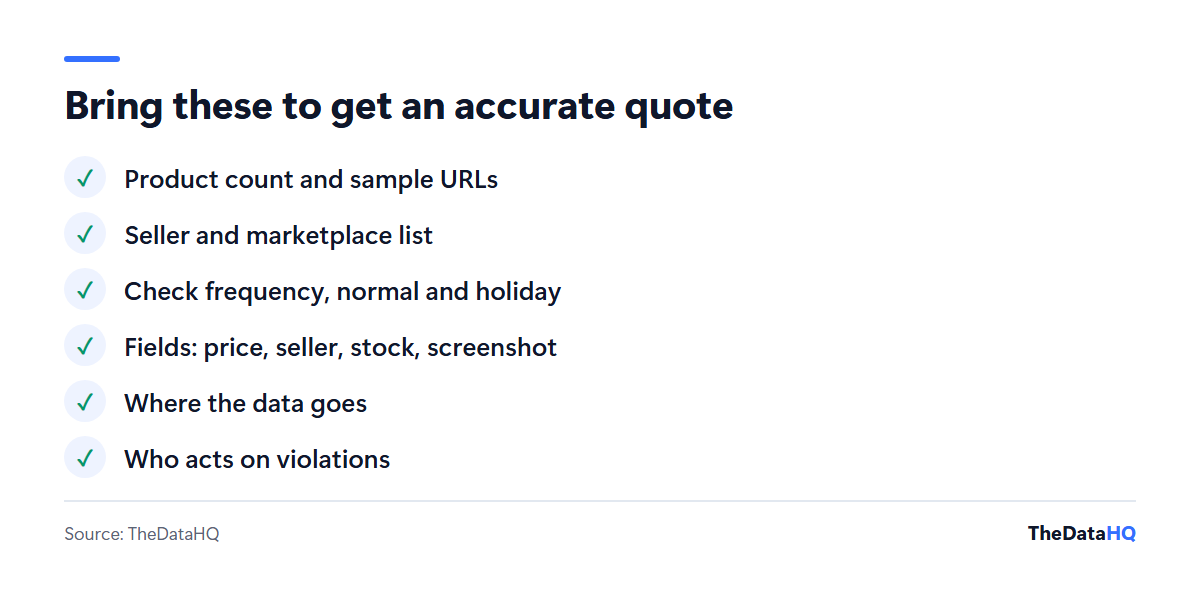
- Your product count and a sample of product URLs.
- The list of sellers and marketplaces, with links.
- How often to check, normally and in holiday weeks.
- The fields you need: price, seller, stock, shipping, screenshot.
- Where the data should go: dashboard, spreadsheet or your database.
- Who will act on violations, and how fast.
Ask each vendor what counts as one unit on their plan, and what happens when you go over it.
Want to see what a feed of your sellers' prices would look like? Send us one URL and the fields you want; we'll send back a free sample of the real output. No charge, no commitment. You can start from our pricing page, which explains how a fixed project or a monthly retainer is quoted. We've delivered 260+ projects over 12 years, with anonymised examples on our case studies page.
Frequently asked questions
How much does MAP price monitoring cost?
On public plans checked in October 2026, dedicated MAP monitoring tools cost $49 to $999 a month. MAP Authority starts at $49 for 50 Amazon products, Priceva at $99, Pricefy at $189 and Prisync at $399. A general page monitor such as PageCrawl costs $80 a year for 100 pages. Large catalogues with tens of thousands of product-seller pairs usually move to custom enterprise quotes or a managed data feed.
Is it cheaper to do MAP price monitoring in-house?
Usually not. Writing a script that reads prices is quick, but keeping it working as dealer sites change takes ongoing developer time, servers and someone to check the output. In-house only pays off if you already have spare engineering capacity and few sites to watch. Otherwise a tool or a managed feed costs less overall.
What is the difference between MAP and MSRP?
MAP, the minimum advertised price, is the lowest price a reseller may show in ads and on product pages under the brand's policy. MSRP, the manufacturer's suggested retail price, is a recommendation the brand doesn't enforce. MAP monitoring tracks the first: it flags sellers advertising below MAP, while MSRP mostly serves as a reference point.
Is a MAP policy legal in the US?
Generally yes, when it limits only the advertised price and the brand enforces it on its own. Since Leegin v. PSKS (2007), federal courts judge minimum price agreements by their effects rather than banning them outright. Some states are stricter about agreements on the actual sale price. This is not legal advice; check your policy with a lawyer.
How often should MAP prices be checked?
Daily is the normal minimum for most brands, and it's what most entry plans offer. In holiday weeks, from Thanksgiving to Cyber Monday, checking several times a day catches short-lived violations. More checks multiply the volume, so confirm how your plan counts them before you increase the frequency.
Can MAP monitoring identify the seller on Amazon?
Yes, but not on every plan. On Amazon, several sellers often share one product listing, so the tool has to read each offer and record the seller's name. MAP Authority, for example, includes seller visibility from its $49 plan and automated seller emails from $249. Ask any vendor to show it on one of your listings.
When should a brand start MAP monitoring before Black Friday?
Start by early November. That gives you a few weeks to list every seller, fix product matches and record normal prices before Thanksgiving, which falls on November 26, 2026. Starting during Cyber Week means you'll spot violations without the history or evidence you need to act on them.