
Scrapy Consulting for Teams That Run Their Own Scrapers
Our Scrapy consulting is for companies that want to keep scraping in-house but need senior help to do it well. We audit your spiders, fix what is failing, design an architecture that scales and train your developers, working inside your repository and alongside your team rather than replacing it.
What a Scrapy Code Audit Report Looks Like
Sample data. This is an extract from the findings table we hand over after auditing a client's Scrapy project. Each issue has a measured impact, a fix and an effort estimate, so your team can plan the work.
| ID | Area | Finding | Impact | Fix | Effort |
|---|---|---|---|---|---|
| A-01 | Settings | CONCURRENT_REQUESTS left at default on all spiders | Crawl takes 9 hours, could take 3 | Per-domain concurrency and AutoThrottle | 2 hours |
| A-02 | Rendering | Every page opened in a headless browser | High server cost, frequent timeouts | Read the JSON endpoint, browser only for 2 sites | 1 day |
| A-03 | Parsing | Selectors depend on generated CSS class names | Spiders break after each site deploy | Anchor on stable attributes and labels | 1 day |
| A-04 | Pipelines | No item validation before database write | Empty prices stored as zero | Schema check pipeline with alerts | 4 hours |
| A-05 | Scheduling | Cron jobs with no retry or alerting | Failed runs noticed days later | Airflow DAG with retries and Slack alerts | 2 days |
What Does a Scrapy Consultant Help With?
Most teams call us for one urgent problem and keep us for the next. These are the engagements we take on most often.
Scraper code audit
A full review of spiders, settings, middlewares and pipelines, with a ranked fix list.
Broken spider fixes
Spiders that return nothing, break after a site update or produce bad data, fixed and tested.
Architecture design
Project layout, shared item schemas, distributed crawling and storage for hundreds of spiders.
Playwright integration
Browser rendering added only where needed, with sensible resource limits.
Airflow scheduling
DAGs with retries, dependencies, alerting and backfills instead of fragile cron jobs.
Team training
Hands-on sessions on your own code, covering patterns your developers will reuse.
Why Do In-House Scrapy Projects Break Down?
Scrapy is an excellent framework, and the first few spiders usually go well. Trouble starts around the twentieth. Each developer has written spiders in a slightly different style, settings are copied between projects, nobody owns the proxy setup, and there is no shared definition of a valid item. Fixing one spider takes longer than writing it did.
The second common cause is reaching for a browser too early. When a page loads data with JavaScript, the quick answer is to render everything in Playwright or Selenium. It works, but it is slow and expensive, and timeouts pile up. Very often the same data is available from a JSON request the page makes in the background, which plain Scrapy can read at a fraction of the cost.
The third is silent failure. A spider that returns 200 responses but empty fields looks healthy in the logs. Without item validation, monitoring per field and alerts on volume drops, bad data reaches reports long before anyone notices. Most of our audits recommend these checks first, because they protect everything else.
What Is Included in Our Python Scraping Consulting
Everything we write stays in your repository and belongs to you. There is no lock-in.
- Code delivered through pull requests to your own repository
- Written findings and architecture notes your team can keep
- Tests for parsers and pipelines we touch
- Monitoring and alerting set up on your own infrastructure
- Handover sessions so your developers can maintain the work
- Direct access to the senior engineer doing the work
- Repairs and ongoing maintenance for crawlers your team has already built
Not part of consulting
- Help to collect personal data or get around logins
- Running your scrapers on our servers (see managed services)
- Work on sources whose terms rule out your use
How a Scrapy Consulting Engagement Works
- 01
Intro call (day 0)
You describe the problem and stack, we agree scope and sign an NDA if you need one.
- 02
Repository access (day 1)
Read access to your code and logs is enough to start. We never need production credentials for an audit.
- 03
Findings or fix (days 2–5)
An audit report, a fixed spider or an architecture proposal, depending on what you asked for.
- 04
Implement and hand over (ongoing)
We build the agreed changes with your team, or hand over a plan for your developers to carry out.
Scrapy at Scale: 15,000 Spiders on One Pipeline
Our largest Scrapy system ran more than 15,000 scrapers for HiCounselor, scheduled through Airflow with Redis for queueing and MySQL for storage. It collected 50,000+ job postings a day from 12 countries. The patterns we use in consulting come from keeping a system like that healthy for years.
Read the case studyFreelance Scrapy Developer vs Full-Time Hire vs Scrapy Consulting
| Option | Freelance developer | Full-time hire | TheDataHQ consulting |
|---|---|---|---|
| Time to start | Days, after vetting | Months | Days |
| Depth of scraping experience | Varies widely | Varies, hard to test | 10+ years, 15,000+ scrapers |
| Cover if someone is away | None | None | Backed by the BinaryBits engineering team |
| Cost model | Hourly | Salary and overheads | From $15 an hour or fixed price |
| Knowledge left behind | Often little | Stays while they stay | Written notes, tests and training |
How Much Does Scrapy Consulting Cost?
No minimum project size. Small fixes and big builds are both welcome.
Why Hire TheDataHQ as Your Scrapy Experts
Our engineers have used Scrapy, Playwright and Airflow in production since 2015, across more than 10,000 websites and 200+ projects. Consulting rates sit between $15 and $30 an hour depending on seniority. A dedicated engineer starts at $2,400 a month, and audits or fixed pieces of work can be quoted at a fixed price before we start.
If, after an audit, running the scrapers yourself no longer makes sense, we can take them over as a managed service. If it does make sense, we help you do it properly and step back. Either way, the advice comes from people who run scrapers every day.
Where can I hire a Scrapy expert?
You can hire one of our Scrapy engineers by the hour, for a fixed-price task or as a dedicated engineer. Start through the contact form and we reply within 4 business hours.
How much does a Scrapy developer cost per hour?
Our engineers charge from $15 to $30 an hour depending on seniority. A dedicated engineer is from $2,400 a month, and fixed-price quotes are available for audits and defined fixes.
Can you fix my Scrapy spider that stopped working?
Yes. Send the spider and recent logs, and we will find whether the cause is a layout change, requests exceeding a site's rate limits, a JavaScript change or a code issue, then fix and test it.
Should I use Scrapy or Playwright for scraping?
Use Scrapy for most work, because it is fast and efficient. Add Playwright only for pages that truly need a browser, often through the scrapy-playwright plugin, and check first whether the data is available from a background JSON request.
How do I scale Scrapy to hundreds of spiders?
Share item schemas and settings across spiders, queue work centrally, schedule with a tool such as Airflow and monitor each spider's output per field. An audit maps out which of these your project needs first.
Do you sign NDAs for consulting work?
Yes. We are happy to sign your NDA before we look at any code, and all code we write belongs to you.
Can you train our developers in Scrapy?
Yes. We run hands-on sessions using your own spiders, covering selectors, middlewares, pipelines, testing and monitoring.
Can you fix a Scrapy project we already built?
Yes. Send us the repository and a description of what is failing. We diagnose the broken spiders, fix them, and can keep maintaining them on an hourly or monthly basis so your team stops firefighting.
Scrapy consulting guides
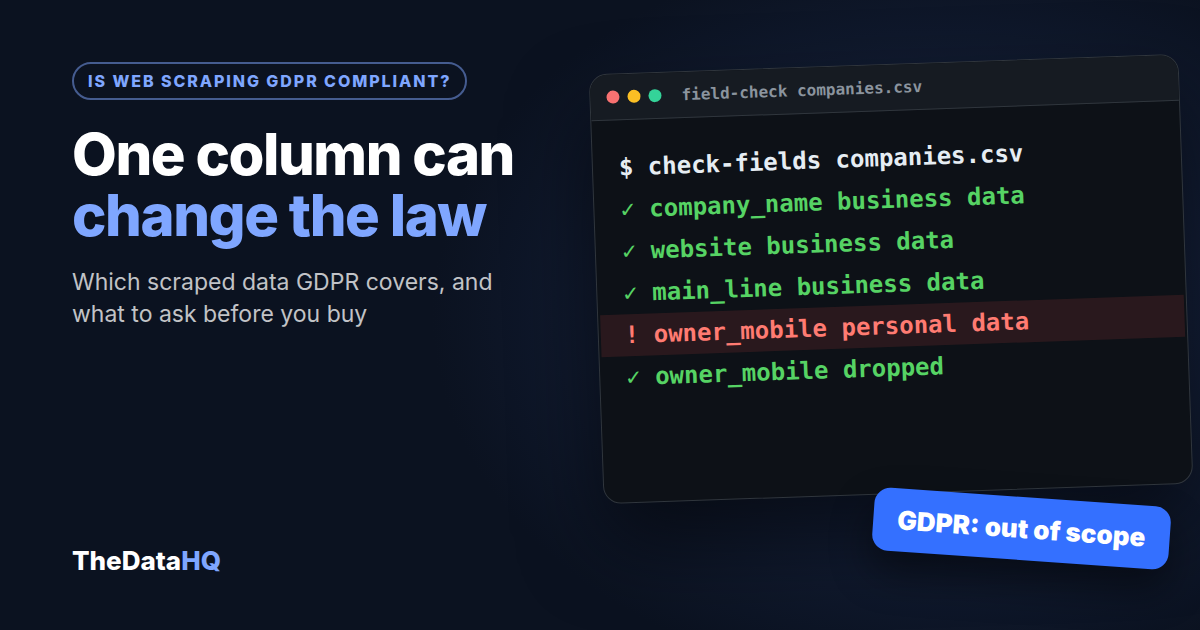
Is Web Scraping GDPR Compliant When You Buy the Data?
GDPR only applies when scraped data identifies a person. Which data is in scope, who is responsible when you buy it, what the EDPB draft…
Read the guide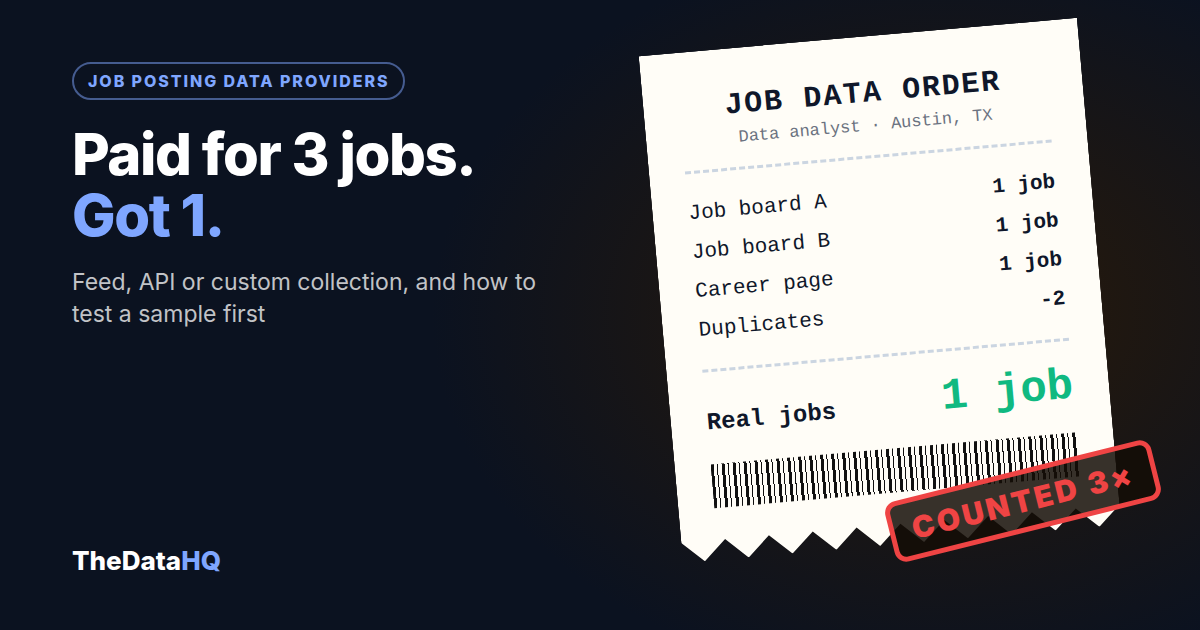
Job Posting Data Providers Compared: Feed, API or Scrape
Job posting data comes as a ready dataset, a pay-per-record API or a custom collection of named sites. Named providers with their…
Read the guide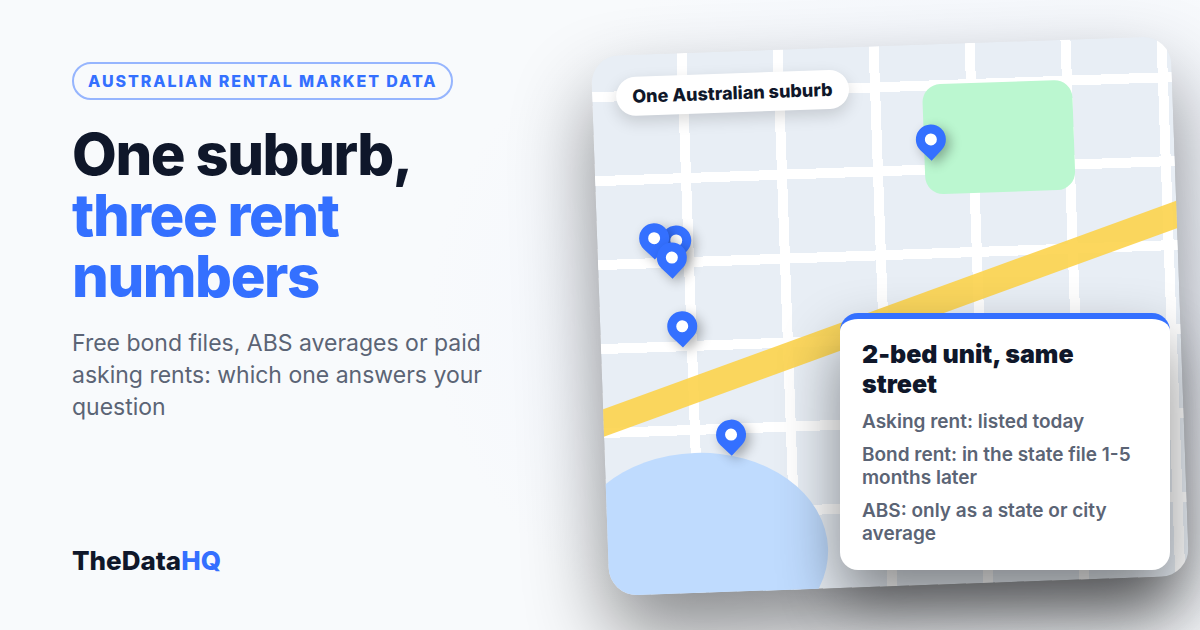
Rental Market Dataset Australia: Free vs Paid Sources
Australian rent data comes from free state bond files (suburb medians, months late), ABS averages, and paid asking-rent data from…
Read the guide