
Data Entry and Processing Services That Scale Past Manual Typing
Our data entry and processing services take untidy data, from supplier spreadsheets and PDF price lists to scraped pages and legacy exports, and turn it into consistent records loaded where you need them. Scripts handle the volume, rules handle the formatting, and a person reviews the rows the rules cannot settle.
What Does Data Processing Actually Change?
This is sample data from a supplier catalogue job. The left columns show what arrived in three different supplier files. The right columns show the single format the client's online store needed.
| Raw supplier entry | Supplier | Brand | Product name | Size | Unit | Price (GBP) | Action |
|---|---|---|---|---|---|---|---|
| ACME CORDLESS DRILL 18v 2x2.0AH BATT | supplier-1 | Acme | Cordless Drill 18V, 2 × 2.0Ah Batteries | 18 | V | 89.00 | Normalised |
| Acme drill cordless 18 volt w/ 2 batteries | supplier-2 | Acme | Cordless Drill 18V, 2 × 2.0Ah Batteries | 18 | V | 91.50 | Merged as duplicate |
| Masonry bit set 5pc 4-10mm | supplier-3 | Unbranded | Masonry Drill Bit Set, 5 Pieces, 4–10mm | 4–10 | mm | 7.99 | Normalised |
| Wood glue 1 ltr | supplier-1 | Fixwell | Wood Glue, 1L | 1 | L | 6.40 | Normalised |
| Sander 240v ??? see spec sheet | supplier-2 | Sent to reviewer |
What Data Processing Jobs Do Clients Outsource?
These are the recurring jobs we take off teams most often. Each one used to be done by hand in a spreadsheet.
Product catalogue entry
Supplier files turned into store-ready listings with consistent titles, units, attributes and categories.
Learn morePDF and document entry
Price lists, invoices, forms and reports read into structured rows, with low-confidence fields checked by a person.
Learn moreDeduplication
Duplicate customers, companies, products or listings found and merged with a clear rule for which value wins.
Normalisation
Dates, currencies, units, addresses and job titles written one way across every source.
Migration and loading
Old system exports cleaned, mapped to new fields and loaded into your database, CRM or CMS.
Categorisation
Records sorted into your taxonomy, such as product categories, industries or job families, with rules plus review.
Why Automated Data Processing Beats Manual Data Entry
Traditional outsourced data entry puts a large team in front of spreadsheets. It is slow to scale, and quality depends on how tired each typist is by the afternoon. Two people will write the same product title two different ways, and nobody notices until a customer searches for it.
We do it the other way round. Engineers write the rules first: how a size is parsed, which supplier wins when prices conflict, what a valid postcode looks like. Code applies those rules to every row in the same way, whether there are 500 rows or 500,000. People are kept for the work code does badly, such as reading a smudged scan, deciding between two near-identical records or checking a sample of every batch.
The result is cheaper per row, faster on large jobs and, above all, consistent. When you want a rule changed, we change it once and reprocess, rather than retraining a team and hoping the old habit fades.
What Data Cleaning Rules Do We Apply?
Format
- Dates to one format and time zone
- Currencies with ISO codes
- Units converted and labelled
- Phone and postcode patterns checked
- Text case and spacing fixed
Content
- Required fields present
- Values within expected ranges
- Categories from your approved list
- Brand and supplier names standardised
- Obvious typos corrected by rule
Structure
- Duplicates found and merged
- IDs matched to your master list
- Parent and variant products linked
- Orphan and broken rows flagged
- Change log kept for every edit
Data Processing Case Study: 50,000 Records a Day, One Schema
HiCounselor needed job postings from many countries and thousands of employers in one usable format. Our pipeline cleans every posting, standardises titles, locations and salary formats, removes duplicates the moment they appear and hands a consistent record to their matching engine.
Read the case studyHow Our Data Processing Service Works
- 01
Share files and target format (day 0)
Send a sample of the raw data and the template, system or schema it needs to end up in.
- 02
Rules and test batch (day 2)
We write the processing rules and return a test batch with every change logged for you to check.
- 03
Full processing (days 3–10)
The full volume runs through the rules. Edge cases go to reviewers and a sample is checked by hand.
- 04
Recurring runs
New files, feeds or scraped data are processed on arrival and loaded automatically.
What Should You Look for in a Data Processing Company?
Ask to see the rules, not just the price per row. A provider that cannot show you, in writing, how it decides which duplicate survives or how it parses a messy size field is relying on individual judgement, and that judgement will drift as staff change. Ask also how errors are measured: a quoted accuracy figure means little unless you know how the sample was drawn and who checked it.
Check what happens on the second file. One-off clean-ups are easy to make look good. The real test is whether next month's supplier file comes back in exactly the same shape without you re-explaining the job. Because our rules live in code, the second, tenth and hundredth batch follow the same logic, and any change you request is versioned so you can see when it took effect.
What Is Included in Our Data Entry and Processing Services
You get clean data in the exact shape your system expects, plus the paper trail that shows how it got there.
- Written processing rules you can read and change
- A free test batch on your own data
- Human review of low-confidence rows
- Sampled quality checks on every batch
- A log of every merged, changed or rejected row
- Loading into your database, CMS, CRM or marketplace template
What is not included
- Data entry into systems we are not given authorised access to
- Processing of sensitive personal data such as health or financial records
- Transcribing audio or handwriting at scale
How Much Do Data Entry and Processing Services Cost?
No minimum project size. Small fixes and big builds are both welcome.
What are data processing services?
Data processing services take raw data and make it usable: cleaning errors, standardising formats, removing duplicates, categorising records and loading the result into a system. We automate most of it and use people for the hard cases.
How much does outsourced data entry cost?
Most jobs are quoted at a fixed price after a free test batch, based on volume and complexity. For continuous feeds, you can book engineer hours from $15 an hour or a dedicated engineer from $2,400 a month.
Is automated data entry accurate?
Usually more accurate than manual entry, because every row follows the same rule. We target 98% accuracy, check a sample of each batch by hand and route uncertain rows to a person.
Can you clean data from PDFs and scanned documents?
Yes. We extract text and tables from PDFs and scans, then apply the same cleaning rules. Fields we read with low confidence are checked by a reviewer.
How fast can you process a large dataset?
Once the rules are set, hundreds of thousands of rows can usually be processed in a day. The first test batch is back within 48 hours.
Can you upload products to our online store?
Yes. We format product data to your store or marketplace import template, including titles, attributes, variants and categories, and can load it directly where the platform allows.
Can you process data you scrape for us?
Yes, and most clients combine the two. Scraped data is cleaned and normalised in the same pipeline, so it arrives ready to use. See our web scraping services.
Data entry and processing services guides
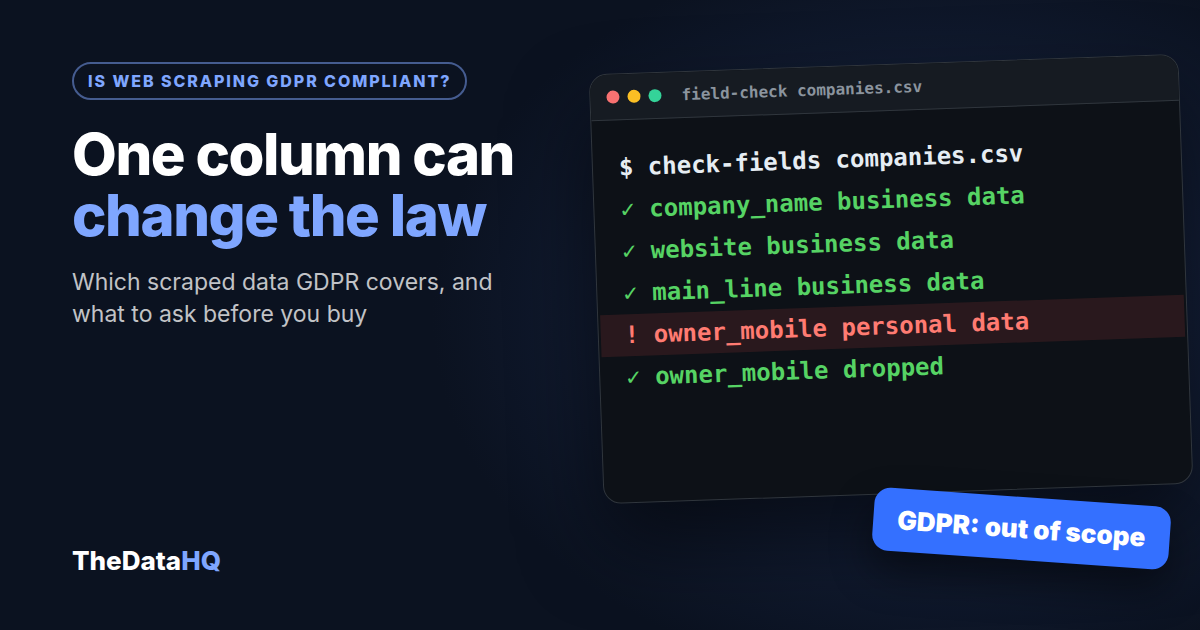
Is Web Scraping GDPR Compliant When You Buy the Data?
GDPR only applies when scraped data identifies a person. Which data is in scope, who is responsible when you buy it, what the EDPB draft…
Read the guide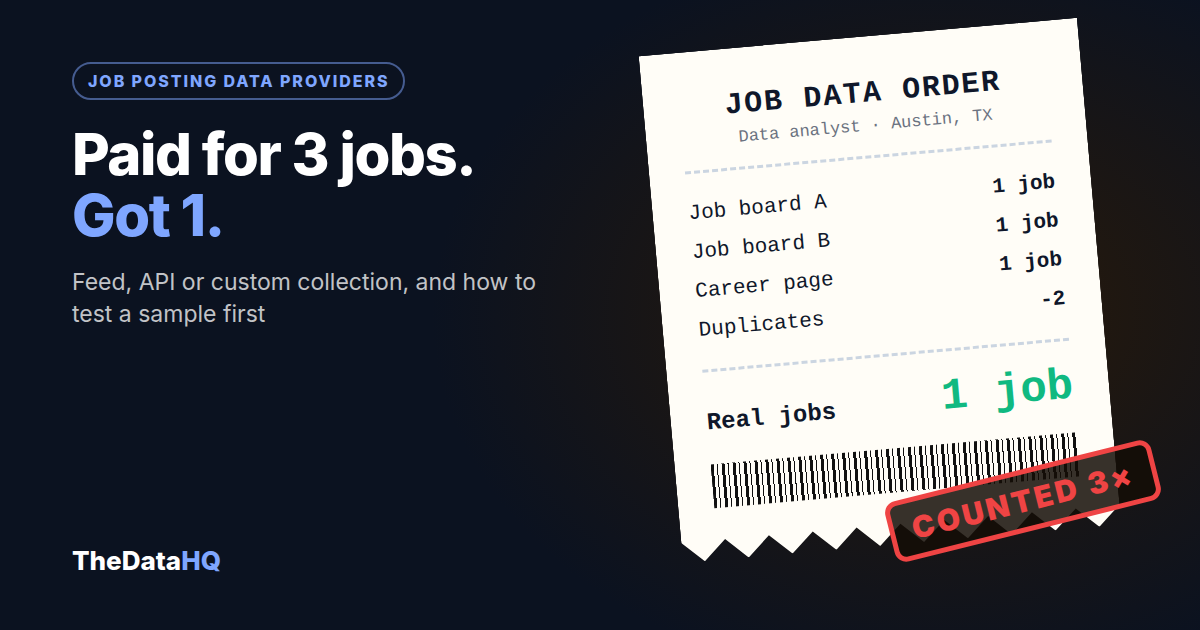
Job Posting Data Providers Compared: Feed, API or Scrape
Job posting data comes as a ready dataset, a pay-per-record API or a custom collection of named sites. Named providers with their…
Read the guide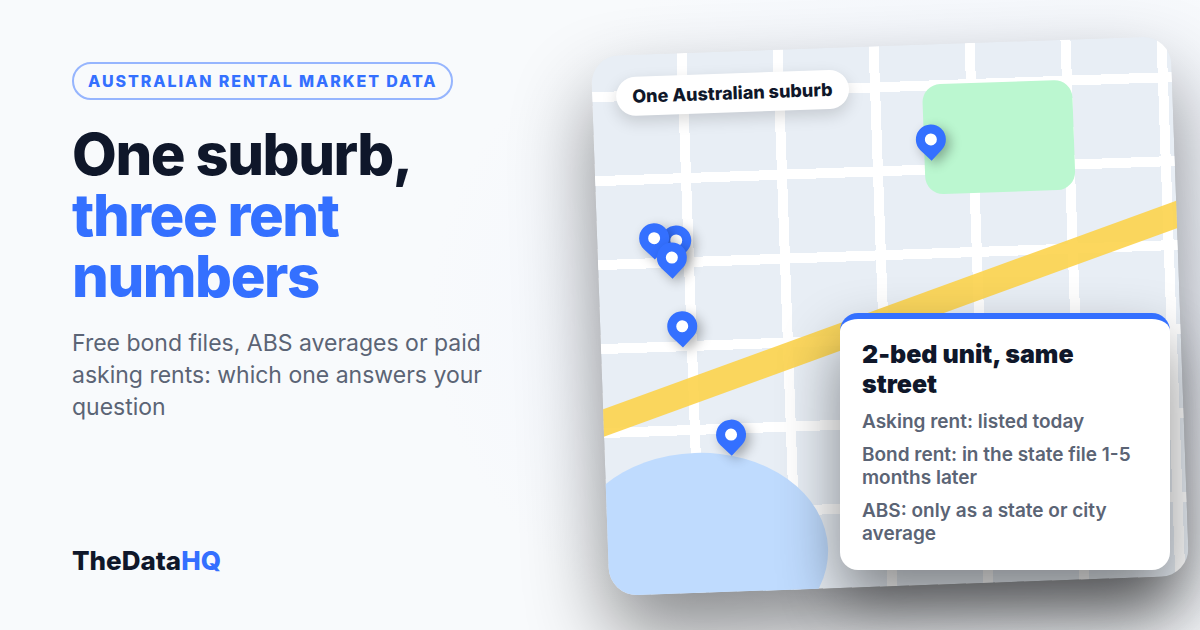
Rental Market Dataset Australia: Free vs Paid Sources
Australian rent data comes from free state bond files (suburb medians, months late), ABS averages, and paid asking-rent data from…
Read the guide