Job posting data providers sell the same raw material three ways: a ready dataset or feed, a pay-per-record API, or a custom collection of the sites you name. Self-serve APIs start at about $49 a month, bulk datasets at a few hundred dollars, and enterprise labour-market data at five figures a year. Pick the route by how many sites you need and how often.
A note before the comparison: most pages ranking for this search are written by a provider that puts itself first. We sell one of the three routes too (custom collection), and we don't sell a global jobs feed. So we'll say where a ready feed is the better buy.
Feed, API or custom collection: which do you need?
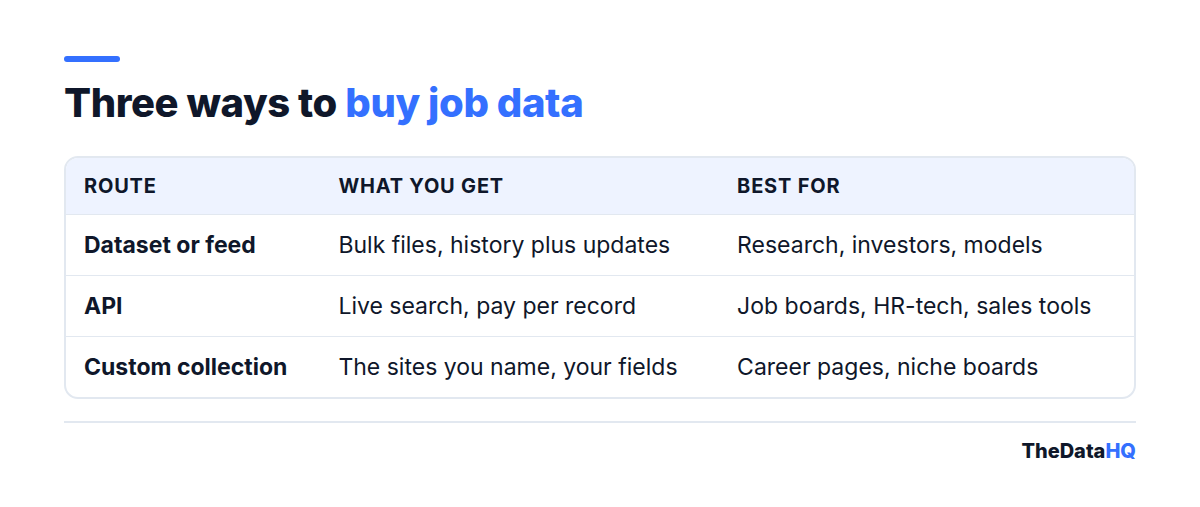
You need a feed if you want millions of postings across many countries and can work with files. You need an API if your product looks jobs up as users ask. You need a custom collection when the sites you care about aren't in anyone's feed.
| Route | What you get | Best for | Watch out for |
|---|---|---|---|
| Dataset or feed | Bulk files (CSV, JSON, Parquet) of history plus daily or weekly updates | Research, investment signals, training data, market maps | Minimum orders, sources you can't choose |
| API | Search jobs by title, company or place; pay per record or per credit | Job boards, HR-tech products, sales tools that need live lookups | Credit costs that grow with use, rate limits |
| Custom collection | The sites you name, the fields you want, on your schedule | Competitors' career pages, niche or local boards, one region | A smaller footprint; each site is set up one by one |
Job posting data providers compared
The prices below are the ones each provider publishes, read on their own pricing pages on 14 November 2026 unless noted. Several big names don't publish a price at all; we say so rather than guess.
| Provider | Route | Published price | Sources and history |
|---|---|---|---|
| TheirStack | API, datasets | Free plan (200 API credits a month); API from $49 a month for 1,500 credits (1 credit per job); datasets on request | 225M job records, about 305,000 new a day, history to 2021 |
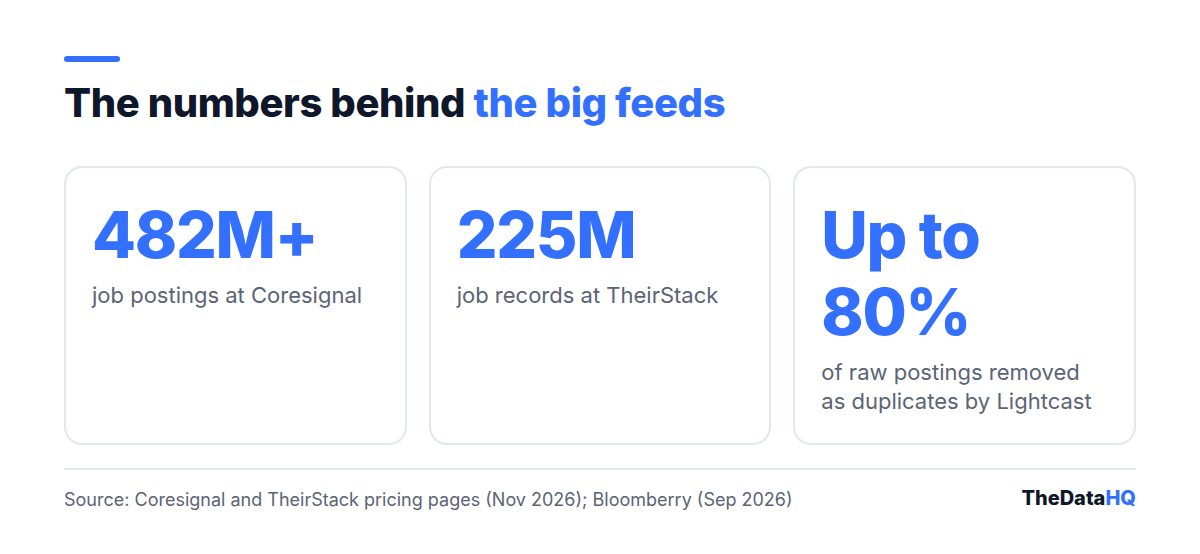
| Coresignal | API, datasets | API plans from $49 a month (1 credit per job); datasets from $1,000 (all data types) | 482M+ job postings from LinkedIn, Indeed, Glassdoor and Wellfound |
| Bright Data | Datasets | Up to $0.0025 per record, $250 minimum order | LinkedIn, Indeed and Glassdoor listings |
| JobsPipe | API | Free for 1,000 jobs a month; $49 a month for 25,000 credits (per Bloomberry) | 30+ applicant tracking systems and boards; 12 months of history |
| Lightcast | Datasets, API | $16,500 a year for one country; $99,000 for all 27 EU countries (AWS Marketplace, per Bloomberry) | 220,000+ sources; US data since 2010, 150+ countries |
| LinkUp | Datasets | Not published; by demo | Employer websites only, 195 countries, history to 2007 |
| Revelio Labs | Datasets, platform | Not published; by demo | 4.1B+ postings from 6.6M companies |
| Revealera | Datasets | Not published | About 5,000 companies' career pages, history to late 2018 |
| Apify marketplace | Pay-per-use scrapers | About $1 to $12 per 1,000 jobs, by builder | Varies by actor; built by third parties |
| TheDataHQ | Custom collection | $15–$30/hour, or a fixed price quoted up front | The sites you name, from the day we start |
Sources: TheirStack pricing, Coresignal pricing, Bright Data jobs datasets, and Bloomberry's provider review (updated 8 September 2026) for JobsPipe, Lightcast, LinkUp, Revelio Labs and Revealera. Record counts are the providers' own figures on those dates; they change monthly, so ask for a current count.
Self-serve APIs
TheirStack, Coresignal and JobsPipe let you sign up, get a key and pull jobs the same day. They suit products that need a few thousand lookups a month. Costs climb with volume, so price your busiest month, not your first.
Bulk datasets
Bright Data and Coresignal sell large files with refresh options. Bright Data, for example, lists discounts of 25% to 80% for biannual to monthly updates. A dataset is the cheapest way to get history, but you take the sources they chose.
Enterprise labour-market data
Lightcast, LinkUp and Revelio Labs sell cleaned, classified data with skills and occupation codes. Lightcast says its deduplication removes up to 80% of raw postings as duplicates, according to Bloomberry's review. That cleaning is what the higher price buys.
Which job data provider fits which buyer?
Start from what you'll do with the data. The use decides the route more than the provider's size does.
- Recruiting and HR-tech products: an API for live search, plus a dataset for history.
- Investors and hedge funds: a deduplicated feed with long history, such as LinkUp or Lightcast, because hiring trends need clean counts.
- Labour-market researchers: Lightcast or official statistics first; scraped adverts are a supplement, not a census.
- Sales and RevOps teams: hiring signals by company (who is hiring for which roles) from an API such as TheirStack or Coresignal.
- Recruitment agencies: often a custom collection of the employers and local boards in their patch, because a national feed may not include those smaller sites.
What's in a job posting record?
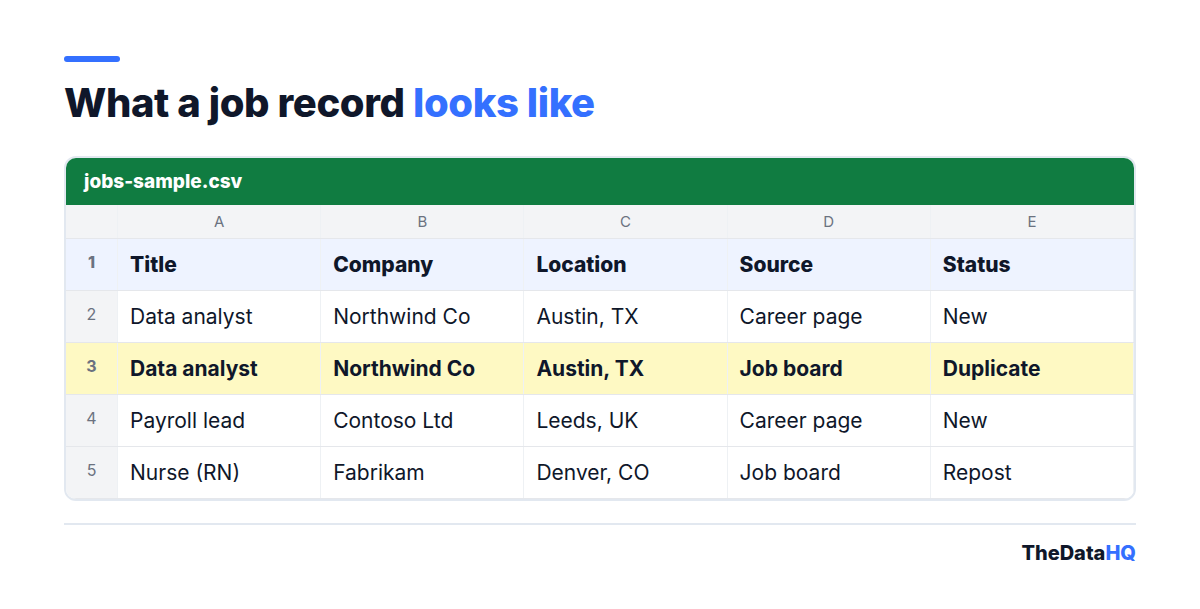
A full record can run to dozens of fields; TheirStack, for example, lists 40+ job fields in its datasets. The ones that matter most are below.
- Job title, and a normalised title or occupation code
- Company name, domain and size
- Location, plus remote or hybrid
- Date first seen, date last seen and date closed
- Salary, where the advert states it
- Source URL and which site it came from
- Description text, for skills and keywords
Delivery is usually JSON, CSV or Parquet (a compact file format for large tables), sent to cloud storage such as Amazon S3, by SFTP or through an API.
How do you test a job data sample before you buy?
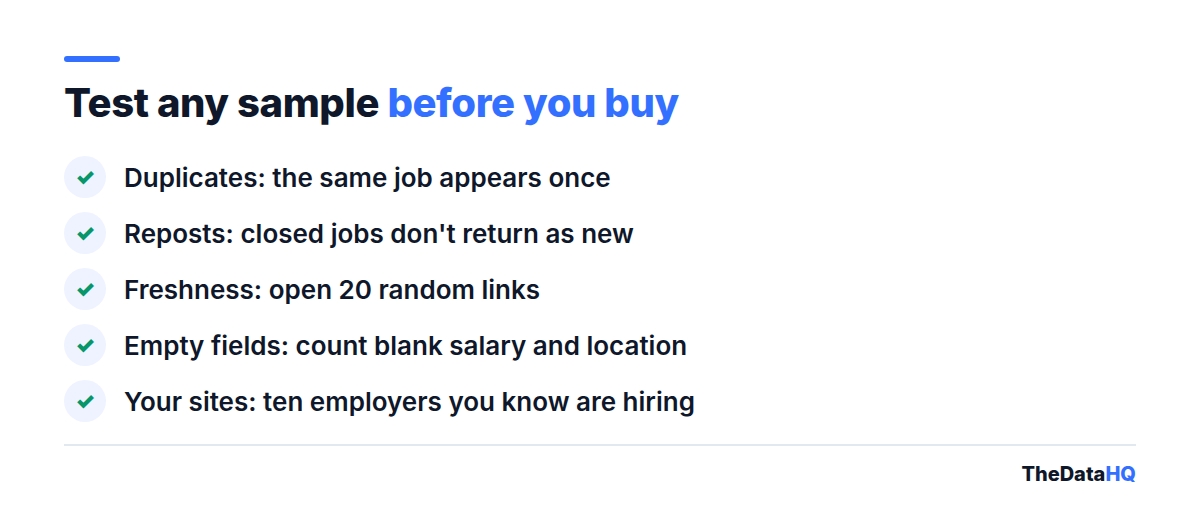
Ask every provider for a sample from the same week and the same market, then run four tests. A spreadsheet is enough, and the results tell you more than any sales call.
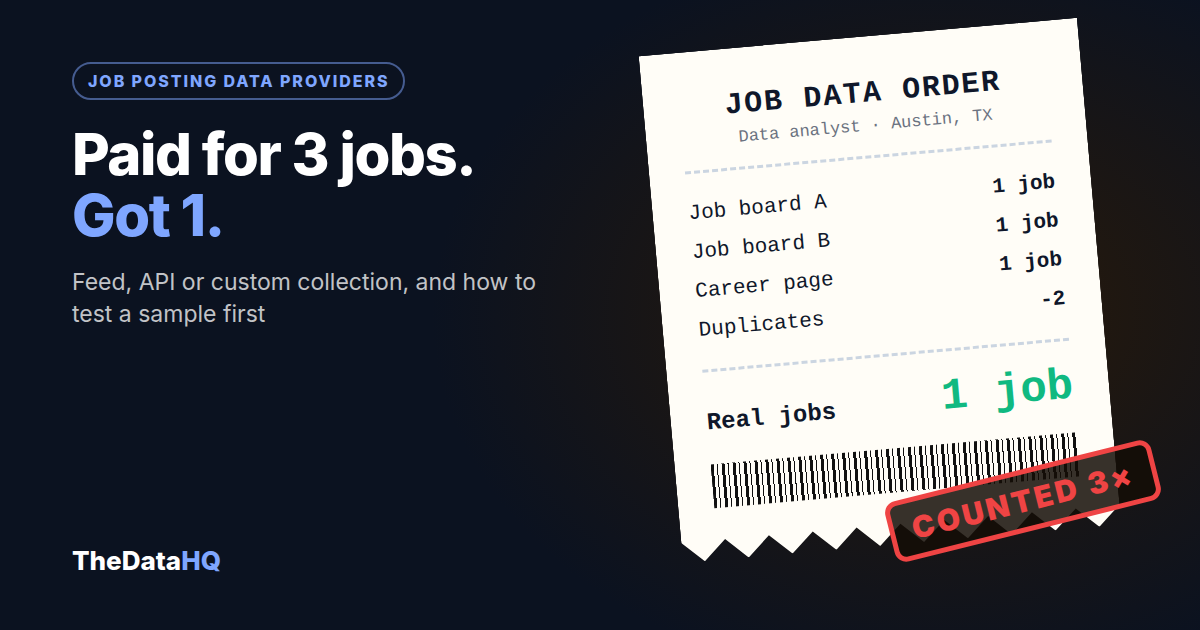
- Duplicates: sort by company, title and city. The same job from three boards should appear once, with its sources listed.
- Reposts: look for jobs that close and reopen with a new date. Counted twice, they inflate hiring trends.
- Freshness: open 20 source URLs at random. Count how many are still live and how many closed weeks ago.
- Empty fields: count the blanks in salary, location and company domain. A field that's 60% empty isn't a field you can use.
Then check the sites you care about. Pick ten employers you know are hiring, and see whether their current jobs are in the sample.
Do job posting data providers cover the UK and Europe?
Yes, but usually thinner than the US, and the comparison pages we read for this guide don't say how much thinner. Ask each provider for counts by country and by site, not a global total.
- Lightcast's UK job postings data goes back to January 2016.
- Lightcast sells the 27 EU countries as one package, at $99,000 a year on AWS Marketplace (per Bloomberry).
- Marketplace scrapers exist for single countries, such as an Apify UK jobs actor priced at $1.20 per 1,000 records.
The gaps show up in local boards, non-English sites and small employers' own career pages. If you need official UK vacancy numbers instead of adverts, our guide to UK job vacancies data explains the ONS counts and how they differ.
Is it legal to collect job postings?
Collecting public job adverts is generally lower-risk than collecting data about people, but "it's public" isn't the legal test. Contract terms, database rights and privacy law all apply. This is not legal advice; ask a lawyer about your own case.
The US view
In hiQ v. LinkedIn, the appeals court said scraping public pages probably wasn't "unauthorised access" under the federal anti-hacking law. Then hiQ lost on contract: in late 2022 the court found it had broken LinkedIn's user agreement, and the case ended with an injunction, as ZwillGen's summary explains. The lesson for buyers: ask how a provider treats site terms and logins.
Recruiter names, emails and phone numbers in adverts are personal information. Under California's CCPA, that data comes with duties if you hold it about California residents.
The UK and EU view
Under the UK GDPR and the EU GDPR, recruiter contact details are personal data, so you need a lawful basis. That's usually legitimate interests, which the ICO treats as a three-part test. The Dutch regulator has gone further, warning that public availability alone doesn't make scraping lawful, as Pinsent Masons reports.
Job boards can also hold database right in the UK and EU, which protects a substantial part of a database from being copied. Questions to put to any provider:
- Which sites does the data come from, and do any require a login?
- Do you remove or mask recruiter names and contact details?
- How do you respect robots.txt and rate limits?
- What happens to the data if a site asks you to stop?
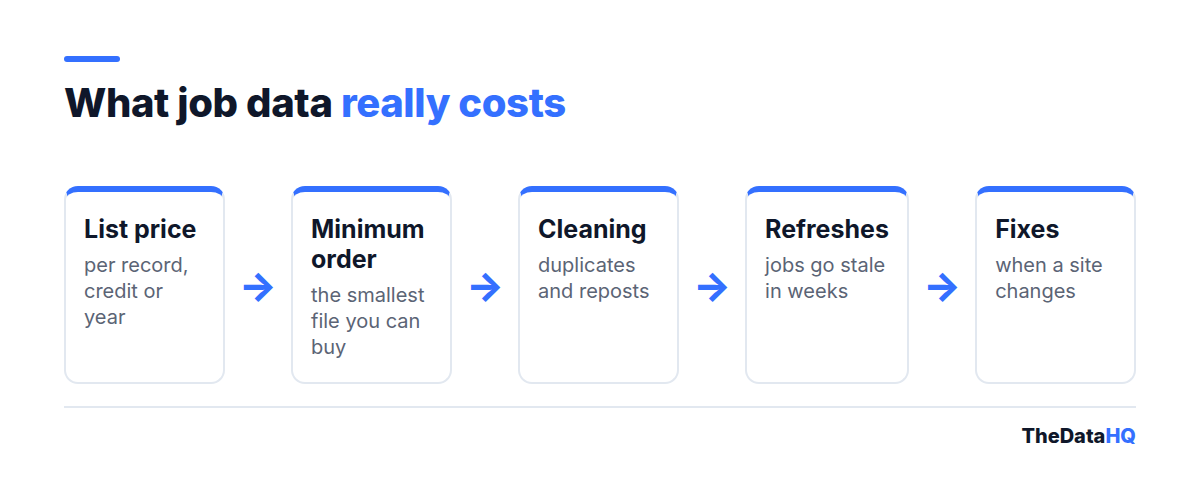
What does job posting data really cost?
The list price is only the first line. The real cost is the list price plus the minimum order, plus your team's time cleaning, plus every refresh.
- List price: from about $1 per 1,000 records on marketplaces to $16,500 a year for one country of enterprise data.
- Minimums: Bright Data's $250 order, Coresignal's datasets from $1,000.
- Cleaning: cheaper raw data usually needs duplicates and reposts removed by you.
- Refreshes: a one-off file goes stale within weeks; jobs data is a subscription in practice.
- Changes: a custom collection needs fixing when a site changes its layout. Ask who pays for that.
For custom work, the price depends on the number of sites, how often they're collected, how they're built, the volume, and the fields and cleaning. Our pricing page explains fixed-price projects and monthly retainers.
When is a custom collection better than a feed?
A custom collection wins when your list of sites is short and specific. Think 200 competitors' career pages, a regional board or employers in one sector. It loses when you need every job in a country: a feed has already done that work, and it's cheaper.
We've collected job and company data for a recruitment agency, built around the employers and roles it actually recruits for. That kind of brief suits our custom data extraction service. Since 2015 we've delivered 200+ projects and collected data from 10,000+ websites. Our limit, plainly: we don't sell a ready global jobs database, so for national hiring trends start with the providers above.
If you're weighing data sources for an AI tool rather than a jobs product, see our guide to data providers for AI agents. And if you'd rather build the collection in-house, BinaryBits builds that kind of system.
Want to see what your own job data would look like? Send us one URL and the fields you want; you'll get a free sample of real rows from your own sources within 48 hours. No charge, no commitment. Ask for a free sample.
Frequently asked questions
What does a job posting data provider do?
A job posting data provider collects job adverts from job boards, employer career pages and applicant tracking systems, then cleans and delivers them as structured data. You get fields such as title, company, location, salary and dates, as files, a feed or an API. The better providers also remove duplicates and reposts, so each job is counted once.
How much does job posting data cost?
Published prices run from about $1 per 1,000 records on scraper marketplaces, through self-serve APIs from $49 a month, to $16,500 a year for one country of Lightcast data. Datasets often carry minimum orders, such as Bright Data's $250. Add the cost of cleaning and refreshes before you compare quotes.
Is it legal to scrape job postings?
Collecting public job adverts is often lawful, but it depends on the site's terms, database rights and privacy law. Recruiter names and contact details are personal data under the GDPR, the UK GDPR and the CCPA. hiQ v. LinkedIn shows a site's user agreement can still decide a case. This is not legal advice.
What's the difference between a job postings API and a dataset?
An API answers a query as you ask it, such as "data analyst jobs in Austin", and charges per record or credit. A dataset is a bulk file of many jobs, often with years of history, delivered once or on a schedule. APIs suit products that look things up live; datasets suit analysis and models.
How do job data providers remove duplicate postings?
They match postings that share a company, title, location and similar description text, then keep one record and list every source. Some also track reposts, where a job closes and reopens with a new date. Lightcast says its process removes up to 80% of raw postings as duplicates. Test this yourself on a sample.
Can I get job postings data for the UK and Europe?
Yes. Lightcast has UK postings from 2016 and sells all 27 EU countries as one package, and API providers cover major European boards. Coverage is thinner than in the US, especially for local boards and non-English sites. Ask for counts by country and by site, and remember the GDPR applies to recruiter details.
Should I build job data collection in-house or outsource it?
Outsource it unless job data is your product. Collecting is the easy part; keeping hundreds of sites working as they change, and removing duplicates, takes steady engineering time. Buy a feed for broad coverage, or a custom collection for a named list of sites. Build in-house only when you need full control of sources.

Co-founder of TheDataHQ, running delivery and operations across client web scraping engagements.