
Ecommerce Data Scraping for Retailers, Brands & Marketplaces
Ecommerce data scraping gives your pricing, category and marketplace teams a daily view of every competitor shelf they care about. We collect prices, promotions, stock, sellers, reviews and full catalogues from online stores and marketplaces worldwide, match them to your own products and deliver one clean feed.
Why Do Retailers and Brands Scrape Ecommerce Data?
Online prices now move several times a day. A competitor runs a flash sale at 10am, a marketplace seller undercuts your recommended price by lunchtime and a rival store quietly runs out of your best-selling size by the evening. Teams that still check prices by hand once a week see these moves days late, after the margin or the sale has already gone.
Brands face a different version of the same problem. They need to know which resellers list their products, at what price, with which images and descriptions, and whether the listing is even in stock. Marketplaces add thousands of third-party sellers, so the picture changes daily and cannot be followed manually.
Ecommerce data scraping replaces that guesswork with a structured daily record. Every product, price, offer and review becomes a row you can sort, chart and alert on, and the history builds up so you can see patterns such as which competitor always discounts first before a holiday weekend.
What Ecommerce Data Can Be Scraped?
Product and catalogue
- Product title, brand and category path
- SKU, model number, GTIN or EAN where shown
- Variants such as size, colour and pack
- Images, bullet points and specifications
- New and removed products since the last run
Price and availability
- Current price, list price and unit price
- Promotions, coupons and multi-buy offers
- Stock status and delivery promise
- Shipping cost and free-delivery thresholds
- Price by region or postcode where it varies
Sellers, rank and reviews
- Seller name and number of offers
- Featured offer winner on marketplaces
- Search position and category rank
- Star rating and review count
- Review text and date for chosen products
Ecommerce Scraping Sample Output
A morning feed for a home appliance brand. Each competitor listing is matched to the brand's own product code, so price gaps and stock problems show up in one table.
| Your code | Source | Listing title | Seller | Price | Promo | Stock | Rating |
|---|---|---|---|---|---|---|---|
| HA-2207 | marketplace-1.com | Cordless Stick Vacuum 25.2V | Third-party seller | 139.00 | None | In stock | 4.5 |
| HA-2207 | store-a.com | Stick Vacuum Cordless 25V Grey | store-a | 149.99 | 10% off code | In stock | 4.3 |
| HA-3150 | store-b.com | Air Fryer 5.5L Digital | store-b | 64.99 | 2 for 110 | Low stock | 4.7 |
| HA-3150 | marketplace-2.com | Digital Air Fryer 5.5 Litre | Reseller 4471 | 58.40 | None | In stock | 4.6 |
| HA-4019 | store-c.com | Steam Iron 2600W Ceramic | store-c | 34.00 | None | Out of stock | 4.1 |
Ecommerce Data Scraping Use Cases
These are the jobs online retail teams bring to us most often. Each card links to a page with more detail.
Competitor price tracking
Daily or hourly prices and promotions from rival stores, with alerts when a key product moves.
Learn moreDigital shelf health
Check that your listings show the right content, images, availability and rank on every retailer.
Learn moreSeller and reseller tracking
See every seller offering your products and spot unauthorised resellers or pricing below policy.
Learn moreReview and rating research
Collect ratings and review text to find product faults, feature requests and competitor weak spots.
Learn moreAssortment and catalogue gaps
Compare full catalogues to see which products, brands and sizes competitors stock that you do not.
Learn morePrice comparison platforms
Feed a comparison site or app with live prices from dozens of sellers through a private API.
Learn moreWhich Ecommerce Sites and Marketplaces Do You Scrape?
We collect public data from large marketplaces, national retailers, brand stores and small independent shops. These platforms have their own scraper pages.
 Amazon Scraper
 Walmart Scraper
 eBay Scraper
 Target Scraper
 Etsy Scraper
 Shopify Scraper
Trademarks belong to their owners. TheDataHQ is not affiliated with these companies and collects publicly available data only.
Ecommerce Price Comparison Case Study: Sales Nearly Doubled
A price comparison business needed live prices from more than 50 seller websites to show shoppers the best deal. We built and ran the collection layer and kept it current as sellers changed their pages. With accurate, up-to-date prices on every product, the client nearly doubled its sales.
Read the case studyHow Do You Match Products Across Different Online Stores?
Raw scraped prices are only useful once you know that two listings are the same item. Retailers rename products, bundle them, change pack sizes and hide barcodes. We match on GTIN or model number where the page shows one, then on brand, size, specification and title similarity, and we flag uncertain matches for a person to confirm rather than guessing.
Location matters too. Many stores show different prices, delivery dates and stock by postcode or region, and marketplaces rotate the featured seller. We set the shopper location on every request, so each row describes a real market. For an Australian client we track more than 10,000 digital products a day this way, with price, availability and seller on every row.
Catalogues change constantly, so we also track what appears and disappears. For one marketplace seller-tracking tool we collect a competitor's full catalogue daily and report new listings, removed listings and price changes. Another client's monitoring of over 200 competitor sites replaced a manual weekly check with a daily automated feed.
How Does an Ecommerce Scraping Project Work?
- 01
Share your product list
Send your SKUs, the competitor stores and marketplaces you watch, and the regions that matter.
- 02
Check a free sample
Within 48 hours you get real, matched rows from your own competitors to review.
- 03
Go live in about 7 days
Daily or hourly feeds start, delivered to Excel, your database, S3 or a private API.
- 04
Alerts and upkeep
Slack or email alerts on price moves, and our engineers fix any store that changes its layout.
How Much Does Ecommerce Data Scraping Cost?
No minimum project size. Small fixes and big builds are both welcome.
Is it legal to scrape ecommerce websites?
Collecting public product pages, prices and reviews is generally lawful, but it depends on the site's terms and how you use the data. We collect only public data without logging in, avoid personal data and review each store's terms before we start.
How often can competitor prices be scraped?
Anything from weekly to every hour. Fast-moving categories such as electronics usually run several times a day, with alerts within about 15 minutes of a change.
Can you scrape prices for a specific postcode or region?
Yes. We set the delivery location for each request, so you see the price, stock and delivery date a shopper in that area would see.
Can you match competitor products to my SKUs?
Yes. We match by barcode or model number where available, then by brand, size and title, and we flag uncertain matches for review.
How many products can you track?
There is no fixed limit. One client tracks more than 60,000 SKUs a day across 50+ marketplaces, and our pipelines handle over a million pages a day.
Can you collect data from Shopify and smaller online stores?
Yes. Small independent stores are often easier to collect than large marketplaces, and we can add hundreds of them to one feed.
What format is scraped ecommerce data delivered in?
Most retail teams take a daily CSV or Excel file, while analytics teams prefer rows loaded straight into their warehouse or an S3 bucket. Comparison sites and apps usually query a private API that always returns the latest price for each product.
What does ecommerce scraping cost per month?
Monthly cost rises with the number of stores, products and daily refreshes. A competitor price feed is usually run by an engineer billed from $15 an hour or a dedicated engineer from $2,400 a month, and we can fix one monthly price once you have approved a free sample.
Ecommerce data scraping guides
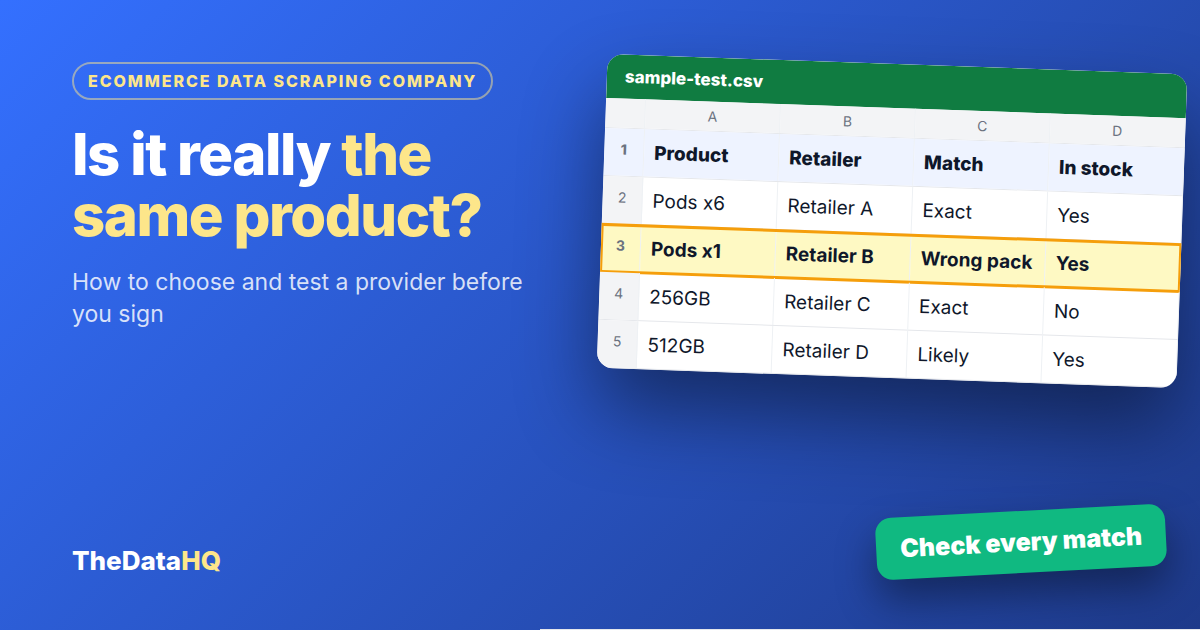
Ecommerce Data Scraping Company: How to Choose and Test One
The buyer's side of a page full of vendor sales pages: what an ecommerce data scraping company should deliver, how products get matched…
Read the guide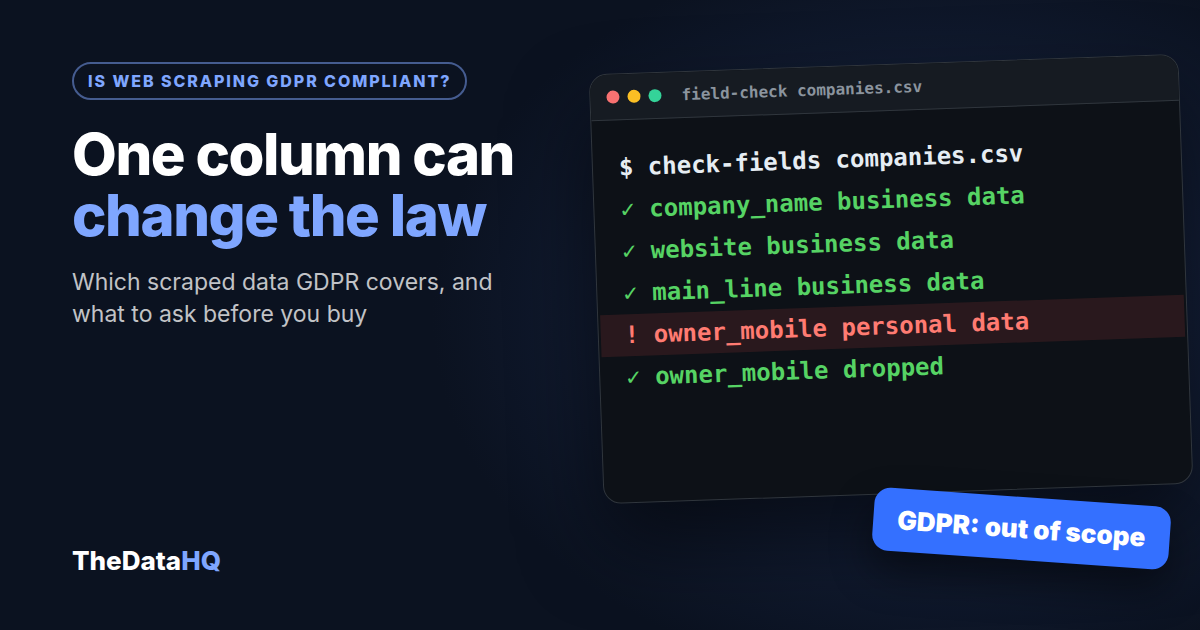
Is Web Scraping GDPR Compliant When You Buy the Data?
GDPR only applies when scraped data identifies a person. Which data is in scope, who is responsible when you buy it, what the EDPB draft…
Read the guide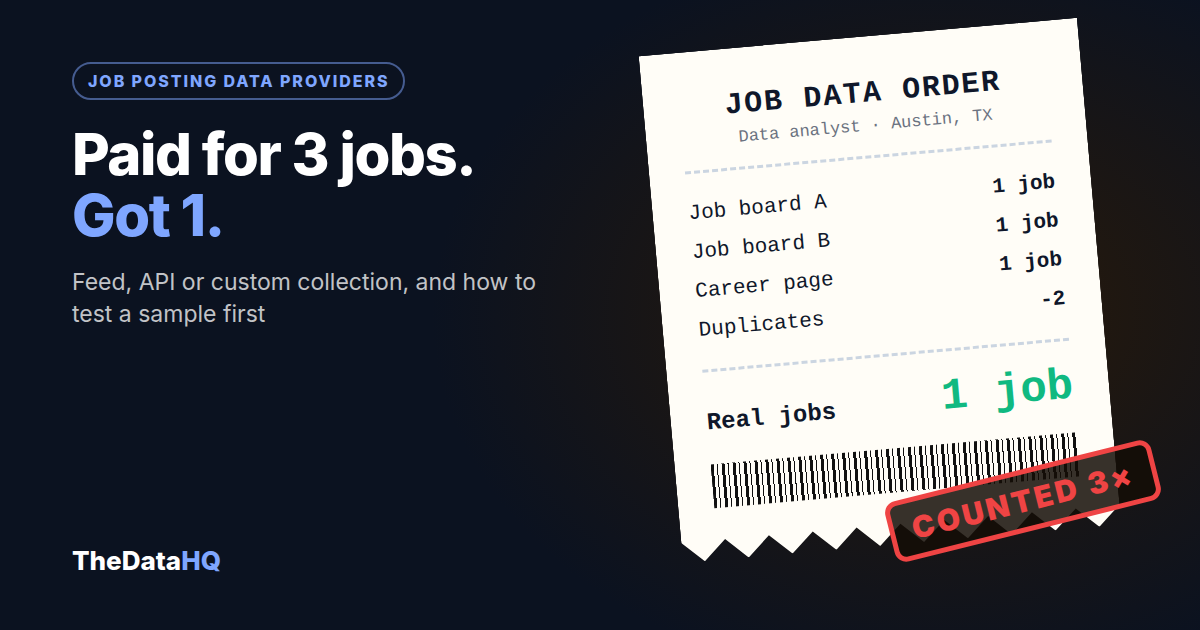
Job Posting Data Providers Compared: Feed, API or Scrape
Job posting data comes as a ready dataset, a pay-per-record API or a custom collection of named sites. Named providers with their…
Read the guide