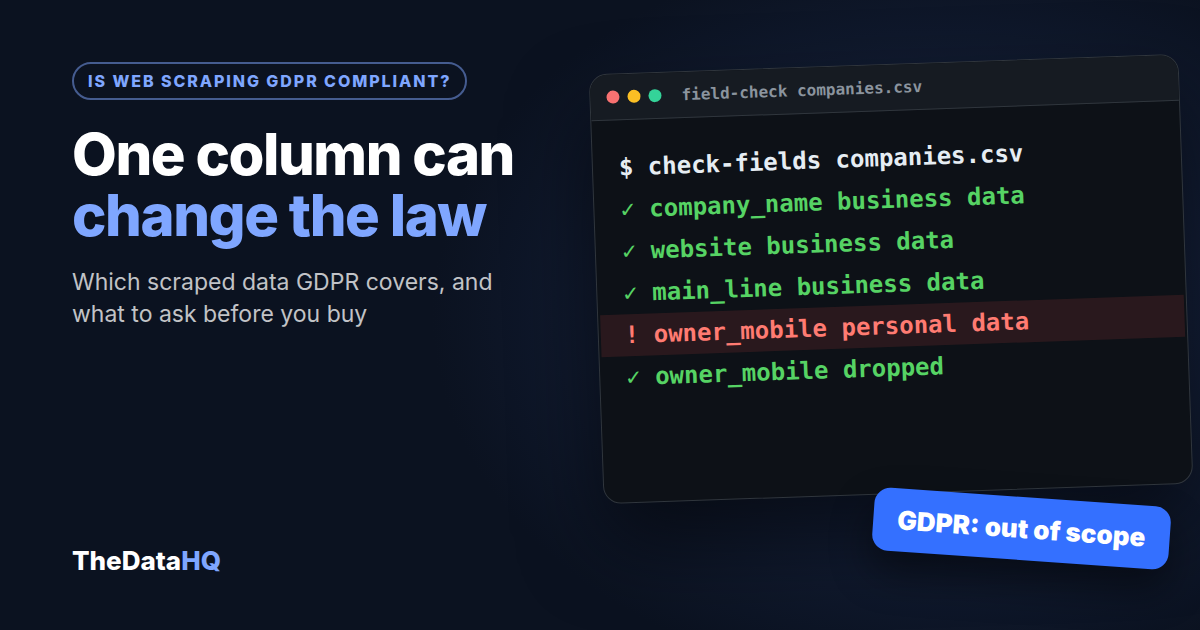
Is web scraping GDPR compliant? Yes, when the scraped data holds no personal data, or the personal data in it has a lawful basis, a clear purpose and a notice to the people concerned. Prices, products, company records and job ads without names usually fall outside GDPR. Contact details, profiles and reviewer names fall inside. If you buy the data, you carry duties too.
This guide is for the person buying a scraped dataset or a data feed, not the person running the scraper. It covers which data is in scope, who is responsible, what Europe's regulators now expect and the questions to ask any provider before you sign. It is not legal advice; for a specific project, ask a data protection lawyer.
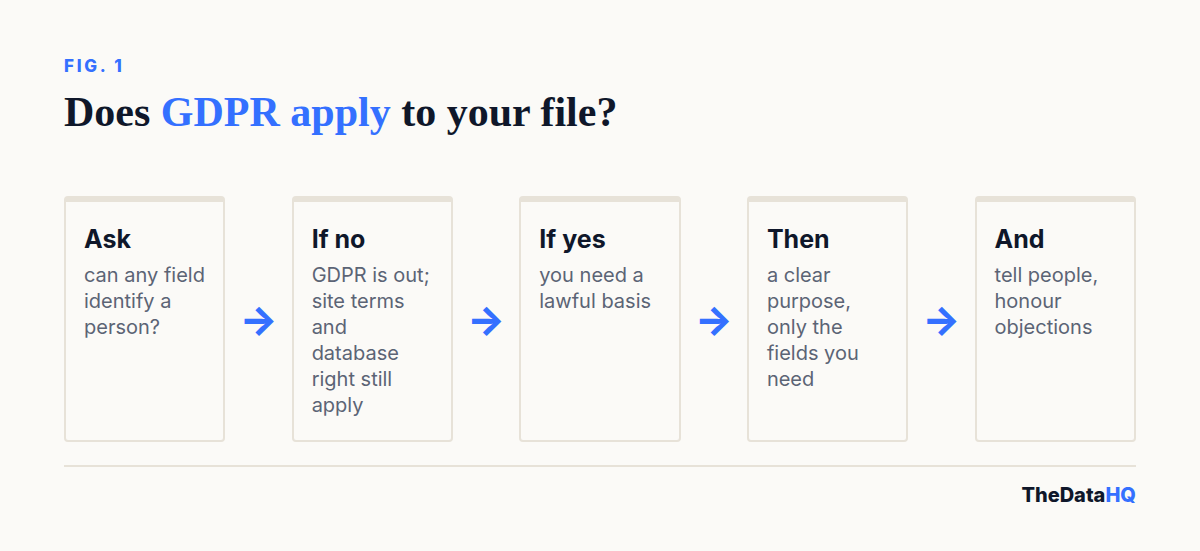
Which scraped data does GDPR cover?
GDPR covers personal data, and nothing else. The test is whether a person can be identified from a field, alone or combined with other fields. The website it came from, and whether the page was public, don't change that test.
| Scraped data | Personal data? | What to check |
|---|---|---|
| Product prices and stock | Almost never | Site terms and database rights |
| Company records (name, address, main phone line, sector) | Usually not | Sole traders, whose business name is their own name |
| Job ads | Usually not | Recruiter names and direct emails in the ad text |
| Property listings | Sometimes | Private sellers and landlords named in the listing |
| Reviews | Often | Reviewer names, photos and usernames |
| B2B contacts (named people, work emails) | Yes | Lawful basis, notice, opt-out, retention |
Most pricing, product and market data never touches a person. That's why many buyers can answer the GDPR question in one line: the file has no personal fields, and the provider filters out any that appear.
What if personal data slips in by accident?
It still counts. A review scraped for its star rating can carry the reviewer's name. A good provider removes those fields at collection, not after delivery. France's regulator, the CNIL, lists the measures it expects from scrapers (CNIL focus sheet on web scraping), including:
- define the collection criteria in advance;
- filter out data categories you don't need;
- delete irrelevant data straight after collection;
- skip sites that refuse scraping through robots.txt or a CAPTCHA;
- keep a default list of sites to exclude, such as sensitive ones.
Does GDPR apply if the provider is outside the EU?
It can. GDPR follows the people in the data, not just the company's address. It covers a business established in the EU, and also a business outside the EU that offers goods or services to people in the EU or monitors their behaviour (GDPR Article 3). If you're an EU buyer, your own use is covered wherever the provider sits; UK GDPR works the same way for UK buyers.
Is B2B contact data personal data?
Yes. A work email such as jane.smith@company.com identifies Jane Smith, so it's personal data, even though it's about her job. A generic address such as info@company.com usually isn't.
B2B data runs from low to high risk:
- Low: company names, websites, sectors, addresses and main phone lines.
- Medium: sole traders and small firms, whose business name is a person's name.
- High: named decision makers with job titles, direct emails or mobile numbers.
The high end is fully inside GDPR. In the EU, sending marketing email to those people also falls under each country's e-privacy rules, which are often stricter than GDPR itself.
Does "publicly available" make scraped data legal?
No. Public data is still personal data if it identifies someone. The Dutch regulator put it plainly in its 2024 guidance: "just because information is public, it does not automatically mean that scraping should be allowed" (Pinsent Masons on the Dutch guidance).
The clearest warning for buyers is an old case. In 2019, Poland's regulator fined a business-data company almost PLN 1 million (about €220,000). It had built a database of over 7.5 million records from public business registers, but emailed only about 682,000 sole traders to tell them, and didn't contact the rest. Posting a letter to everyone else would have been expensive; the regulator still said they had to be told (CMS on Poland's first GDPR fine).
The lesson: the data was public, the sources were official, and it was business data. The fine was about telling people, which is Article 14 of GDPR, the duty that applies when you collect personal data from somewhere other than the person.
What do the EDPB's draft scraping guidelines say?
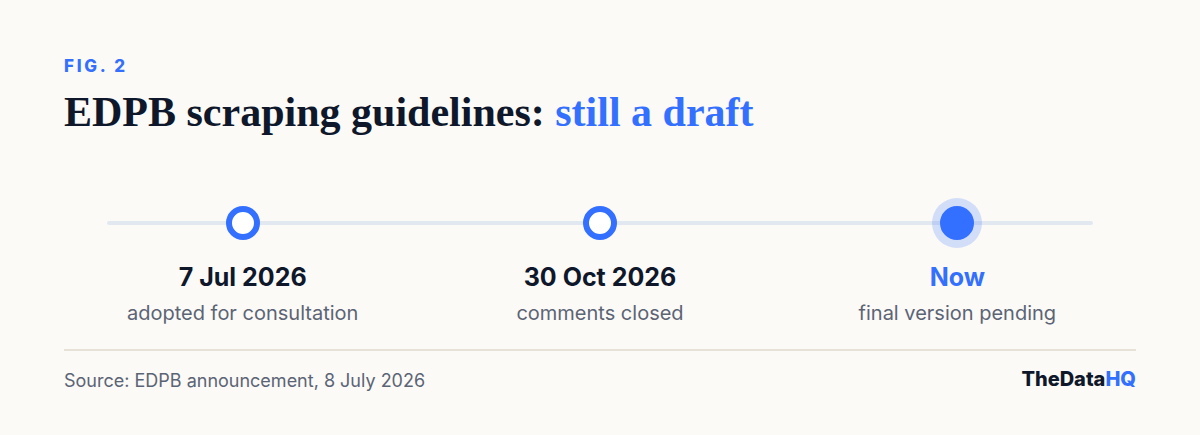
The European Data Protection Board (EDPB), the body of all EU data protection regulators, adopted draft Guidelines 03/2026 on web scraping on 7 July 2026. They were open for comment until 30 October 2026 and are not final yet (EDPB announcement).
According to law firm summaries, the main points are these (Slaughter and May, Reed Smith):
- GDPR applies to scraping whenever personal data is collected.
- Legitimate interest is the likely lawful basis; consent is effectively ruled out at scale.
- robots.txt (a file where a site says which automated visitors are welcome), CAPTCHAs and login walls count as signals of what people expect, and ignoring them weighs against the collector.
- Collectors should publish as complete a list of their sources as possible.
- The exemption from telling people individually must not be used as a matter of routine.
Do they apply if you aren't training AI?
Not directly. The draft is about scraping to train generative AI models, and Reed Smith reads it as leaving out data brokers that only hold datasets. But it is the most detailed statement of how EU regulators think about scraping. A regulator looking at your sales or pricing dataset will ask the same questions, so treat its points as the bar to clear.
Who is responsible: you or your data provider?
Usually both, each for its own part. Under GDPR, the controller decides why and how personal data is used. A processor handles it on the controller's written instructions.
When you commission the scraping
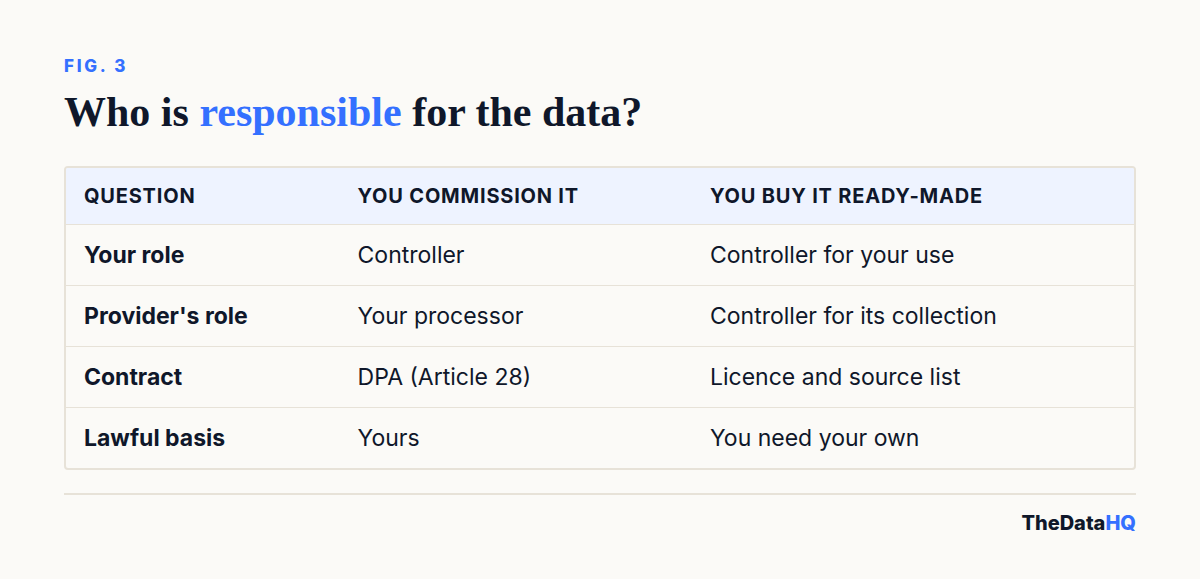
If you tell a provider which sources and fields to collect for your purpose, you're likely the controller and the provider your processor. Reed Smith notes that a scraper working under documented instructions is likely a processor. You then need a data processing agreement (DPA), the Article 28 contract that sets the rules.
When you buy a ready-made dataset
If the provider collected the data for its own purposes and sells copies, it's a controller for its collection and you become a controller for your use. Each party answers for its own processing. You can't rely on the seller's lawful basis; you need your own, and you need to tell people you hold their data.
What if the provider got it wrong?
Its mistake doesn't clean your copy. If the data was collected unlawfully, using it can be unlawful too. That's why the questions below matter more than any badge on a sales page.
Which web scraping services are GDPR-compliant?
There is no official GDPR certificate for scraping providers, so "GDPR-compliant" on a website is a claim, not a status. Judge a provider by what it can show you:
- a written policy on personal data, with what it refuses to collect;
- a source list for your dataset, with the date each source was checked;
- field-level filtering of personal data at collection;
- a DPA ready to sign when any personal data is in scope;
- clear answers on where data is stored and for how long.
The strongest answer is often "your file has no personal data in it, and here's how we make sure". For pricing, product and company data, that's achievable.
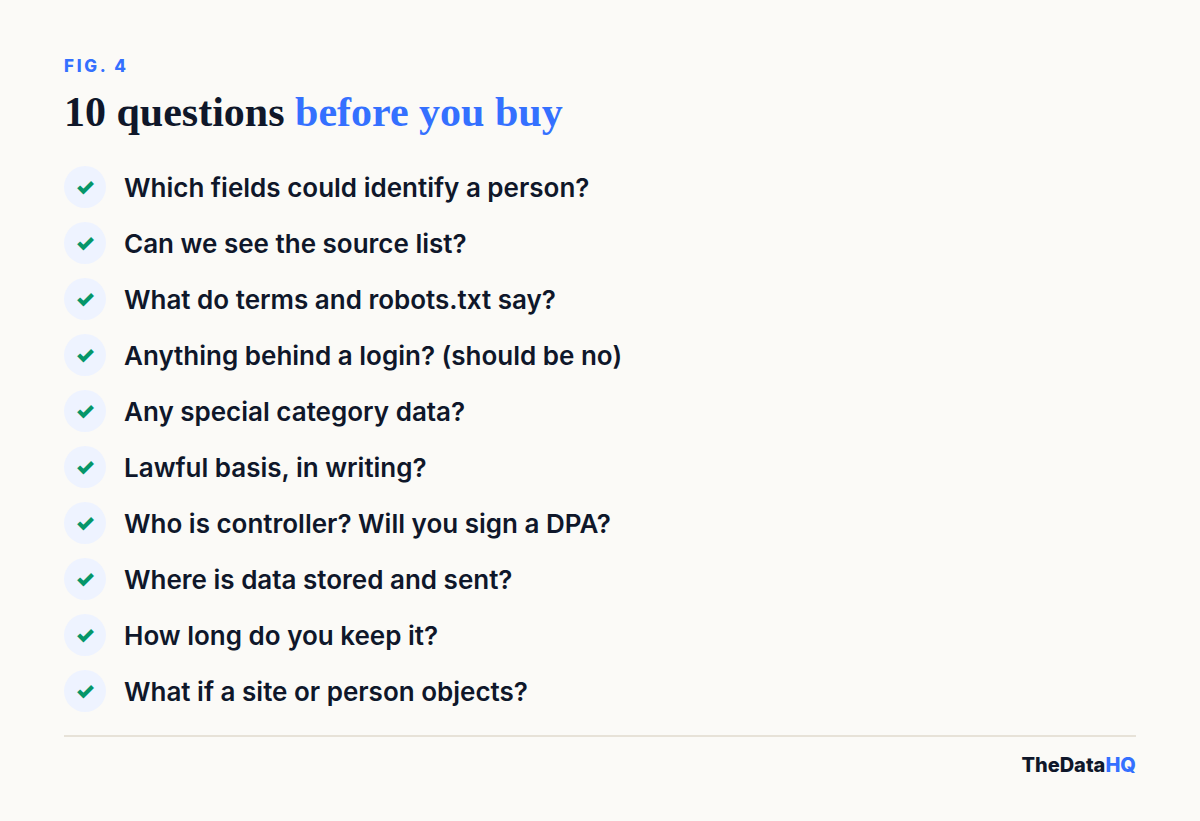
10 questions to ask a data provider before you buy
Send these before you sign. A provider that answers in writing, quickly, is usually one that has thought about it.
- Which fields could identify a person? Ask for the full field list and which ones they filter out.
- Can we have the source list? Every website, with the date it was reviewed.
- What do the terms and robots.txt of each source say? And what they do when a site says no.
- Is anything behind a login or paywall? The answer should be no.
- Is there any special category data? Health, religion, politics, sexuality and similar need an extra legal ground under Article 9.
- What's the lawful basis, and is it written down? For personal data, ask for their legitimate interest assessment.
- Who is the controller? And will they sign a DPA if they act as your processor?
- Where is the data stored and sent? Transfers outside the EU or UK need safeguards.
- How long do they keep it? Ask what's deleted when the project ends.
- What happens if a website owner or a person objects? They should stop, remove and tell you.
How do UK GDPR and US law (CCPA) differ?
The UK follows the same principles as the EU. US law is narrower and treats public data differently.
| Market | Main law | Public data | What buyers should do |
|---|---|---|---|
| EU | GDPR | Still personal data | Lawful basis, notice, minimisation |
| UK | UK GDPR and the Data (Use and Access) Act 2025 | Still personal data | Same as the EU; check the ICO's guidance |
| California | CCPA / CPRA | Publicly available information is excluded, narrowly | Check the data fits the exclusion |
Is web scraping legal in the UK?
Yes, within the same limits as the EU. UK GDPR has the same rules on personal data, lawful basis and notice. The Data (Use and Access) Act 2025 added "recognised legitimate interests", a fixed list of public-interest purposes such as crime prevention; buying a sales or pricing dataset isn't on it (ICO).
What about the US?
California's privacy law says personal information "does not include publicly available information" (California Attorney General). That exclusion is narrower than "it was on a website": it covers government records and information people made public themselves. Website terms and copyright still apply in every market.
How TheDataHQ handles GDPR
We keep personal data out of the file. In practice, we:
- collect public data only, never behind logins or paywalls;
- review each source's terms and robots.txt before we write a line of code;
- remove or re-scope any field that could identify a person;
- sign an NDA on request and deliver only to destinations you control;
- delete project data when the work ends.
For sales and lead generation, we supply company-level sales intelligence data: business names, categories, locations, websites, main phone lines, open jobs and ratings. That's the public data most prospect lists are built on, and it keeps your GDPR answer short.
The full rules, including what we refuse, are in our web scraping legal and compliance policy. If a site owner raises a justified concern, we stop collecting from it and tell you.
Planning outreach and wondering about the people behind those companies? Tell us on the call. We'll scope your list around public business data that answers the same need, and show you which fields would need your own lawful basis before anything is collected. Our guide to web scraping services for sales lead generation shows how teams build prospect lists from public company data.
One thing we can't do for you is choose your lawful basis. It depends on what you'll use the data for, so that decision stays with you.
Get a free sample before you commit
Tell us the sources and the fields you need; you get real rows within 48 hours, free, before you commit. You'll see exactly which fields are in the file, so your GDPR answer starts from the data, not a promise. Ask for your free sample, or see how our managed web scraping services work.
Frequently asked questions
Is scraping publicly available data legal under GDPR?
It can be, but being public doesn't make it exempt. If the data identifies a person, GDPR applies: the collector needs a lawful basis, usually legitimate interest, must collect only what it needs and must tell people. Data with no personal fields, such as prices or product details, falls outside GDPR, though site terms and database rights still apply.
Do I need consent to scrape personal data?
Usually not, because consent isn't practical at scale and the EDPB's draft guidelines effectively rule it out. Most scraping relies on legitimate interest instead. That needs a written assessment showing the purpose is real, the data is necessary and people's interests don't outweigh yours. You still have to tell people and honour objections.
Who is responsible if my provider scraped data unlawfully?
Both of you can be. The provider answers for its collection; you answer for your use. If you commissioned the scraping, you're likely the controller and carry most of the duty. If you bought a ready-made dataset, you're a controller for your own use and need your own lawful basis. Ask for the source list and a DPA before you buy.
Is B2B contact data personal data under GDPR?
Yes, when it names a person. A work email like jane.smith@company.com or a direct mobile number identifies someone, so GDPR applies even though it's business data. Generic addresses such as info@ or sales@ and a company's main phone line usually aren't personal data. Marketing emails to named people also fall under each EU country's e-privacy rules.
Does robots.txt matter for GDPR?
Yes, more than it used to. robots.txt isn't a law, but the EDPB's draft guidelines and the CNIL treat it, along with CAPTCHAs and login walls, as a signal of what people expect. Ignoring it weighs against the collector when a regulator balances interests. Ask your provider how it reads and records robots.txt for each source.
Which web scraping services are GDPR-compliant?
No official certificate exists, so any provider can claim it. Look for proof instead: a written personal-data policy, a source list for your dataset, filtering of personal fields at collection, a DPA when personal data is in scope, and clear storage and deletion rules. A provider that delivers no personal data at all gives you the simplest answer.
Is web scraping legal in Europe?
Yes, scraping itself isn't banned in the EU. GDPR governs the personal data in it, and other laws govern the rest: the EU database right protects substantial investment in databases, and site terms can bind the collector. Scraping only public, non-personal data, with each source's terms and robots.txt checked first, keeps the risk low. This isn't legal advice.

Co-founder of TheDataHQ, building and running web scrapers and data pipelines for businesses that need data off the public web.