Web Scraping Services for Sales Lead Generation: 2026 Checklist
What web scraping services for sales lead generation deliver, why freshness and the listing date matter most, what's legal in the US and UK, and 10 questions to ask a provider.
By Chirag Jakhariya, Co-founder & CEO · · 12 min read
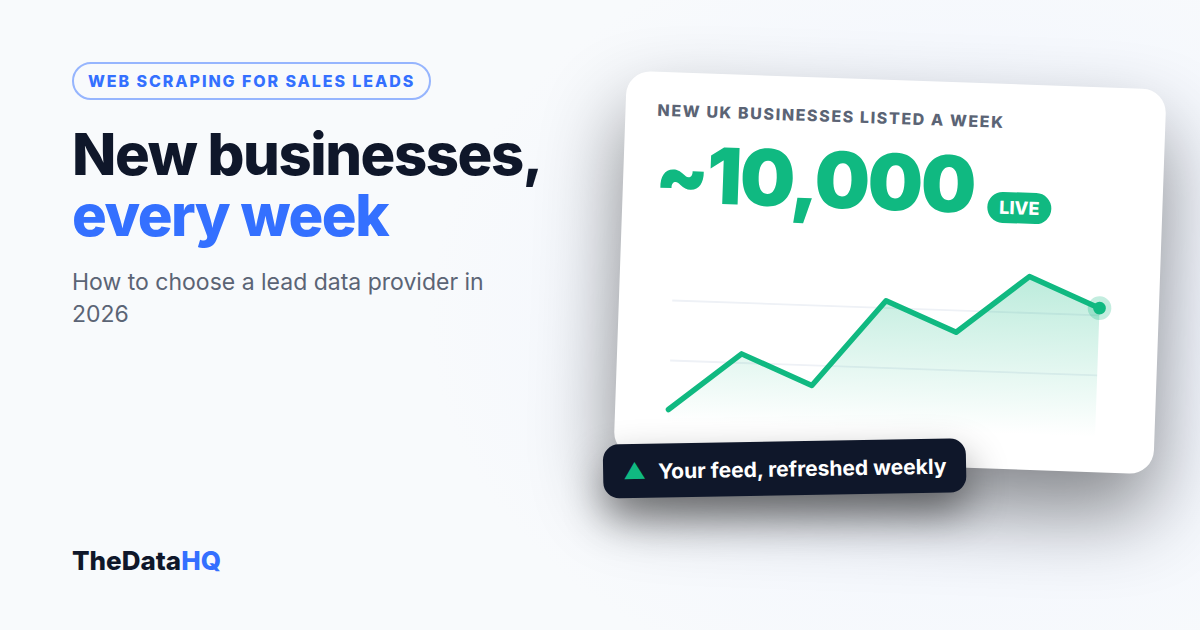
Web scraping services for sales lead generation collect public business details, such as names, categories, addresses, phone numbers and websites, from directories and company sites, then deliver a clean list your sales team can use. The provider worth paying is the one that keeps that list fresh. Ask first how often it updates, whether each record carries the date the business was listed, and what is legal to collect.
What does a web scraping service for sales leads deliver?
It delivers a file or a feed of businesses that match your target market, with the same columns every time. You name the sources, the area and the fields. The provider collects, cleans and sends them.
A typical lead record looks like this:
| Field | What your team uses it for | How to check it in a sample |
|---|---|---|
| Business name and category | Filtering to your market | Categories match what you asked for |
| Trading address, city, ZIP or postcode | Territories and local campaigns | Addresses are complete, not cut off |
| Main business phone and website | First contact and research | Open 10 websites; they should load |
| Listing date or first-seen date | Finding brand-new businesses | Every row has a date, not just some |
| Source URL and collection date | Proving where each record came from | Each row links back to a public page |
The last two rows are the ones most lead lists leave out. They're also the two that tell you whether the data is any good.
Here's an honest limit: directory data describes the business, not the buyer inside it. It rarely gives you a named decision-maker's direct email. If your outreach needs named people, plan a separate enrichment step or a contact database alongside the feed.
Who buys scraped lead data?
Mostly teams that sell to small and local businesses, where no ready database covers the market well. Common buyers we see:
- B2B SaaS sales teams selling booking, payroll or point-of-sale software to shops, salons and trades.
- Marketing and web agencies looking for businesses with no website or an outdated one.
- Payment, insurance and utilities providers that want new businesses before a competitor reaches them.
- Wholesalers and distributors mapping every stockist in a region.
- Recruiters and staffing firms tracking companies that are opening new sites.
What they share is timing. The first supplier to call a business in its first few weeks often wins the account.
Static database, one-off scrape or weekly feed: which do you need?
Pick a weekly feed if new businesses are your best leads. Pick a one-off scrape for a fixed campaign. Use a database when you need named contacts more than fresh ones.
| Option | What you get | Freshness | Best for |
|---|---|---|---|
| Static B2B database | Company and contact records the vendor already holds | As old as the vendor's last update | Named contacts at larger firms |
| One-off scrape | Your fields from your sources, collected once | Fresh on delivery, then ageing | A single campaign or a market sizing |
| Weekly feed | The same fields, plus only what's new or changed, every week | Never more than a week old | Steady outreach to new and local businesses |
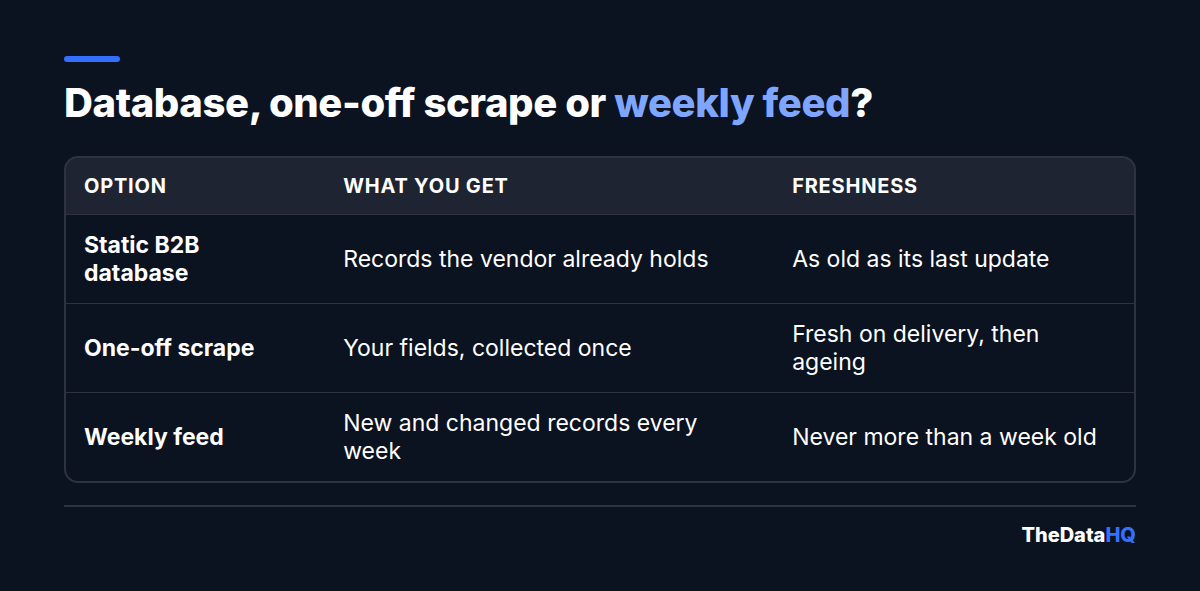
A feed costs more than a single scrape because someone has to keep it running. That upkeep is the point. Sites change their layouts, and a feed that quietly breaks is worse than no feed. We explain how that happens in why web scrapers break when site layouts change.
Why do freshness and the listing date matter most?
Because a lead list starts going wrong the day it's delivered. People change jobs, businesses move or close, and numbers get reassigned.
How fast does B2B lead data go stale?
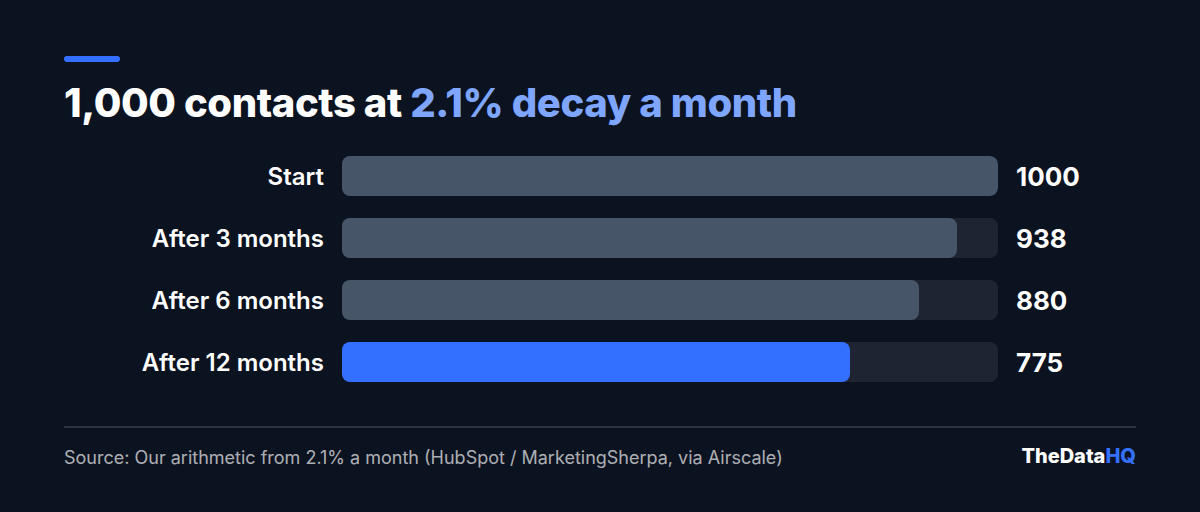
The most quoted figure is 2.1% a month, or 22.5% a year, from a HubSpot simulation based on MarketingSherpa research, as summarized by Airscale. An older benchmark puts it nearer 30% a year, tracing back to a 2017 HBR article and a 2018 Gartner report, according to Cleanlist's 2026 data quality study.
On the 2.1% figure, our arithmetic says that of 1,000 contacts, about 938 are still right after 3 months, 880 after 6 and 775 after 12. A list bought once a year loses about one record in four before you finish working it.
Why ask for the listing date?
The listing date turns a list into a signal. With it, you can filter to businesses that appeared this week and call them before anyone else does.
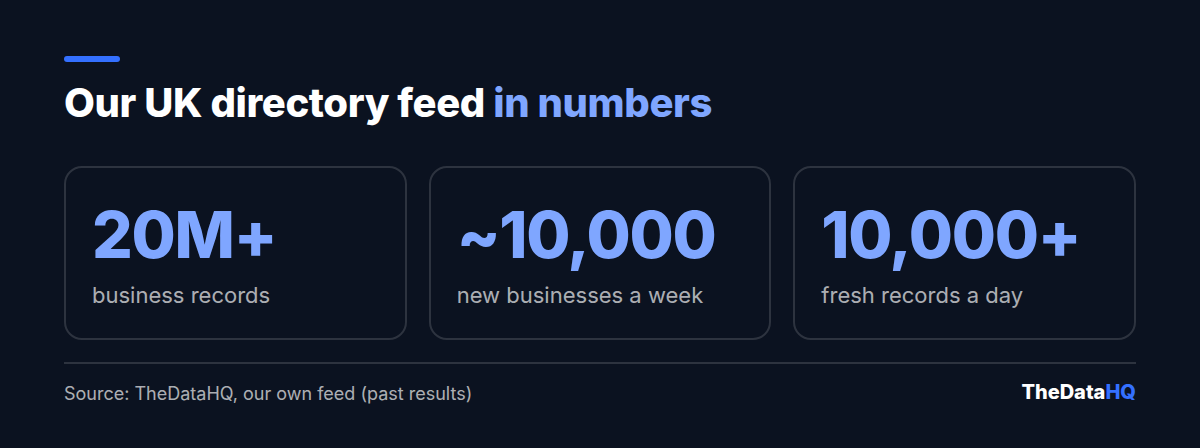
Here's what that looks like in our own work. Our UK directory feed has grown past 20 million business records. About 10,000 new businesses appear on those directories each week, and we currently collect 10,000+ fresh records a day. Those are our past results from one feed, not a promise for every market. They do show how much changes in a week. We describe the method in how to get business directory data.
10 questions to ask a lead scraping provider
Ask these before you sign. A good provider answers each one in writing, in a sentence or two.
Questions about freshness
- How often does the data update: once, monthly, weekly or daily?
- Does every record carry a listing date or first-seen date?
- Do you send only new and changed records, or the full list each time?
Questions about quality
- How do you remove duplicates when one business appears on several directories?
- What checks run on every delivery, and what happens when a check fails?
- Who fixes the feed when a source site changes, and is that included in the price?
Questions about compliance and delivery
- Which sources do you use, and do you respect their rate limits and robots.txt?
- Do you collect personal data, and what lawful basis do you rely on for it?
- Can you deliver in the format our CRM imports, such as CSV, Excel or a database?
- Can we see a free sample from our own sources before we pay?
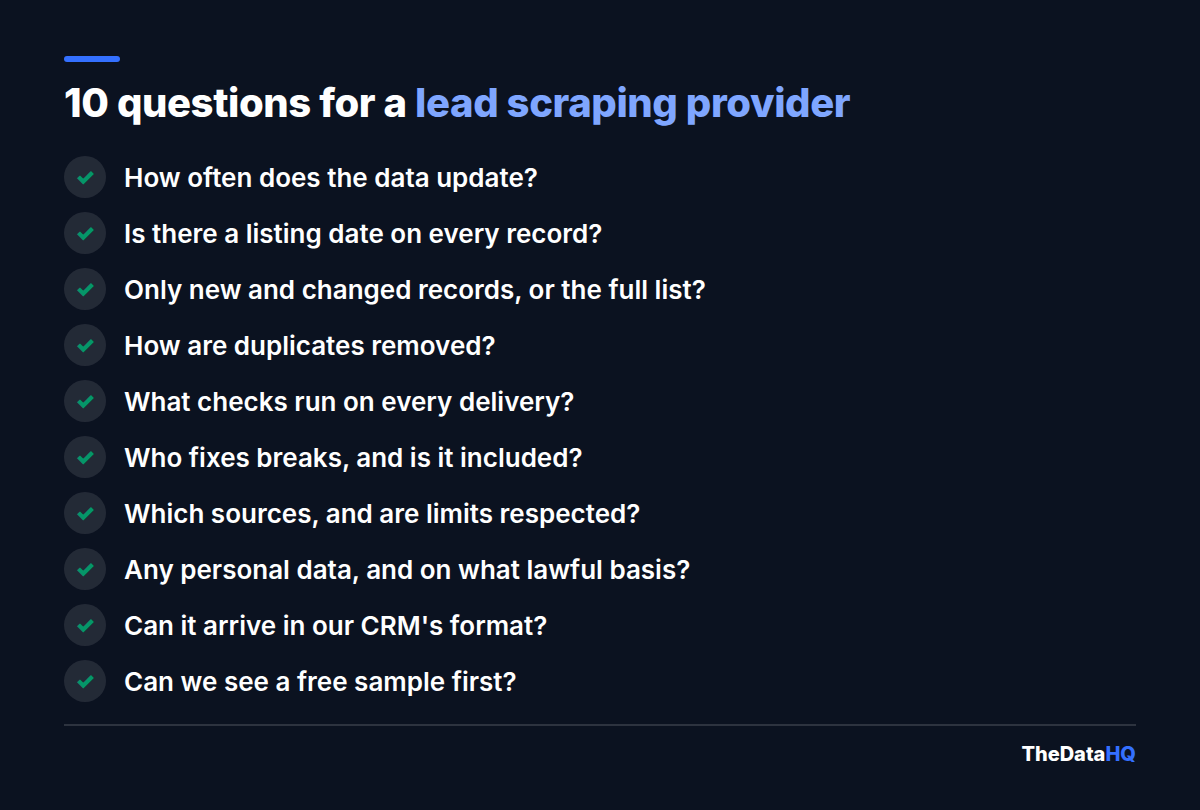
Vague answers to questions 2, 6 and 8 are the clearest warning signs. They decide whether the list stays usable and whether you can use it at all.
What's legal to collect for sales leads in the US and UK?
Public business information is generally fine to collect. How you contact people is where most of the law sits. This is not legal advice; check your own plan with a lawyer.
"It's public" is not the legal test on its own. Site terms, database rights in the UK and EU, and data protection law can all apply to public pages.
The US: CAN-SPAM, CCPA and the TCPA
- Email: the CAN-SPAM Act covers all commercial email, including business-to-business messages. You need an honest subject line, your postal address and a working opt-out, and penalties are counted per email.
- Privacy: California's exemption for business-to-business information expired on December 31, 2022, according to the California Attorney General. Business contacts can now count as personal information.
- Calls and texts: the TCPA restricts autodialed and prerecorded calls and texts to cell phones without consent. Personal mobile numbers are the riskiest field in any lead list.
- Collection: in hiQ v. LinkedIn, the court found that collecting public pages wasn't "unauthorized access" under the CFAA, the US anti-hacking law. hiQ still lost on breach of LinkedIn's user agreement.
The UK: UK GDPR, PECR and the TPS
- The ICO's B2B marketing guidance lets you email limited companies without consent, as long as you identify yourself and offer an opt-out.
- Sole traders and some partnerships count as individuals, so they need consent for marketing email.
- Screen numbers against both the TPS and the CTPS before live sales calls.
- Any personal data needs a lawful basis under UK GDPR, usually legitimate interests with a written assessment.
We collect public business data only, not data behind logins or paywalls. For more on choosing a UK provider, see our guide to web scraping services in the UK.
How much do web scraping services for sales lead generation cost?
It depends on six things more than on the number of leads. Providers that publish a flat price per 1,000 records are usually selling an existing database, not collecting fresh data for you.
- Number of sources: each directory has its own layout to set up.
- How often it runs: once, or refreshed weekly or daily.
- How the sites are built: plain pages, or pages built in the browser.
- Volume: thousands of records, or millions.
- Fields and cleaning: six fields, or sixty matched across sources.
- Upkeep: fixes for site changes over the life of the feed.
We don't publish prices. A one-off list is a fixed price per project; a weekly feed is a monthly retainer with fixes for site changes included. Both are quoted after a free sample, so you see the real output before you pay.
Should you build it in-house or outsource it?
Outsource it if you want the list, not the software. Build it only if you have a developer with time for upkeep every week.
The build itself is the easy part. The cost is in the weeks after, when sources change, duplicates creep in and nobody owns the fixes. We compare the two paths in run the scraper or buy the feed. If you do decide to build your own tools, our sister company BinaryBits does that kind of development work.
How do you test a provider before you sign?
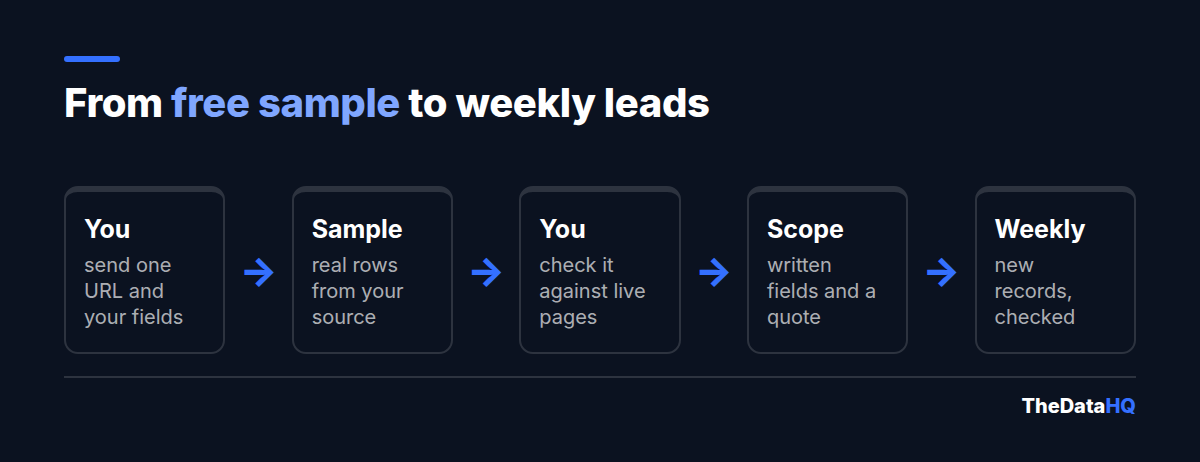
Ask for a sample from your own sources and fields, then check it against the real pages. Fifteen minutes with a sample tells you more than any sales call.
- Send one source URL and the fields you want.
- Open 20 records at random and check them against the live listing.
- Count how many rows have a listing date and a source URL.
- Look for the same business twice under slightly different names.
- Import the file into your CRM and check that every column maps.
For context, we've delivered 260+ projects over 12 years and scraped 10,000+ websites, with a 99.98% success rate. Those are past results. Your sample is still the better test.
Want to see what a weekly lead feed would look like for your market? Send us one URL and the fields you want; we'll send back a free sample of the real output, usually around 100 rows, and quickly. No charge, no commitment. Ask for your free sample, or read how our enterprise web scraping service runs feeds at scale.
Frequently asked questions
What does a web scraping sales lead generation provider do?
It collects public business details, such as names, categories, addresses, phone numbers and websites, from directories and company sites you choose. It then removes duplicates, checks the data and delivers it in your format, once or on a schedule. A good provider also adds the listing date and source URL to every record, so your team can find new businesses and trace where each lead came from.
How much does web scraping sales lead generation cost?
It depends on the number of sources, how often the data updates, how the sites are built, the volume, the fields and the upkeep. A one-off list is usually a fixed project price, while a weekly feed is a monthly retainer. We don't publish prices; we quote after a free sample, so you can judge the output before you spend anything.
Should I build web scraping sales lead generation in-house or outsource it?
Outsource it if your goal is a steady lead list and you don't have a developer with spare time every week. Building the first scraper is quick; keeping it working as directories change their layouts is the ongoing cost. Build in-house only when you need full control and have someone who will own the fixes, the duplicates and the quality checks.
Is it legal to scrape business data for sales leads?
Collecting public business information is generally lawful, but site terms, database rights and privacy law still apply, and outreach has its own rules. In the US, CAN-SPAM covers business email and the TCPA covers calls and texts to cell phones. In the UK, sole traders need consent for marketing email and calls must be screened against the TPS and CTPS. This is not legal advice.
How often should a B2B lead list be refreshed?
At least monthly for active outreach, and weekly if new businesses are your best leads. B2B data goes out of date by about 22.5% a year on the most quoted estimate, and older benchmarks put it nearer 30%. A weekly feed that sends only new and changed records keeps the list current without re-importing everything each time.
Can scraped leads go straight into HubSpot or Salesforce?
Yes, if the provider delivers in a format your CRM imports, usually CSV or Excel with fixed column names. Agree the column mapping once, including the listing date and source URL, so every weekly file imports the same way. Ask the provider to remove duplicates before delivery, because a CRM's own duplicate matching often misses businesses listed under slightly different names.