
Pricing Intelligence, Matched to Your Own Products
Pricing intelligence tells you what every competitor charges for the products you sell, and when that changes. We collect prices, promotions and stock from competitor stores and marketplaces, match each listing to your own SKUs, and send alerts, reports and clean feeds your pricing team can act on the same day.
What Pricing Intelligence Data Looks Like
This is part of a morning price report for a home and garden retailer. Each competitor listing is matched to the retailer's own SKU, so the gap to their own price is calculated for them, not left as a spreadsheet job.
| Your SKU | Your price | Competitor | Their price | Promo | Stock | Gap | Seen |
|---|---|---|---|---|---|---|---|
| HG-4410 | 64.99 | store-a.com | 59.00 | Weekend deal | In stock | −9.2% | 22 Nov, 05:40 |
| HG-4410 | 64.99 | market-1.com | 66.45 | None | 3 sellers | +2.2% | 22 Nov, 05:42 |
| HG-1187 | 189.00 | store-b.com | 149.00 | Clearance | Low stock | −21.2% | 22 Nov, 05:44 |
| HG-2093 | 22.50 | store-c.com | 22.50 | Buy 2 save 10% | In stock | 0.0% | 22 Nov, 05:45 |
| HG-3356 | 349.00 | store-a.com | 379.00 | None | Out of stock | +8.6% | 22 Nov, 05:47 |
What Questions Does Pricing Intelligence Answer?
A price list on its own is not intelligence. The value is in the answers your team gets from it every morning.
Are we priced right?
Your price against the cheapest, the average and the most expensive competitor for every matched product.
Who is discounting, and how deep?
Promotions, coupons, bundle offers and clearance flags, with the date each one started and ended.
Where can we raise prices?
Products where competitors are out of stock or priced well above you, so margin is not left on the table.
What changed overnight?
Alerts for any move past your threshold, sent to Slack or email within minutes of the change.
Which sellers undercut us?
Marketplace sellers and their offer prices, so you can see who drives the lowest price on a listing.
How do competitors behave over time?
Price history that shows each rival's pattern: weekly promotions, payday drops or slow creep upwards.
Pricing Data We Collect From Competitor Sites
Price and promotion
- Current selling price and list price
- Promotion text and discount percentage
- Coupons, multibuy and bundle offers
- Shipping cost and free-delivery threshold
- Price per unit where the site shows it
Availability and sellers
- In stock, low stock or out of stock
- Marketplace seller names and offer count
- Lowest offer and fulfilment type
- Delivery promise and dispatch time
- Regional or store-level availability
Product matching
- GTIN, EAN, UPC or model number
- Brand, title and variant (size, colour)
- Your SKU and match confidence
- Product URL and image
- Date first seen and last seen
What You Get From a Pricing Intelligence Service
Most clients take two or three of these. All of them come from the same matched dataset, so the numbers always agree.
- Price-change alerts in Slack or email, with thresholds you set per category
- A daily or weekly price position report by brand, category and competitor
- A raw price feed (CSV, JSON or API) for your own repricing tool or BI stack
- A dashboard with price index, gap to market and promotion calendar
- Full price history for every matched product, kept from day one
- New and delisted product reports, so your coverage keeps up with the market
What we do not do
- Collect prices shown only after a login or to account holders
- Set your prices for you or run automatic repricing on your store
- Share your matched catalogue or results with any other client
Pricing Intelligence Case Study: 60,000 SKUs a Day
An ecommerce client needed live price, stock and seller data across 50+ marketplaces. We built a pipeline that checks more than 60,000 SKUs every day, adds new products automatically as they appear and sends Slack and email alerts within 15 minutes of a competitor price change.
Read the case studyDoes Competitor Price Monitoring Actually Pay Off?
It does when the data is complete and arrives on time. One retail client used to check competitor prices by hand once a week. We replaced that with automated collection from more than 200 competitor sites, refreshed every day, with alerts when something moves. Their team stopped copying prices into spreadsheets and started reacting to changes the morning they happened. You can read the details in our competitor price tracking case study.
For a price comparison business, live prices are the product itself. We collected prices from more than 50 seller sites and kept them current, and the client nearly doubled their sales, an increase of about 100%. In Australia, we monitor more than 10,000 digital products a day for price, availability and seller changes, with alerts built in. The price comparison case study and the Australian monitoring case study show how each was set up.
Why Product Matching Decides the Quality of Price Intelligence
A competitor price is only useful when it is attached to the right product. Retailers name the same item differently, split variants in different ways and often hide the barcode. A 500 ml bottle compared with a 750 ml bottle, or a single item compared with a twin pack, makes your price gap look wrong and leads to bad decisions.
We match on GTIN, EAN, UPC or model number first, because those are exact. Where codes are missing we match on brand, title, size, colour and pack count, and give each match a confidence score. Low-confidence matches go to a human check before they enter your report. You can review, approve or correct any match, and the correction is kept for every future run.
We also compare like with like on price. Where one site includes delivery and another adds it at checkout, or one shows a per-unit price on a multipack, we record both the shelf price and the landed price so the gap you see is the gap a shopper sees.
How Our Pricing Intelligence Service Works
- 01
Agree scope (day 0)
Send your product list and the competitors that matter. We agree fields, refresh times, alert thresholds and the reports you want.
- 02
Matched sample (day 2)
You receive real competitor prices matched to a slice of your SKUs, so you can check the matching before we scale up.
- 03
Go live (about day 7)
Collection runs on our servers at the times you chose. Alerts, files and the dashboard switch on.
- 04
Keep it accurate (ongoing)
We fix scrapers when sites change, add new competitors on request and review match quality every month.
How Much Does Pricing Intelligence Cost?
No minimum project size. Small fixes and big builds are both welcome.
What is pricing intelligence?
Pricing intelligence is the collection and analysis of competitor prices, promotions and stock so you can set your own prices with evidence. We collect the data from public websites, match it to your products and deliver alerts, reports and feeds.
How often can competitor prices be checked?
From once a week to several times an hour, depending on how fast your market moves. Alerts can reach you within 15 minutes of a price change.
How do you match competitor products to my SKUs?
We match by barcode or model number first, then by brand, title, size and pack count, with a confidence score. Low-confidence matches are checked by a person, and your corrections are kept.
Is it legal to monitor competitor prices?
Collecting publicly displayed prices is generally lawful. We only collect public pages, never data behind a login, and we review each site's terms before we start.
How much does a price monitoring service cost?
It depends on the number of products, competitors and how often you need updates. Price monitoring can be billed at $15 an hour for engineering time, as a dedicated engineer from $2,400 a month, or as a fixed monthly price we quote before you start.
Can you track prices on marketplaces with many sellers?
Yes. We record each seller's offer, the lowest price, the offer count and fulfilment type, so you can see who sets the price on a listing.
Can I get the data into my own repricing tool?
Yes. Alongside reports and alerts, we deliver a raw feed as CSV, JSON, a database load or a private API that your repricing tool can read directly.
Pricing intelligence guides
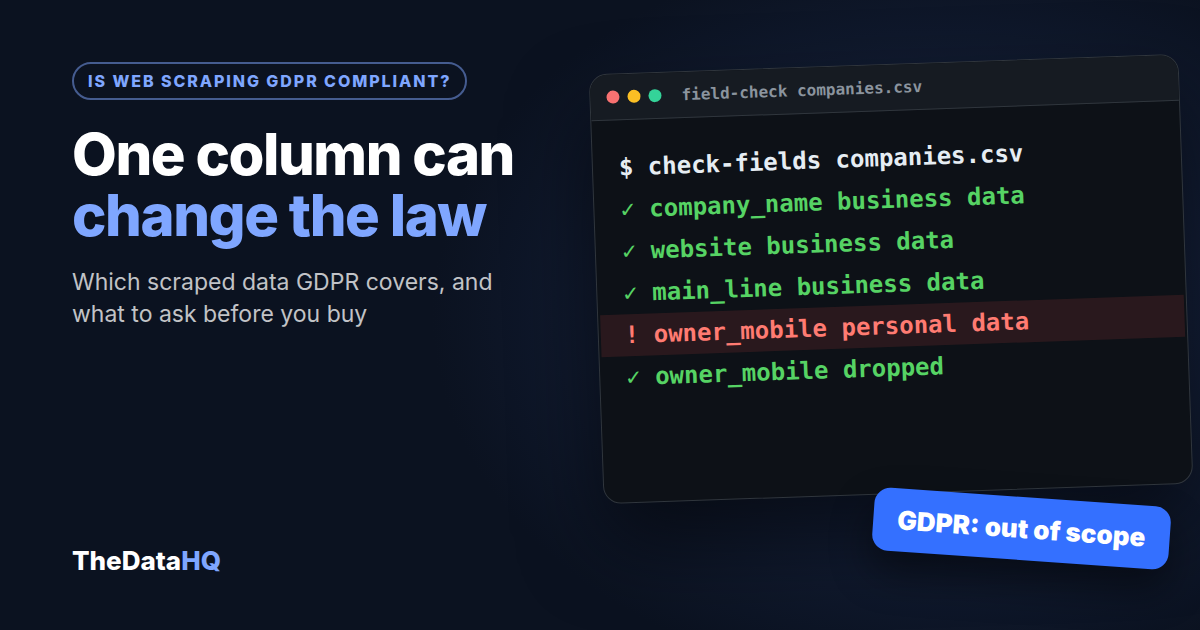
Is Web Scraping GDPR Compliant When You Buy the Data?
GDPR only applies when scraped data identifies a person. Which data is in scope, who is responsible when you buy it, what the EDPB draft…
Read the guide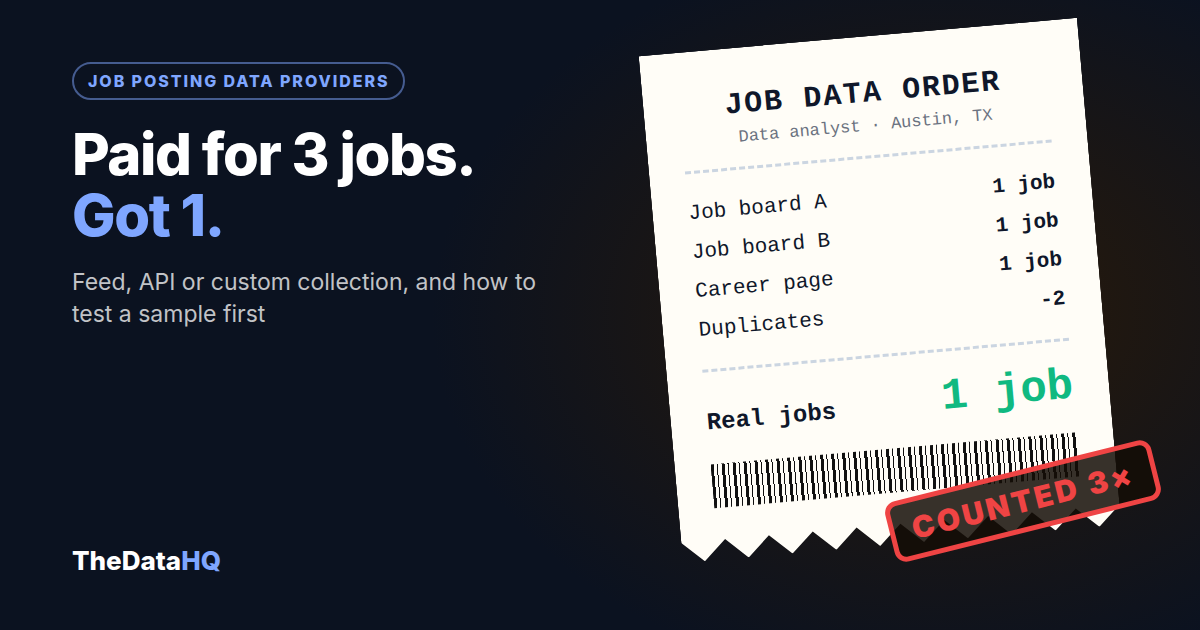
Job Posting Data Providers Compared: Feed, API or Scrape
Job posting data comes as a ready dataset, a pay-per-record API or a custom collection of named sites. Named providers with their…
Read the guide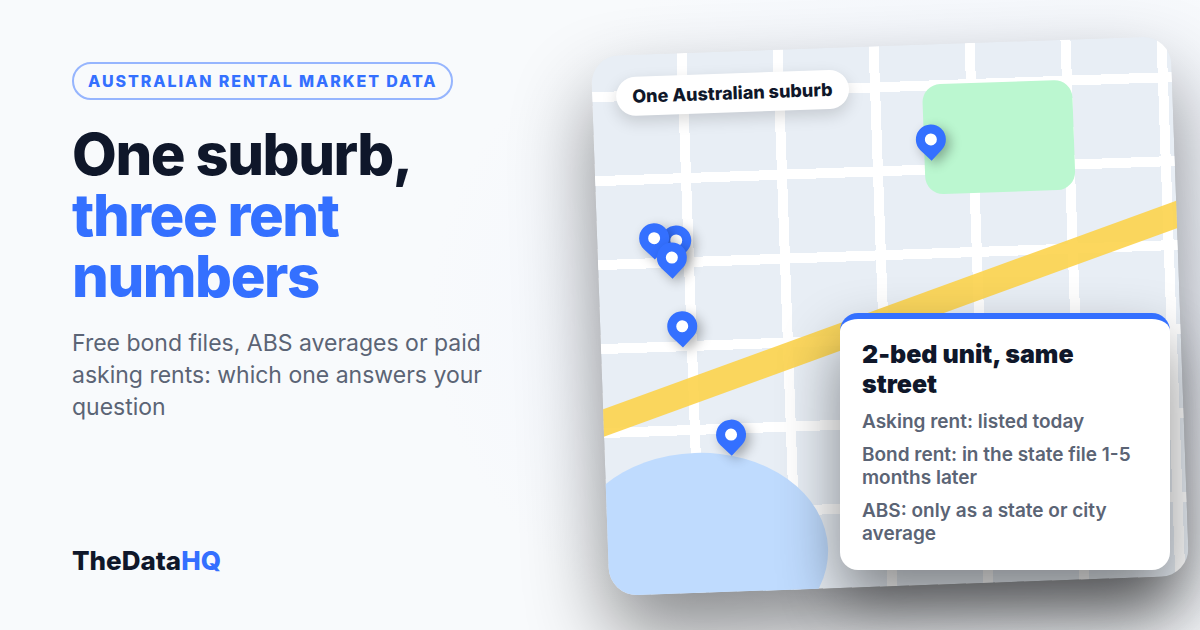
Rental Market Dataset Australia: Free vs Paid Sources
Australian rent data comes from free state bond files (suburb medians, months late), ABS averages, and paid asking-rent data from…
Read the guide