
Competitor Price Tracking Case Study: 200+ Sites Refreshed Every Day
This competitor price tracking case study follows a retailer that moved from slow weekly manual checks to automated monitoring of more than 200 competitor websites. Every site is refreshed daily, and price moves trigger an alert within 15 minutes.

The Challenge: Weekly Manual Price Checks Were Too Slow
The retailer competes in a crowded market where rivals change prices often. Its team checked competitor websites by hand once a week, copying prices into a spreadsheet and sharing it with buyers and category managers.
That routine had three problems. It was slow, so a rival's promotion could run for days before anyone noticed. It was partial, because people could only get through a small share of the competitor range. And it was error-prone, since a mistyped price or a missed sale badge led to the wrong decision.
The list of competitors also kept growing. New online stores and marketplace sellers entered the category, and the team wanted to watch more than 200 of them. Adding staff to check prices by hand would have cost more than the margin it protected.
What the Retailer Needed From Competitor Price Tracking
- Coverage of 200+ competitor websites, not a hand-picked few
- Fresh prices every day instead of once a week
- Alerts soon after a competitor changes a price
- Competitor products matched to the retailer's own range
- Reliable figures the pricing team could act on without double-checking
Our Solution: Automated Competitor Price Monitoring With Alerts
We built a Python and Scrapy scraper for each competitor website and scheduled every one to run daily. Each run records the product, current price, any was-price or promotion label and availability, and stores the result in MongoDB with the date and source.
Competitor products are matched to the retailer's own range, so each of their products has a list of rival offers beside it. When a tracked price moves, the change is compared against the retailer's rules, and an alert goes out within 15 minutes with the old price, new price and a link to the page.
We monitor the scrapers as a fleet. If a competitor redesigns its site, the affected scraper is flagged and an engineer updates it; if a site restricts access, that source is paused until the client decides, and the other sites keep running. New competitors are added from a template, so the list can keep growing without a new project each time.
| Our product | Competitor | Old price | New price | Change | Alerted |
|---|---|---|---|---|---|
| Trail running shoe M | store-a.com | $129.00 | $109.00 | -15.5% | 07:42 |
| Trail running shoe M | store-b.com | $124.99 | $124.99 | 0.0% | n/a |
| Rain jacket W | store-c.com | $89.00 | $94.00 | +5.6% | 09:15 |
| Hiking pack 30L | store-d.com | $75.00 | $59.99 | -20.0% | 11:03 |
| Hiking pack 30L | store-e.com | $72.50 | $69.00 | -4.8% | 11:20 |
The Result: Daily Competitor Prices Without Manual Checking
The weekly spreadsheet is gone. More than 200 competitor websites are refreshed every day, and the pricing team hears about important moves within 15 minutes instead of a week later.
The staff who used to copy prices now spend that time deciding how to respond. Buyers see which rivals undercut them, on which products and for how long, and they can match a promotion or hold their price with evidence in hand. Daily history also shows patterns, such as which competitors discount at the end of each month.
This approach fits any retailer or brand that watches rivals: a short list of key products across many competitors, or a full range across a few. We run the scrapers, keep them working when sites change, and deliver prices and alerts in the format your team already uses.
How do I track competitor prices automatically?
Use scrapers that visit each competitor site on a schedule and record prices. In this project we track 200+ competitor sites daily and send alerts when prices move.
How fast can I get alerted when a competitor changes its price?
In this project alerts arrive within 15 minutes of a price change on a tracked product.
How many competitor websites can you monitor?
We monitor more than 200 for this retailer. New competitors are added from a template, so the list can grow over time.
What happens when a competitor changes its website?
The affected scraper is flagged by our monitoring and an engineer updates it, while every other site keeps running as normal.
Is competitor price tracking legal?
We collect prices that competitors publish openly, with no login and no personal data, and review site terms before starting.
What does competitor price tracking cost?
A similar setup can run on an hourly arrangement from $15, a monthly retainer, or a fixed quote agreed before any work starts. You can start with a free sample.
More Web Scraping Case Studies
 HR tech50K+
Job listings delivered every day
50,000 fresh job listings a day from 15,000+ sources for HiCounselor
Read the case study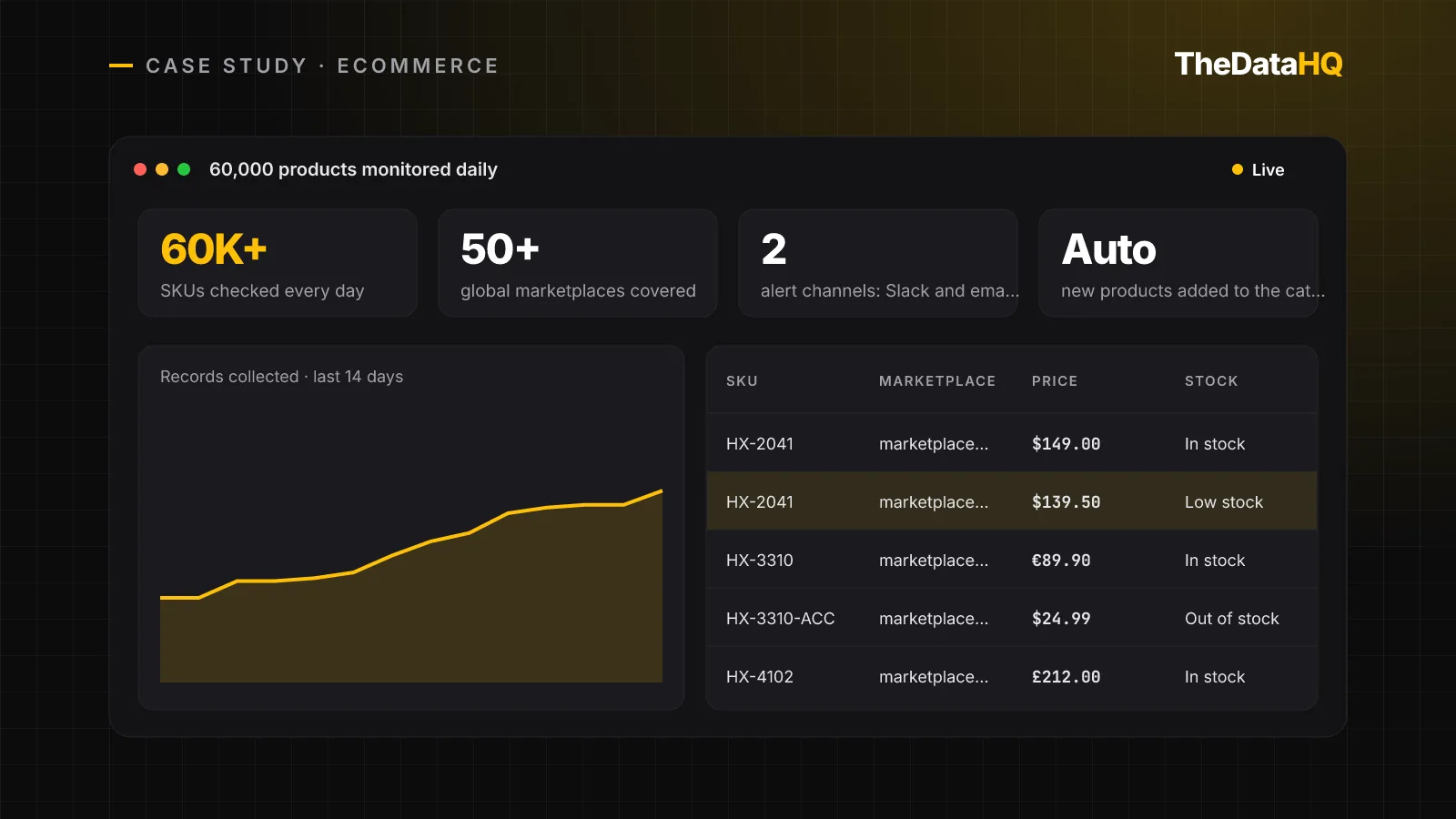 Ecommerce60K+
SKUs monitored every day
60,000+ SKUs tracked daily across 50+ marketplaces, with live alerts
Read the case study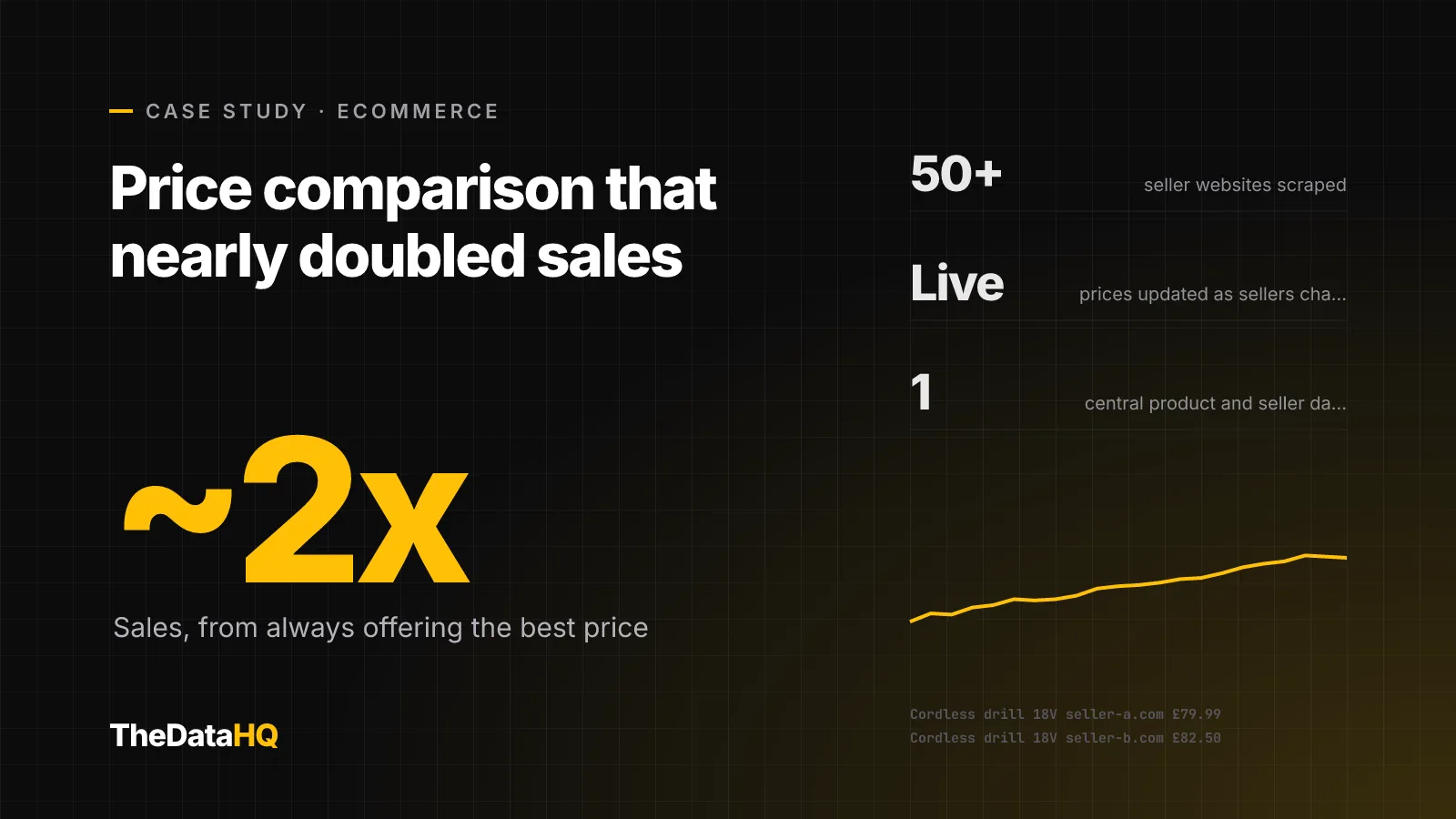 Ecommerce~2x
Sales, from always offering the best price
Live prices from 50+ seller sites helped an online seller nearly double sales
Read the case study