
Ecommerce Price Monitoring Case Study: 60,000+ SKUs Tracked Every Day
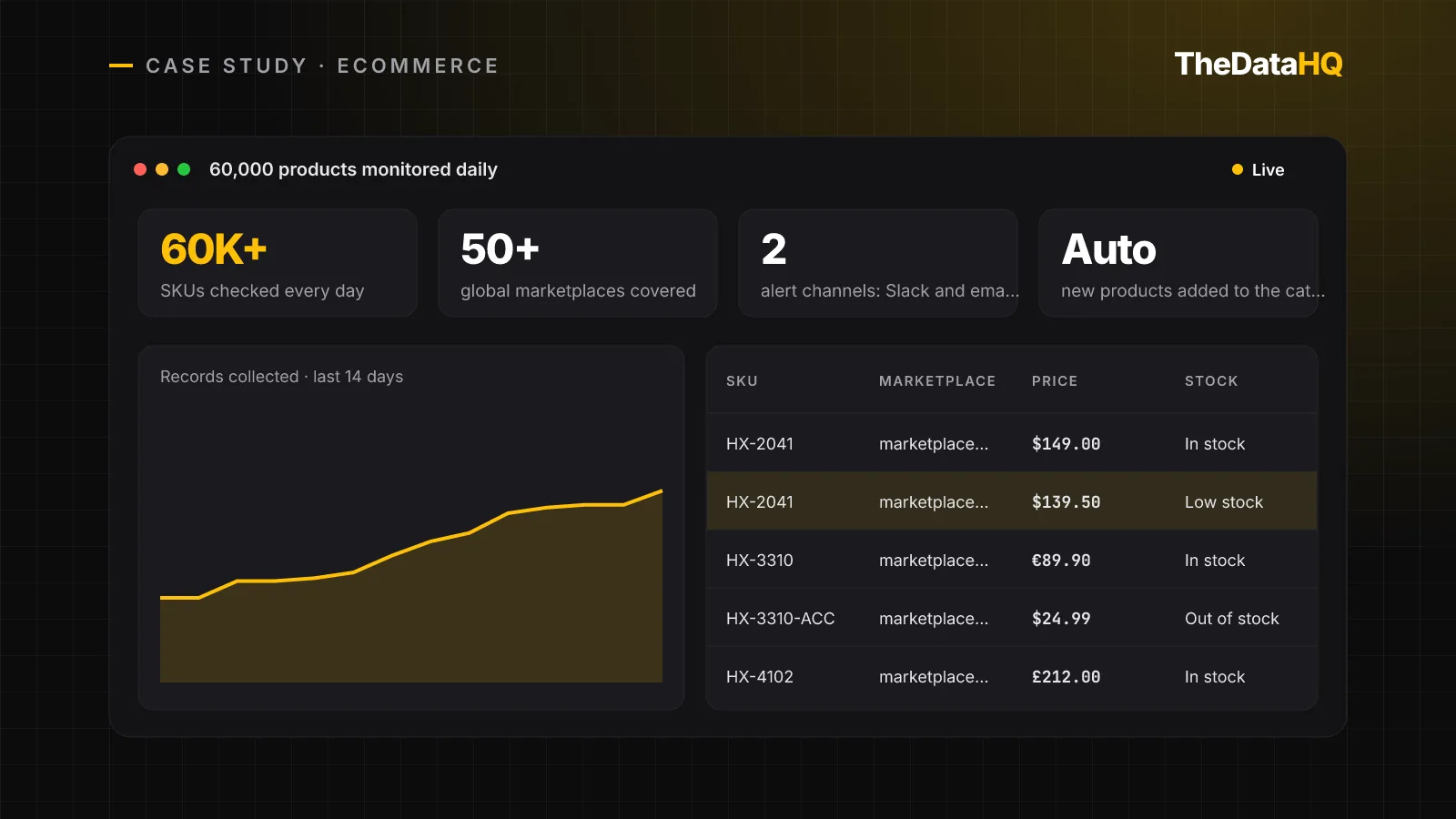
This ecommerce price monitoring case study covers a system that checks more than 60,000 SKUs every day across 50+ global marketplaces. It tracks price, stock status, sellers and accessories by product ID, and tells the team about changes the moment they matter.
The Challenge: Tracking Prices Across 50+ Marketplaces by Hand
The client sells a large catalogue on marketplaces in many regions. Each marketplace shows the same product with a different price, a different set of sellers and its own stock message, and those details can change several times in one day.
Their pricing team had no single view. Checking a handful of best sellers by hand was possible, but tens of thousands of SKUs across more than fifty marketplaces was not. By the time a price drop or a stock-out was spotted, the moment to react had usually passed.
Matching was the other problem. A product page on one marketplace rarely looks like the same product on another, and accessories and bundles are listed separately. To compare like with like, every record had to be tied to the right SKU or product ID, not just to a similar title.
What the Client Needed From Ecommerce Price Monitoring
- Daily checks of price, stock status and sellers for every SKU
- Products matched across marketplaces by SKU or product ID
- Accessory and add-on listings tracked alongside the main product
- Instant alerts in Slack and email when something important changes
- New products picked up and added to the catalogue without manual work
- Data clean enough to drive repricing and pricing compliance checks
Our Solution: A Marketplace Monitoring System Keyed to Every SKU
We built a scraper for each marketplace in Python and Scrapy, all writing to one MongoDB store keyed on SKU and product ID. Each run collects the listed price, stock status, seller profiles and any linked accessories, so the pricing team sees the full offer rather than a single number.
A rules layer in Node.js compares every new reading with the last one. When a price moves, a product goes out of stock or a new seller appears, the system posts an alert through the Slack API and sends an email, with a link to the listing. A React dashboard shows history for each SKU and each marketplace.
Catalogue upkeep is automatic. When the client launches a product or a new listing shows up for a tracked brand, the crawler finds it, matches it to the right SKU and starts monitoring it the next day. Engineers watch success rates per marketplace and fix a scraper as soon as a page layout changes.
| SKU | Marketplace | Price | Stock | Sellers | Change |
|---|---|---|---|---|---|
| HX-2041 | marketplace-a | $149.00 | In stock | 6 | -8.0% |
| HX-2041 | marketplace-b | $139.50 | Low stock | 3 | -12.4% |
| HX-3310 | marketplace-c | €89.90 | In stock | 4 | 0.0% |
| HX-3310-ACC | marketplace-a | $24.99 | Out of stock | 1 | n/a |
| HX-4102 | marketplace-d | £212.00 | In stock | 9 | +3.5% |
The Result: One Daily Price and Stock View for 60,000+ SKUs
The system now checks more than 60,000 SKUs every day across 50+ global marketplaces. The pricing team works from one view of price, stock and sellers instead of spot checks, and Slack and email alerts bring the important changes to them.
Because every record is tied to a SKU or product ID, the data feeds repricing decisions directly and makes it easy to see where a marketplace seller is breaking pricing rules. New products join the monitoring on their own, so coverage grows with the catalogue.
The same setup suits brands, retailers and marketplace sellers who need to watch their own products or a competitor's range. You choose the marketplaces and fields, we build and run the scrapers, and you receive clean data on a schedule or through alerts.
How many products can an ecommerce price monitoring tool track?
In this project we track more than 60,000 SKUs every day across 50+ marketplaces. Capacity grows with the number of sources, so larger catalogues are planned in stages.
Can you monitor stock levels and sellers as well as prices?
Yes. Each check records the price, stock status and the sellers offering the product, plus linked accessories where the marketplace lists them.
How do you match the same product across different marketplaces?
We match by SKU or product ID wherever the marketplace exposes one, and use the client's catalogue as the reference so every listing ties to the right product.
Can price change alerts go to Slack?
Yes. In this project alerts go to Slack and email. We set the rules with you, for example a price drop above a set percentage or a product going out of stock.
Is price monitoring data useful for MAP or pricing compliance?
Yes. Daily seller-level prices show which sellers list below your agreed price, and the history gives you a dated record for follow-up.
How much does ecommerce price monitoring cost?
It depends on the number of marketplaces and how often you need checks. Projects like this are usually priced as a monthly retainer for a dedicated engineer ($2,400 to $4,800), though smaller scopes can be quoted as a fixed price.
More Web Scraping Case Studies
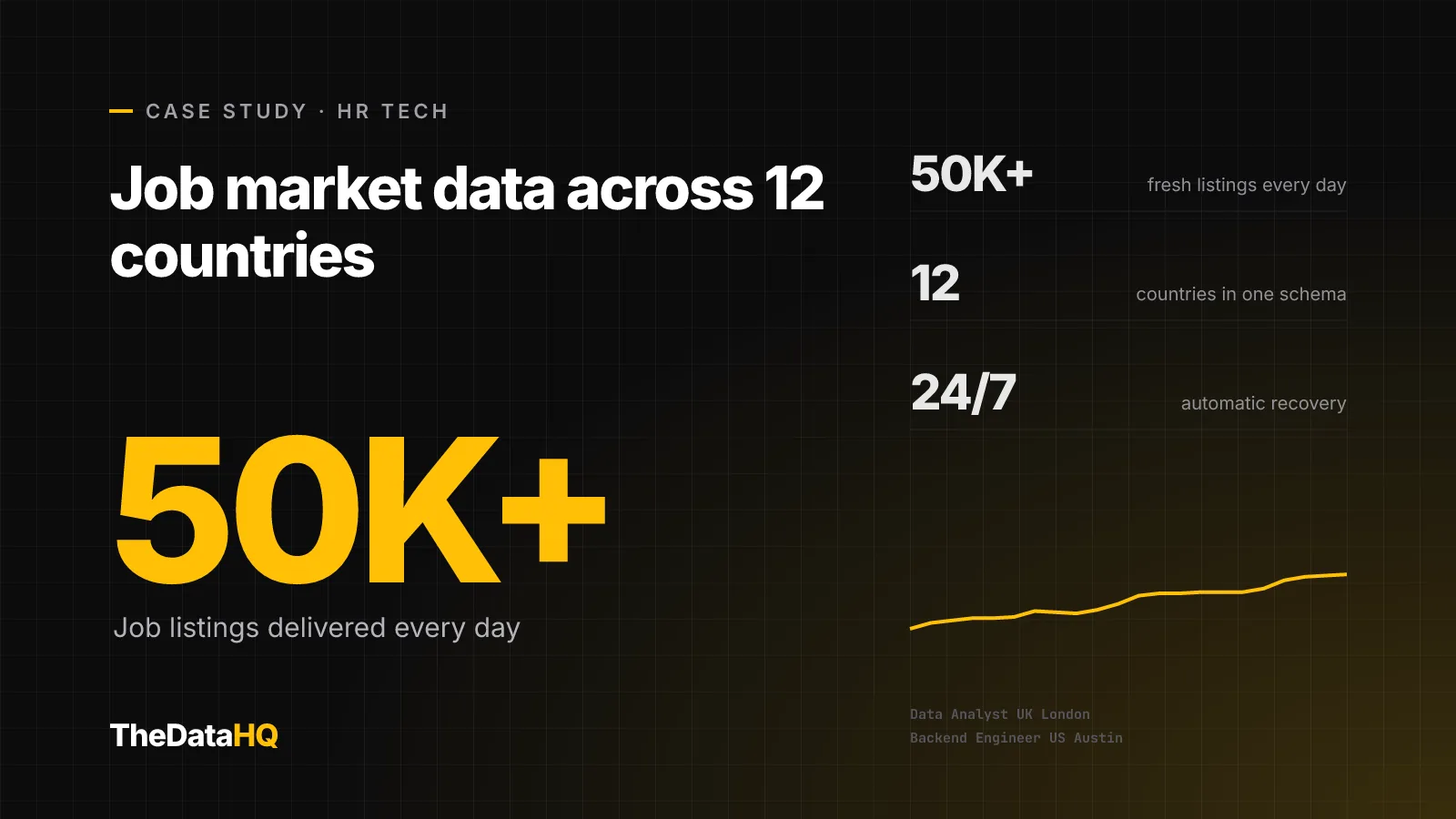 HR tech50K+
Job listings delivered every day
50,000 fresh job listings a day from 15,000+ sources for HiCounselor
Read the case study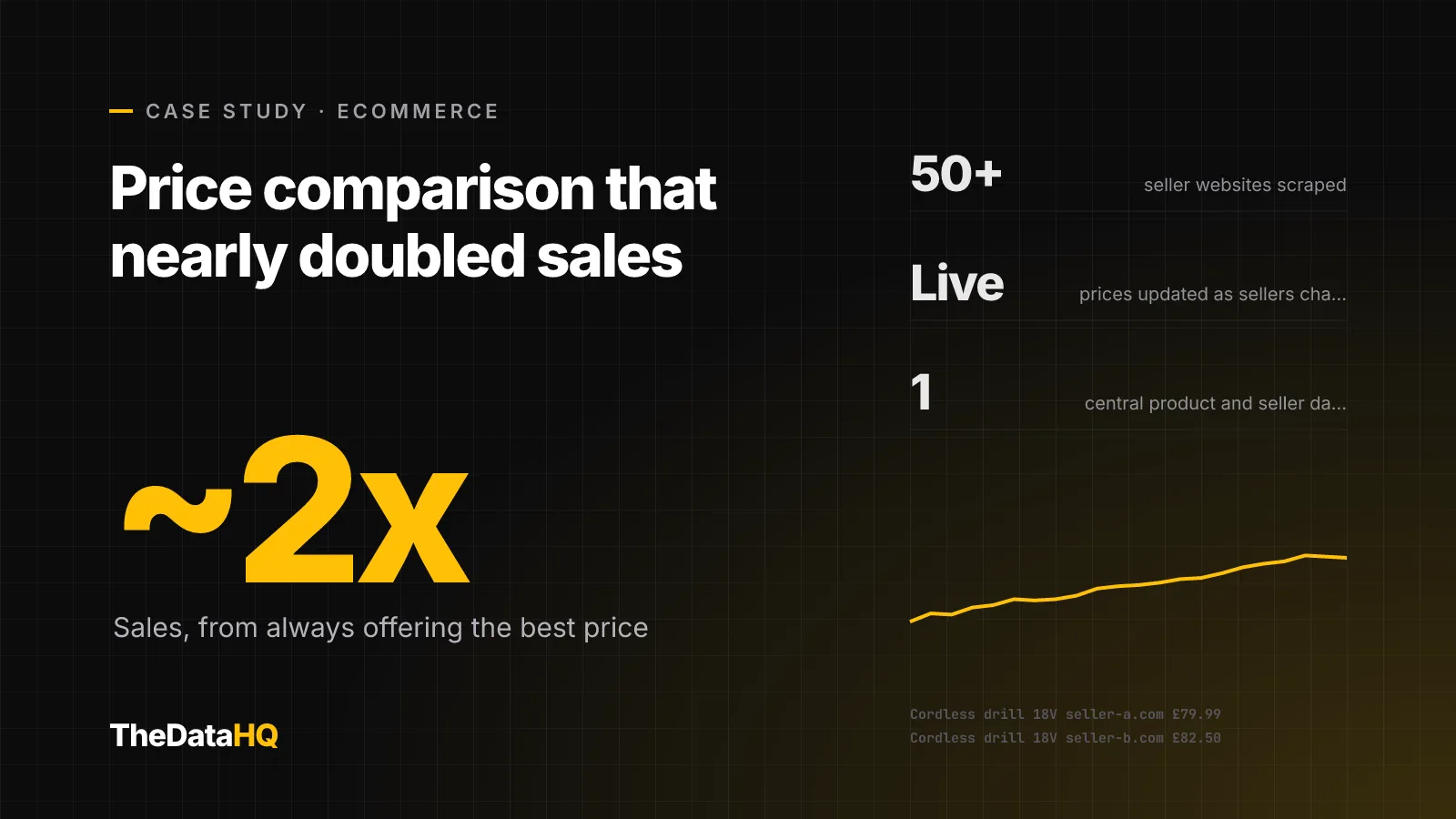 Ecommerce~2x
Sales, from always offering the best price
Live prices from 50+ seller sites helped an online seller nearly double sales
Read the case study Ecommerce retail200+
Competitor sites refreshed daily
From weekly manual checks to 200+ competitor sites refreshed every day
Read the case study