UK Job Vacancies Data: How to Get Job-Ad Level Data in 2026
The ONS gives you UK vacancy counts for free. If you need the adverts themselves, with title, employer, salary and dates, here are the three routes, what each costs and what to check.
By Vinay Jakhariya, Co-founder & Operation Manager · · 12 min read
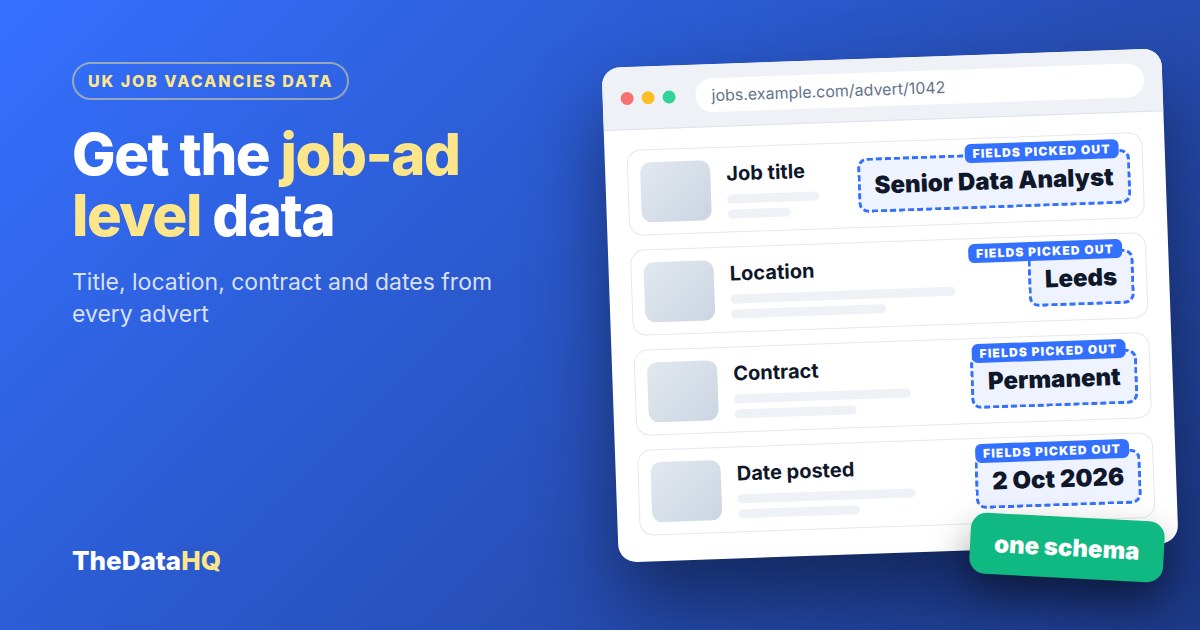
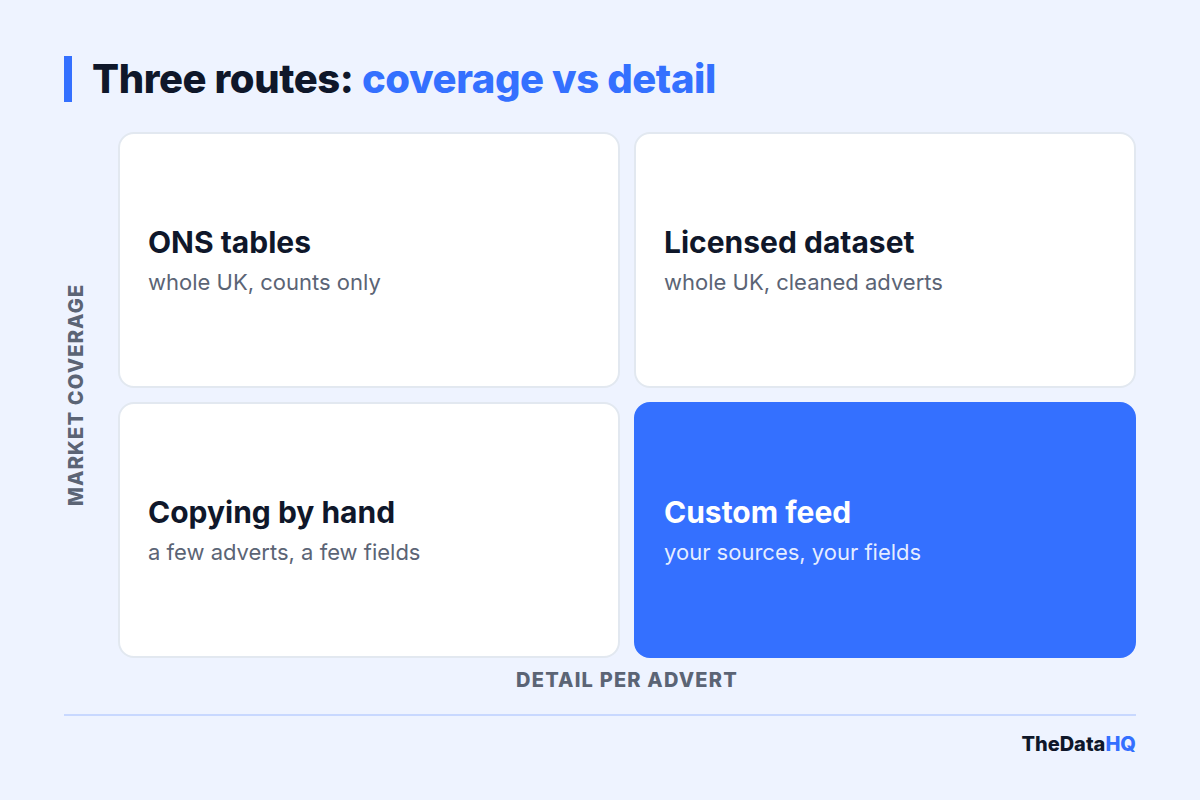
Free job vacancies data in the UK comes as counts: the ONS publishes how many vacancies and online adverts there are, by month, occupation and area. If you need the adverts themselves (job title, employer, salary text, location, posting date), you have two routes: license a labour-market dataset or commission a custom feed. This guide compares all three, with costs and a checklist.
What job vacancies data in the UK can you get for free?
Three free sources cover most needs for a headline number. Each one answers "how many", not "which jobs".
- The ONS Vacancy Survey. A survey of employers, published monthly as three-month averages. It put UK vacancies at 702,000 for June to August 2026, with a 76.4% response rate (ONS, September 2026). This is the accredited official measure.
- ONS labour demand from online adverts. Monthly counts of job adverts by occupation and local authority, built from Textkernel data. More on this one below.
- Adzuna's monthly UK Job Market Report. Advertised vacancies and average advertised salary from the Adzuna job search engine. In May 2026 it counted 799,737 adverts with an average advertised salary of £43,998 (Adzuna, May 2026).
If a monthly UK total or a regional trend is all you need, stop here. These are free, current and well documented.
What happened to the ONS online job advert estimates?
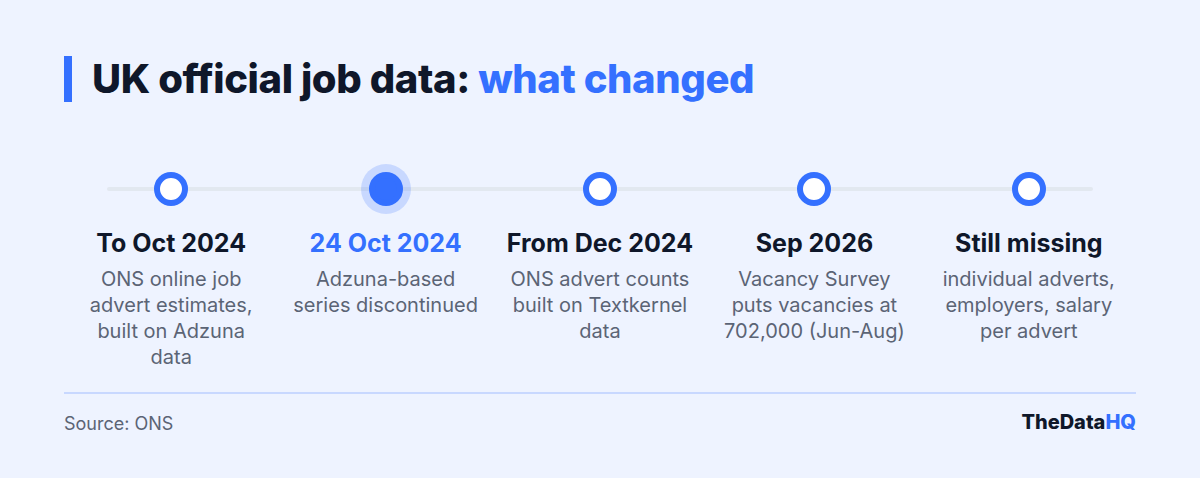
They stopped. The ONS series built on Adzuna data was "no longer being updated from 24 October 2024" (ONS dataset page). Its replacement, from December 2024, uses adverts collected by Textkernel.
Many older articles and dashboards still point to the Adzuna series. If your charts end in late 2024, that's why.
What do the ONS vacancy numbers miss?
The official tables are aggregated counts, so they leave out the detail most commercial uses need. The ONS user guide for its advert series is open about this (ONS Textkernel user guide):
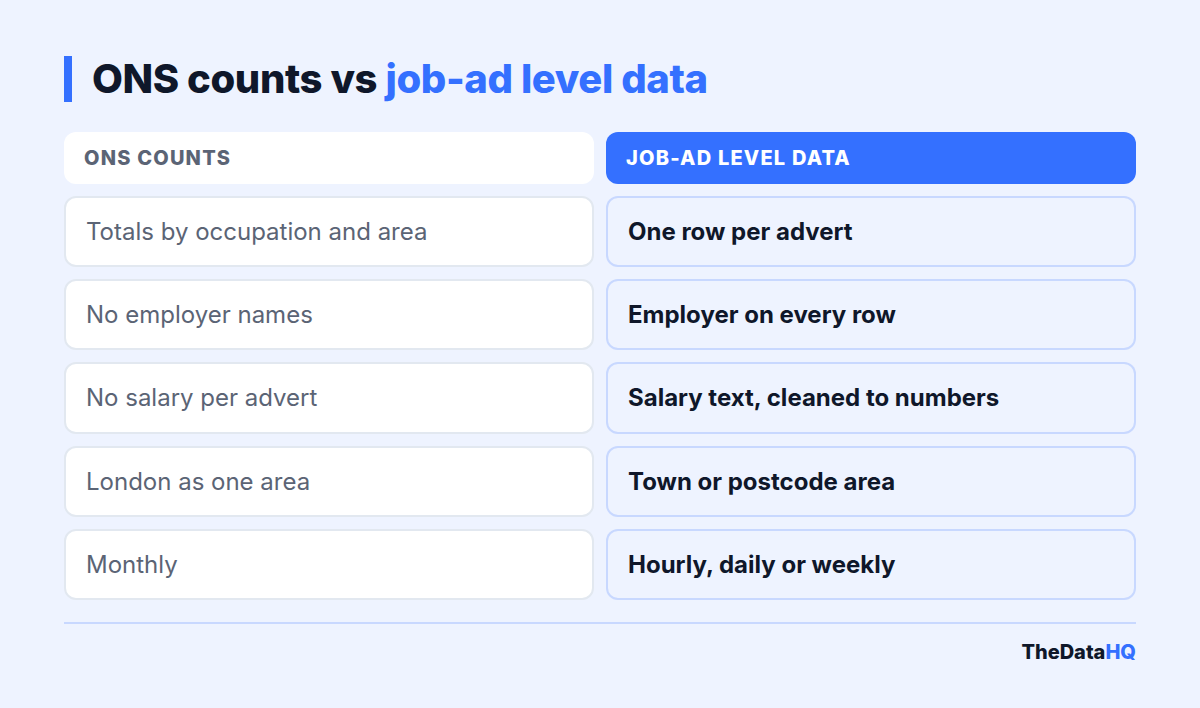
- No individual adverts. You get totals by occupation and area, not rows you can filter by employer or title.
- No salary or skills fields in the published labour demand tables.
- London as one area. It isn't split by borough.
- Occupation matching is rough. Job titles are matched to SOC codes (the UK's standard list of occupations) with about 65% precision at the most detailed level.
- Adverts aren't vacancies. In August 2024 there were 1.43 million live adverts against 860,000 survey vacancies, 66% more, because some adverts are speculative or repeat across sites.
None of this makes the ONS data wrong. It's built to measure the economy, not to tell you which firms in Leeds are hiring data engineers this week.
What does job-ad level data contain?
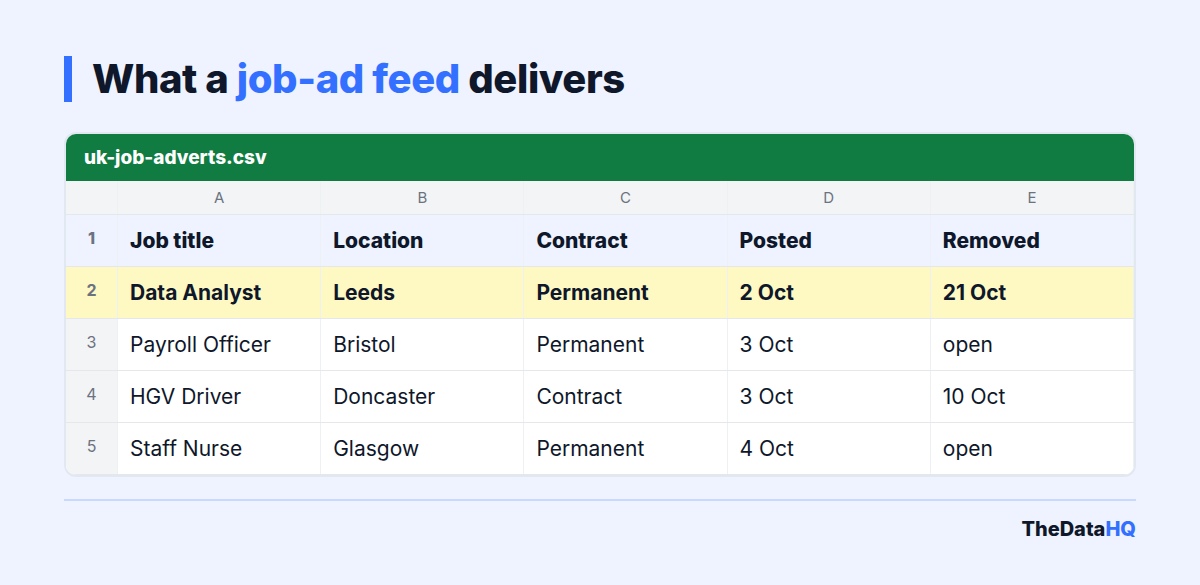
Job-ad level data is one row per advert, with the same fields every time. A typical UK feed looks like this:
| Field | Example | What it's used for |
|---|---|---|
| Job title | Senior Data Analyst | Demand by role, title trends |
| Employer | As shown on the advert | Who is hiring, sales leads |
| Location | Leeds, LS1 | Regional demand, down to town or postcode area |
| Salary text | £45,000 - £52,000 a year | Pay benchmarks, after cleaning into a min and max |
| Contract and hours | Permanent, hybrid | Remote and hybrid share |
| Skills in the description | SQL, Power BI | Skills demand over time |
| Date posted and date removed | 2 Oct 2026 - 21 Oct 2026 | How long roles stay open |
| Source URL | The advert's page | Checking a row by hand |
The date-removed field matters more than people expect. It's the only way to estimate how fast roles fill, and it needs the same advert checked again on later runs.
Who buys UK job postings data?
- HR tech and job-matching products that need fresh adverts to show or analyse.
- Recruitment firms tracking which employers are hiring in their niche.
- Analysts and investors watching hiring as an early signal of a company's plans.
- Councils, colleges and skills bodies planning courses around local demand.
- B2B sales teams who treat a new advert as a reason to get in touch.
Which route should you choose?
Pick the route by the question you're answering. Counts answer "how much", licensed data answers "what, across the market", and a custom feed answers "exactly what we care about, on our schedule".
| Route | What you get | Best for | Limits |
|---|---|---|---|
| Official tables (ONS, Adzuna report) | Monthly counts by occupation and area | Trends, reports, context | No adverts, no employer, no salary per advert |
| Licensed labour-market dataset | Cleaned adverts with standard job and skill codes, through an analytics tool | Broad market research across all sectors | Annual contract; fixed fields and sources; you can't add a site |
| Custom job-ad feed | The sites and fields you choose, delivered to your system | A niche, a product, or fields others don't carry | Takes setup; coverage is the sites you choose, not the whole market |
When is a licensed dataset the better buy?
When you need the whole UK market, every sector, with job and skill codes already applied. Providers such as Lightcast and Textkernel sell this. You won't match their breadth with a custom feed at a sensible cost, and we'd tell you so.
When is a custom feed the better buy?
- You care about a sector or set of employers, not the whole economy.
- You need a field the licensed data doesn't carry, such as the full description or a niche board's tags.
- You want the data in your own database or product daily, not inside someone else's tool.
- You need sources outside the UK too, in one format.
What does UK job postings data cost?
Official counts are free. Licensed data runs to tens of thousands of pounds a year: the Greater London Authority approved up to £62,830 for two years of Lightcast job-postings data, from July 2024 to June 2026 (GLA decision DD2701). That's one public buyer's price, not a price list.
We don't publish prices for a custom feed. It's a monthly retainer, quoted after a free sample, and these things move the price:
- The number of sites, since each has its own layout.
- How often it runs: weekly, daily or hourly.
- How the sites are built: plain pages, or pages that load their content in the browser.
- Volume: thousands or millions of adverts a month.
- The fields and the cleaning, such as turning salary text into numbers.
Maintenance is included in a retainer: when a site changes its layout, we fix the collector at no extra charge. Our pricing page explains how a data feed is quoted.
How is a recurring job-ad feed built?
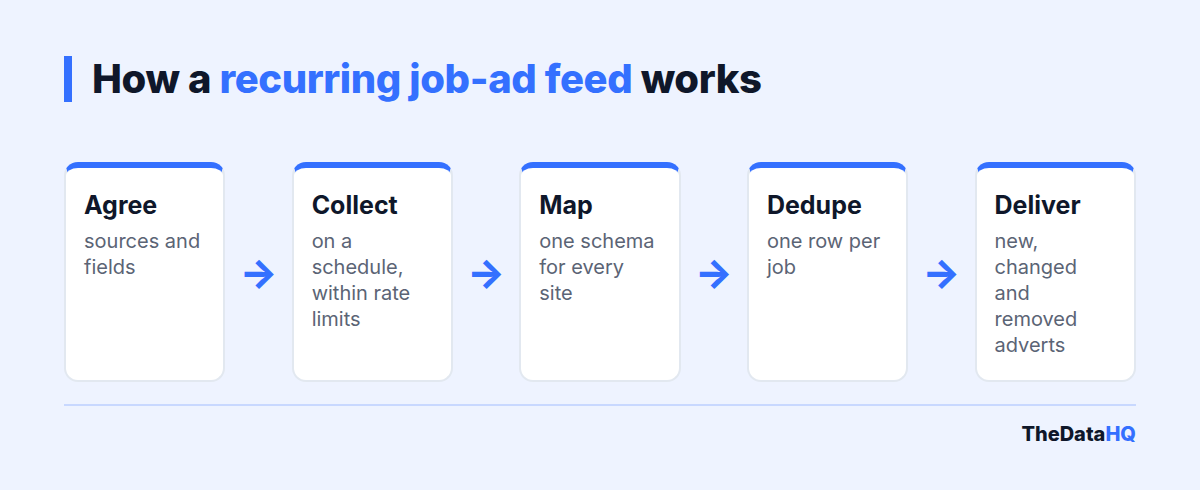
A job-ad feed collects adverts on a schedule, cleans them into one format and removes duplicates before delivery. The steps are:
- Agree the sources and fields. Which boards and career pages, and which of the fields in the table above.
- Collect on a schedule. Within each site's rate limits and robots.txt (the file where a site says what automated visitors may read), backing off when a site asks.
- Map to one format. That format is a schema: a fixed list of fields with the same names and formats, so a salary from one site lines up with a salary from another.
- Remove duplicates. The same job often appears on several boards. We match on employer, title, location and dates, and keep one row.
- Track changes. Each run marks new, changed and removed adverts.
- Deliver. CSV, Excel, JSON or straight into your database, hourly, daily or weekly.
Duplicates are the step that decides quality. The ONS notes that its own supplier's matching produces both false positives and false negatives, so ask any provider how they handle it.
What should you check before you buy job data?
Ask these before you sign with anyone, us included:
- Can I see a free sample on my own sources and fields first?
- How are duplicates across boards matched, and can I see the rule?
- Is salary delivered as the original text, cleaned numbers, or both?
- How is "date removed" worked out, and how often is each advert re-checked?
- Who fixes it when a site changes, and is that in the price?
- Which sources are included, and do their terms allow this use?
- Are personal details, such as a recruiter's name or email, removed or kept, and on what lawful basis?
Is UK job advert data personal data?
Mostly not, but some adverts name a recruiter or hiring manager with a phone number or email. That part is personal data under UK GDPR and the Data Protection Act 2018, and you need a lawful basis to keep it. The simplest fix is to leave those fields out unless you need them.
"It's public" isn't the legal test. Database rights and a site's terms also apply to how adverts are collected and reused. This is not legal advice; check your use with a solicitor if it's commercial.
A real example: job market data at national scale
One client needed to see hiring demand as it moved, across several countries. A single job board couldn't give that view, so we built collection that runs all the time and put every listing into one schema, the same fields in the same format.
As a past result, that project processes 50,000+ jobs a day from 15,000+ sources across 12 countries (our case studies). The honest limit: a feed like this covers the sources you choose. It doesn't replace the ONS for a national total, and it isn't meant to.
If you're weighing up running your own collector instead, our post on self-hosted scraping vs a data feed sets out the trade-off. For a one-off pull into a spreadsheet, see how to extract website data to Excel. Our data extraction services page covers the formats we deliver.
Get a free sample of UK job-ad data
Send us one URL and the fields you want; we'll send back a free sample of the real output. No charge, no commitment. Ask for your free sample. We already work with UK clients. We're based in India, so a UK morning is our afternoon.
Frequently asked questions
What is job vacancies data?
Job vacancies data is information about open jobs. In the UK it comes in two forms: official counts, such as the ONS Vacancy Survey estimate of 702,000 vacancies for June to August 2026, and advert-level data, with one row per job advert showing title, employer, location, salary text and dates. Counts show the size of the market; advert-level data shows who is hiring for what.
How many job vacancies are there in the UK?
The ONS estimated 702,000 vacancies in the UK for June to August 2026, down 8,000 on the previous three months. That figure comes from a survey of employers. Advert counts run higher: Adzuna counted 799,737 advertised vacancies in May 2026, because one job can be advertised on several sites. Check the ONS monthly release for the latest figure.
Why did ONS stop the online job advert estimates?
The ONS stopped updating its Adzuna-based online job advert estimates on 24 October 2024 and moved to adverts collected by Textkernel from December 2024. The newer tables count adverts by occupation and local authority each month. They still publish counts only, so you can't see individual adverts, employers or salaries in them.
Is job advert data the same as vacancies?
No. A vacancy is a job an employer is trying to fill; an advert is a posting about it. One vacancy can appear on several boards, and some adverts are speculative. In August 2024 the ONS counted 1.43 million live adverts against 860,000 survey vacancies. Good job-ad data removes duplicates, but it still measures adverts.
Is it legal to collect UK job adverts?
It depends on the source, the use and the data. Public adverts are usually lower risk, but a site's terms and database rights still apply, and any recruiter names or emails are personal data under UK GDPR. Collect within each site's limits, keep only the fields you need, and take legal advice for commercial use. This is not legal advice.
How long does it take to set up a job data feed?
It depends on how many sites you need and how they're built. A handful of job boards with standard fields is a small project; hundreds of employer career pages with cleaned salaries takes longer. We start with a free sample on your own sources, so you see the real output and a scope before agreeing a timeline or a price.