Web Scraping Services USA in 2026: Pricing, Law and How to Choose
A buyer's guide for US companies: the four ways to buy web scraping, how providers price it, what US law says after Van Buren, hiQ and Meta v. Bright Data, and the questions to ask.
By Chirag Jakhariya, Co-founder & CEO · · 12 min read
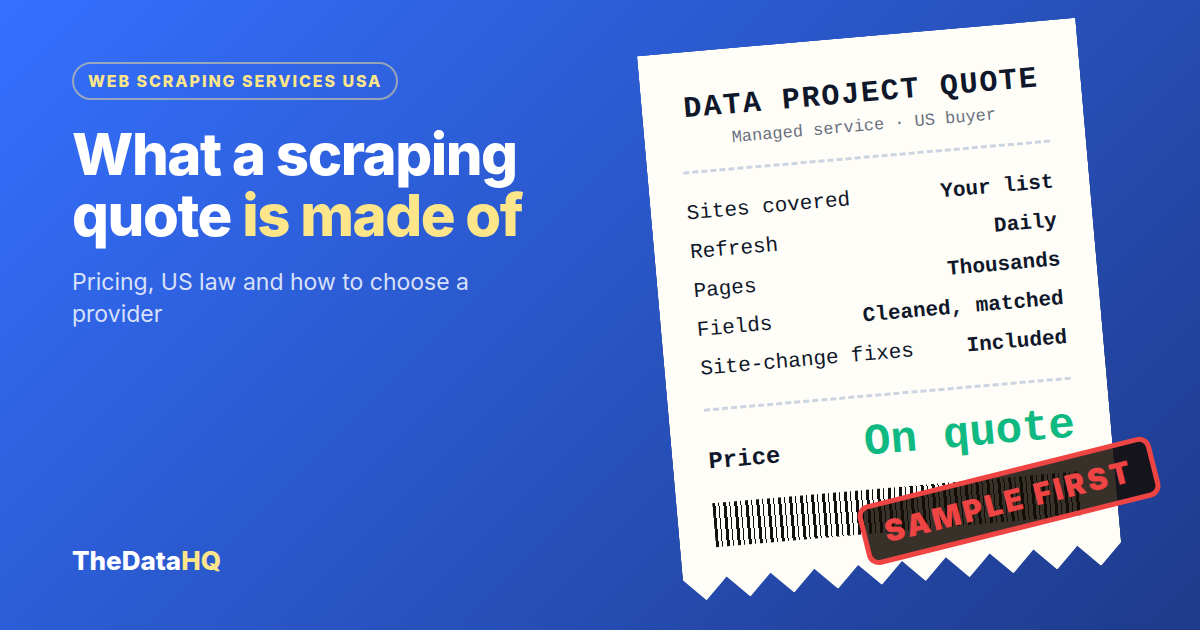
Web scraping services in the USA come in four forms: a managed service that delivers finished data, a scraping API, a self-serve tool, or a freelancer. Most providers charge a setup fee plus a recurring fee, set by the number of sites, how often they run and the volume. Public data is generally collectable under US law, but site terms and privacy laws still apply.
This guide is for US buyers who want the data, not the software. It covers what each option delivers, how pricing works, a plain-English legal checklist and the questions to ask before you sign.
What do web scraping services in the USA deliver?
They deliver structured data taken from public web pages: prices, product details, listings, job ads, store locations or company records. The difference between providers is how much of the work they do for you.
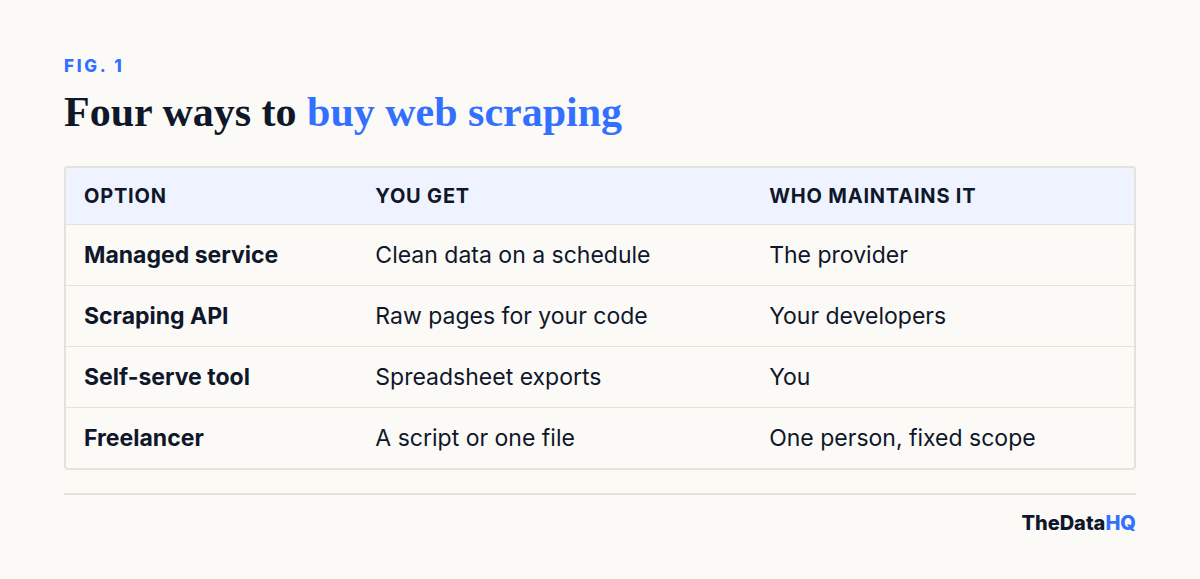
| Option | What you get | Who does the work | Best for |
|---|---|---|---|
| Managed service | Clean files or a database feed on a schedule | The provider builds, runs and fixes everything | Teams with no developers to spare |
| Scraping API | Raw page content through an API (a way for your software to request data) | Your developers write and maintain the extraction | Teams with engineers and many small jobs |
| Self-serve tool | A point-and-click app that exports to a spreadsheet | You set it up and repair it when sites change | One-off pulls from simple sites |
| Freelancer | A script or a one-time file | One person, usually for a fixed scope | Small, once-only jobs |
What is a managed web scraping service?
It's an arrangement where the provider owns the whole job. They build the scrapers, host them, watch every run, fix them when a site changes its layout and send you the finished data.
You agree the sites and the fields up front. After that, your only task is to use the file. This is the model TheDataHQ works in, and it's what most "web scraping services" pages mean.
When is an API or a tool enough?
An API or a tool is enough when you have someone in-house who can maintain it. Sites change their layouts often, and every change breaks the extraction until someone fixes it.
If you'd rather build and run it yourself, our sister company BinaryBits does development work. We compared the two routes in running your own scraper versus buying a data feed.
How much do web scraping services cost in the USA?
There's no standard price list. The cost depends on how the provider charges and on six things about your project. Knowing both lets you compare quotes that look nothing alike.
Which pricing models do US providers use?
Most quotes you'll see use one of these models, or a mix of them:
| Model | How it's charged | Watch out for |
|---|---|---|
| Setup plus recurring | A one-time build fee, then a monthly fee to run and maintain | Whether fixes after site changes are in the monthly fee |
| Per site | A fee for each website covered | Large sites with many page types priced as one |
| Per record or volume | A rate per thousand rows or pages | Duplicate rows counted twice |
| API credits | A monthly plan of requests; harder pages use more credits | Your own developer time, which isn't in the plan |
| Hourly | Time spent, common with freelancers | No cap, and no one on call when the script breaks |
What moves the price of a scraping project?
Six things decide most of the cost, whoever you buy from:
- The number of sites. Each one has its own layout and needs its own scraper.
- How often it runs. Once is cheaper than daily, and daily is cheaper than hourly.
- How the site is built. Plain pages are simpler than pages that load their content in the browser.
- Volume. Thousands of pages and millions of pages are different jobs.
- Fields and cleaning. Six fields from one site is simple; sixty fields matched across ten sites is not.
- Maintenance. Someone has to fix the scraper when a site changes. Ask who pays for that.
How does TheDataHQ price a project?
We don't publish prices, because the six points above vary too much between projects. Every price is quoted after a free sample, so you see the real output before you pay. There are two models, explained on our pricing page:
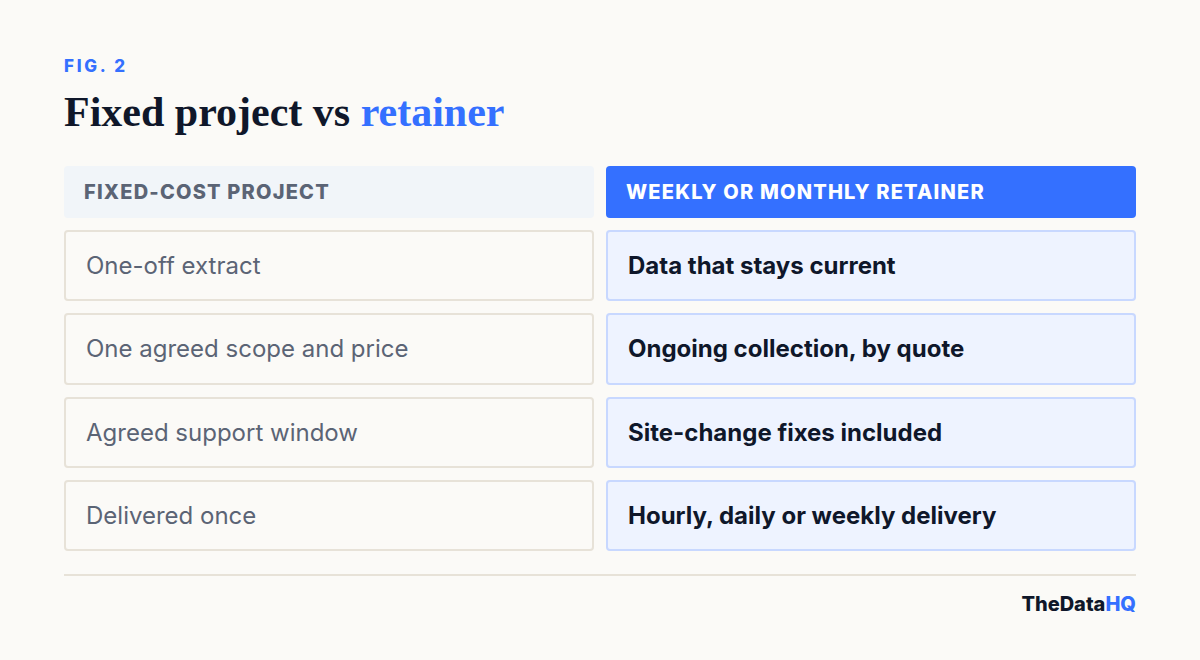
- Fixed-cost project: one agreed scope and one agreed price, for a one-off extract or a set of sites collected once. It includes an agreed support window.
- Weekly or monthly retainer: for data that has to stay current, such as prices, listings or jobs. We build, host and monitor the scrapers, and fixes after site changes are included.
Is web scraping legal in the US?
Collecting publicly visible data is generally lawful in the US, but there's no single law that says so. Four areas decide the risk: the federal hacking law, contract terms, copyright and privacy law. This section is general information, not legal advice.
What does the CFAA say after Van Buren?
The Computer Fraud and Abuse Act (CFAA) is the federal anti-hacking law. In Van Buren v. United States (2021), the Supreme Court read it narrowly. It covers entering parts of a computer system that are off-limits to you, not misusing data you're allowed to see.
Commentators call this the "gates up or down" test. Pages anyone can open without logging in have no gate, which is why public data is treated differently from data behind a password.
What did the hiQ, Meta and X cases decide?
- hiQ v. LinkedIn: the CFAA argument went hiQ's way, but in November 2022 the court found hiQ had breached LinkedIn's User Agreement, partly by using fake profiles. The case settled with a permanent injunction and a $500,000 judgment against hiQ (Morgan Lewis).
- Meta v. Bright Data: in January 2024, a federal court held that Meta's terms didn't stop the collection of public data by someone who wasn't logged in (Farella Braun + Martel).
- X Corp v. Bright Data: in May 2024, a judge dismissed X's claims, finding that its attempt to control public posts clashed with federal copyright law (ArentFox Schiff). X was later allowed to file amended claims.
The pattern is clear: logged-out, public data has fared well in court. Logins, fake accounts and agreed terms are where providers lose.
Do website terms of service still matter?
Yes. hiQ lost on contract, not on hacking. If your company has an account on a site, you've probably agreed to its terms, and those terms may ban automated collection. A careful provider reviews the terms of each site before quoting and collects only pages that need no login.
What about personal data and the CCPA?
Under the California Consumer Privacy Act (CCPA), "personal information" excludes publicly available information, such as government records. But the law applies to businesses with over $25 million in annual revenue (adjusted for inflation), or that handle data on 100,000 or more California residents.
Other states have their own privacy laws, and the list keeps growing; the IAPP state privacy tracker keeps count. If your data includes names, emails or phone numbers of people, you need a lawful basis for using it, under the CCPA, other state laws or the GDPR if any are EU residents.
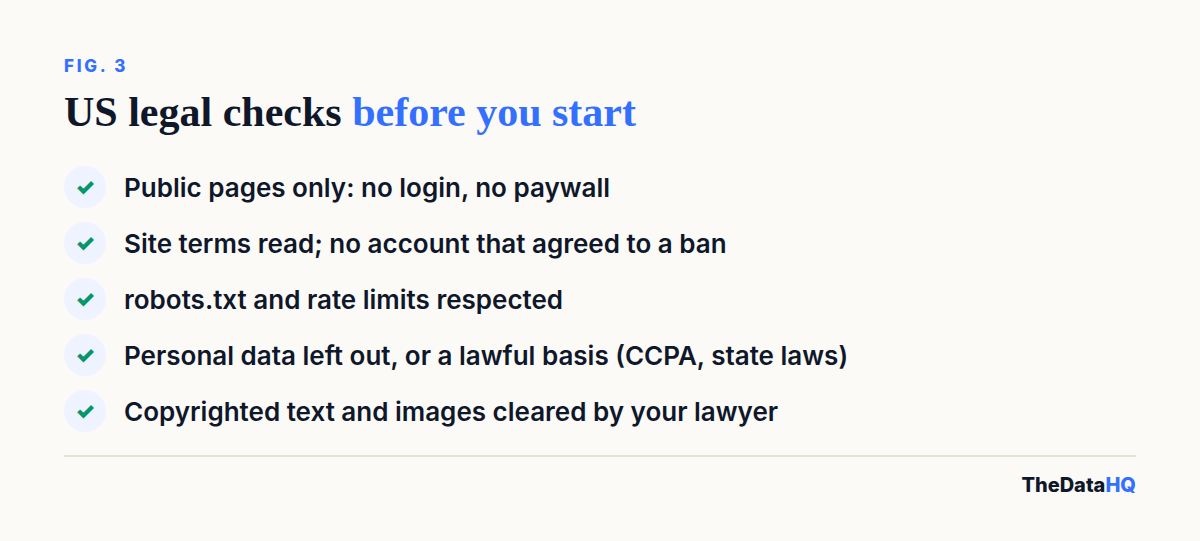
Use this checklist before any project starts:
- The data is visible without logging in or paying.
- The site's terms have been read, and nobody on your side has an account that agreed to a ban.
- The scraper respects robots.txt (a file where sites list what bots may visit) and rate limits, and backs off when asked.
- Personal data is left out, or you have a lawful basis and a plan for opt-outs.
- Copyrighted text and images are used only in ways your lawyer has cleared.
Should you pick a US-based or an offshore web scraping company?
Either can work. What matters more is the contract, the data handling and how quickly problems get fixed. We're based in India, so read this section knowing which side we're on.
| Factor | US-based provider | Offshore provider |
|---|---|---|
| Time zone | Same working day | India is about 10 to 13 hours ahead, so some replies come overnight |
| Contract and disputes | US law and US courts by default | Agree the governing law in writing |
| Data handling | Data often stays on US servers | Ask where data is stored and who can see it |
| Cost | Usually higher labor costs | Usually lower; compare after a sample, not before |
An honest limit: if your legal team requires a US-registered supplier or US-only data storage, an offshore provider won't fit, us included. Ask that question first.
What changes with enterprise web scraping?
Enterprise web scraping means many sites, high volume and data feeding other systems every day. The scraping itself is similar; the stakes around it are not.
- Monitoring: someone checks each run and spots a site change before you notice missing rows.
- Delivery: the data lands straight in your database or cloud storage, not an email attachment.
- One format: fields from every site are matched to one layout, so a price is a price everywhere.
- Paperwork: security questionnaires, a data processing agreement and written scope.
Our enterprise web scraping service covers this kind of work. Over 12 years we've delivered 260+ projects and scraped 10,000+ websites, with a 99.98% success rate (our own figures, past results).
How do you shortlist a web scraping company?
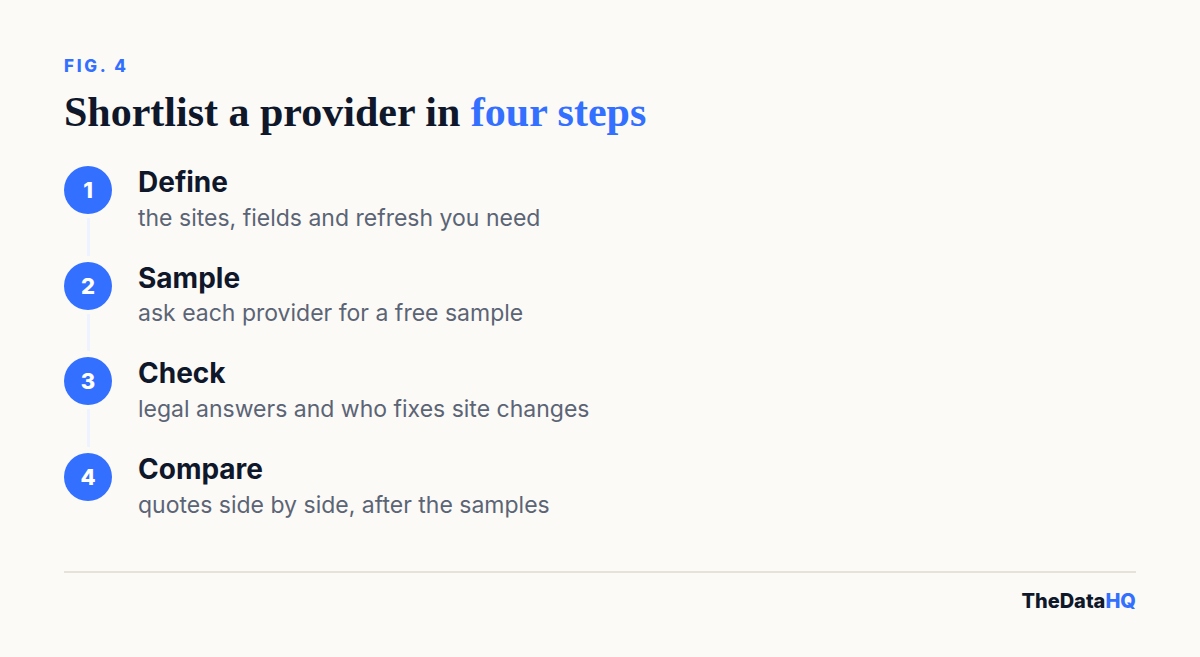
Start with a sample, not a sales call. A sample of the real output tells you more than any proposal.
Which questions should you ask every provider?
- Can you send a free sample from one of my target pages?
- Who fixes the scraper when the site changes, and is it in the price?
- How do you check data quality on each run?
- Which sites or data would you turn down, and why?
- Where is my data stored, and who can access it?
- What formats can you deliver: CSV, Excel, JSON or straight into a database?
What are the warning signs?
- They offer to collect data from behind logins or paywalls.
- They advertise ways around a site's blocking instead of respecting its limits.
- They promise "100% accuracy" or guaranteed uptime on sites they don't control.
- They can't explain who pays for fixes after a site changes.
- They won't send a sample before you pay.
A past example: competitor price monitoring
Price tracking is one of the most common reasons US retailers buy scraped data. In one past e-commerce project, we collected prices and product data from 200+ competitor sites, refreshed daily, with daily reports and alerts when prices changed. The full write-up is on our case studies page.
If price data is your goal, our price scraping service explains the setup. UK readers can read our guide to web scraping services in the UK, which covers UK law.
What should you do next?
Send us one URL and the fields you want; we'll send back a free sample of the real output. No charge, no commitment. Request your free sample.
Frequently asked questions
How much do web scraping services cost in the USA?
It depends on the number of sites, how often the data refreshes, how the sites are built, the volume, the fields and who handles maintenance. Most providers charge a setup fee plus a monthly fee, or a rate per record or per site. TheDataHQ quotes every project after a free sample, as a fixed-cost project or a weekly or monthly retainer.
Is web scraping legal in the US?
Collecting publicly visible data is generally lawful. Van Buren (2021) narrowed the CFAA to entering areas that are off-limits to you, and courts have sided with logged-out collection of public data. Contract terms, copyright and state privacy laws still apply, so logins, fake accounts and personal data carry real risk. This is not legal advice.
Is it safe to outsource web scraping offshore?
It can be, if the contract is clear. Agree in writing the governing law, where data is stored, who can access it and who fixes broken scrapers. Ask for a free sample before you pay. If your company requires US-only data storage or a US-registered supplier, choose a US provider instead.
What is a managed web scraping service?
A managed web scraping service builds, hosts, monitors and maintains the scrapers for you, then delivers finished data on a schedule. You agree the sites, fields and format once. Unlike an API or a tool, you don't need developers to keep it running when websites change their layouts.
Can a web scraping company collect personal data in the US?
Only with care. The CCPA excludes publicly available information, such as government records, from personal information, but other state privacy laws and the GDPR may still apply. If a dataset includes names, emails or phone numbers, you need a lawful basis and a plan for opt-outs. Many projects simply leave personal data out.
Do I need a US-based web scraping company?
Not usually. Location matters less than the sample quality, the maintenance terms and the contract. A US provider gives you the same working day and US courts by default. An offshore provider often costs less but replies overnight. Pick based on your legal team's rules and a side-by-side sample.