Competitor Price Monitoring Services vs Software: 2026 Checklist
Software or a done-for-you service? How to choose a competitor price monitoring option by catalog size, competitors and site difficulty, with 2026 prices and a 10-point checklist before Cyber Week.
By Vinay Jakhariya, Co-founder & Operation Manager · · 11 min read
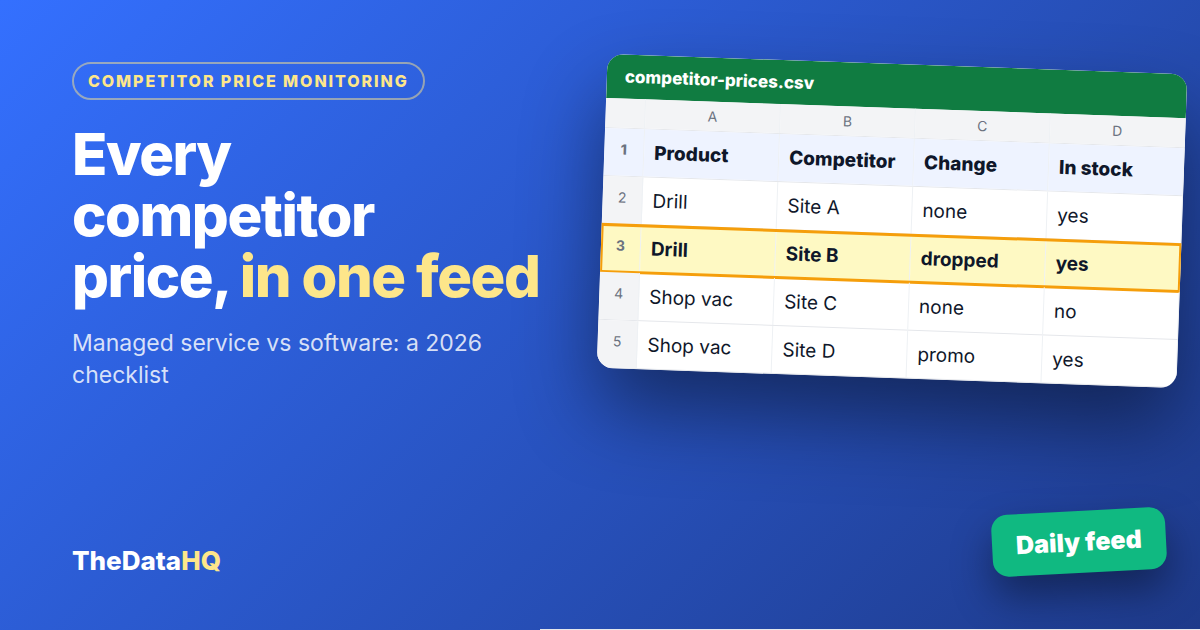
Competitor price monitoring services collect your rivals' prices, stock and promotions for you and deliver them as a clean feed. Software does the same job, but you set it up, match the products and fix it when sites change. Small catalogs on simple sites suit software. Large catalogs, many competitors or sites that load prices late suit a managed service. The checklist below helps you decide before Cyber Week.
What does a competitor price monitoring service actually deliver?
You get the data, not a tool to run. You name the competitors and products; the provider collects, checks and sends the prices on a schedule.
A typical delivery includes:
- Price per product, per competitor, with the currency and the time it was captured.
- Product matching: your SKU linked to the same item on each competitor site, even when the names differ.
- Stock status and seller: marketplaces such as Amazon and Walmart often list several sellers on one product page.
- Promotions: "2 for 1" or "save 15% in cart" captured as text, so a sale isn't mistaken for a new list price.
- History and alerts: every change kept, and a message when a tracked price moves.
- Delivery in your format: CSV, Excel, JSON or straight into your database.
Software gives you most of these fields too. The difference is who does the work to keep them right.
Software or a managed service: what's the real difference?
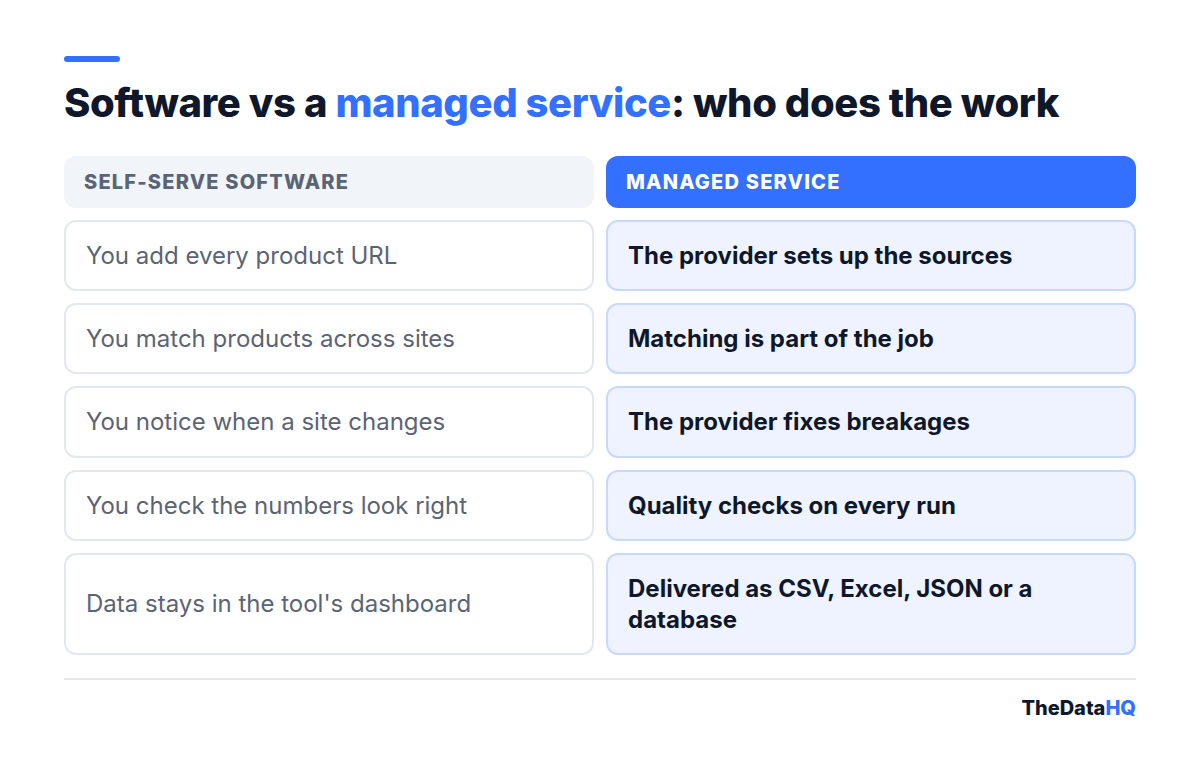
With software you rent the machine and run it yourself. With a service you pay someone to run it and hand you the output.
What do you do yourself with software?
You add each product URL, link it to the right competitor page, and watch for gaps. Prisync, for example, lets you add URLs "one by one or simply in bulk", and sells competitor matching as a separate order (Prisync pricing).
That works well for a few hundred products. It gets heavy when a competitor redesigns its site the week before a sale.
What does the provider do in a managed service?
The provider sets up each source, matches the products, checks every run and fixes breakages. You get a file or a database table each morning.
The honest trade-off: you give up some control and you pay for people's time. For a small, stable catalog, that's often money you don't need to spend.
Which one fits your catalog?
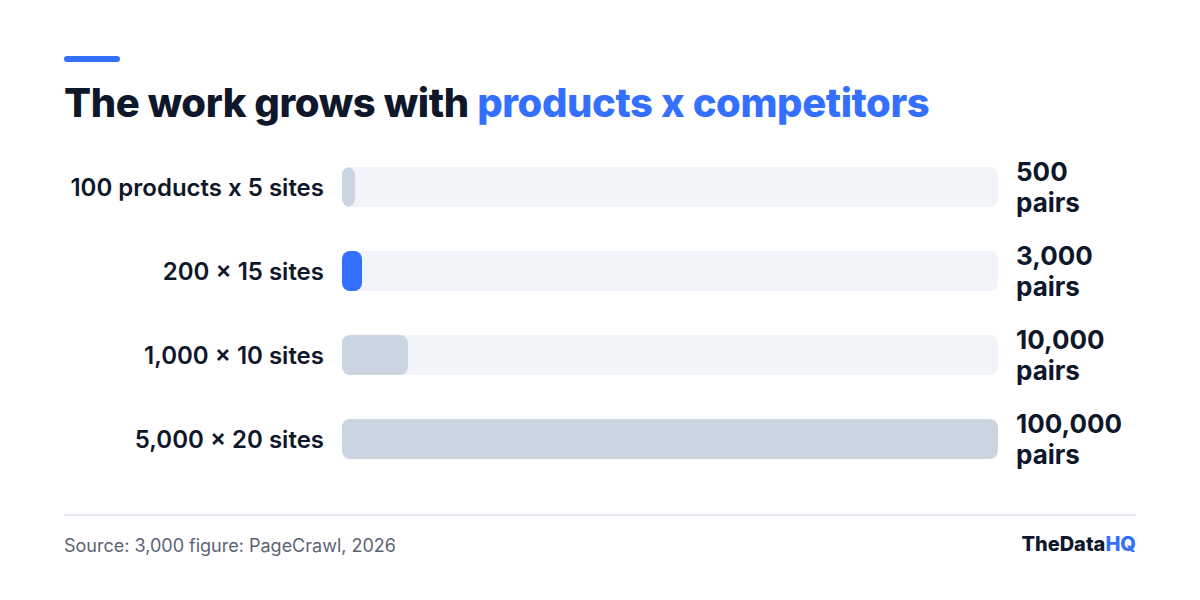
Count product-competitor pairs, not products. Each product you track on each competitor site is one pair to collect, match and check.
The numbers climb fast. 100 products on 5 sites is 500 pairs. PageCrawl notes that 200 products across 15 competitors needs at least 3,000 monitors (PageCrawl, 2026). By our arithmetic, 1,000 products on 10 sites is 10,000 pairs, and 5,000 products on 20 sites is 100,000.
What makes a site hard to monitor?
Some sites are simple: the price sits in the page the server sends. Others are harder:
- Prices loaded by JavaScript (code that runs in your browser after the page arrives). PageCrawl warns that simple checkers "return blank prices" on these pages.
- Prices that change by ZIP code or store, common where retailers price by local store.
- Frequent redesigns, which quietly break a setup that worked last week.
- Many sellers per product, where the price you see depends on which seller wins the listing.
How do you choose from these two numbers?
Put your pair count on one axis and your share of hard sites on the other.
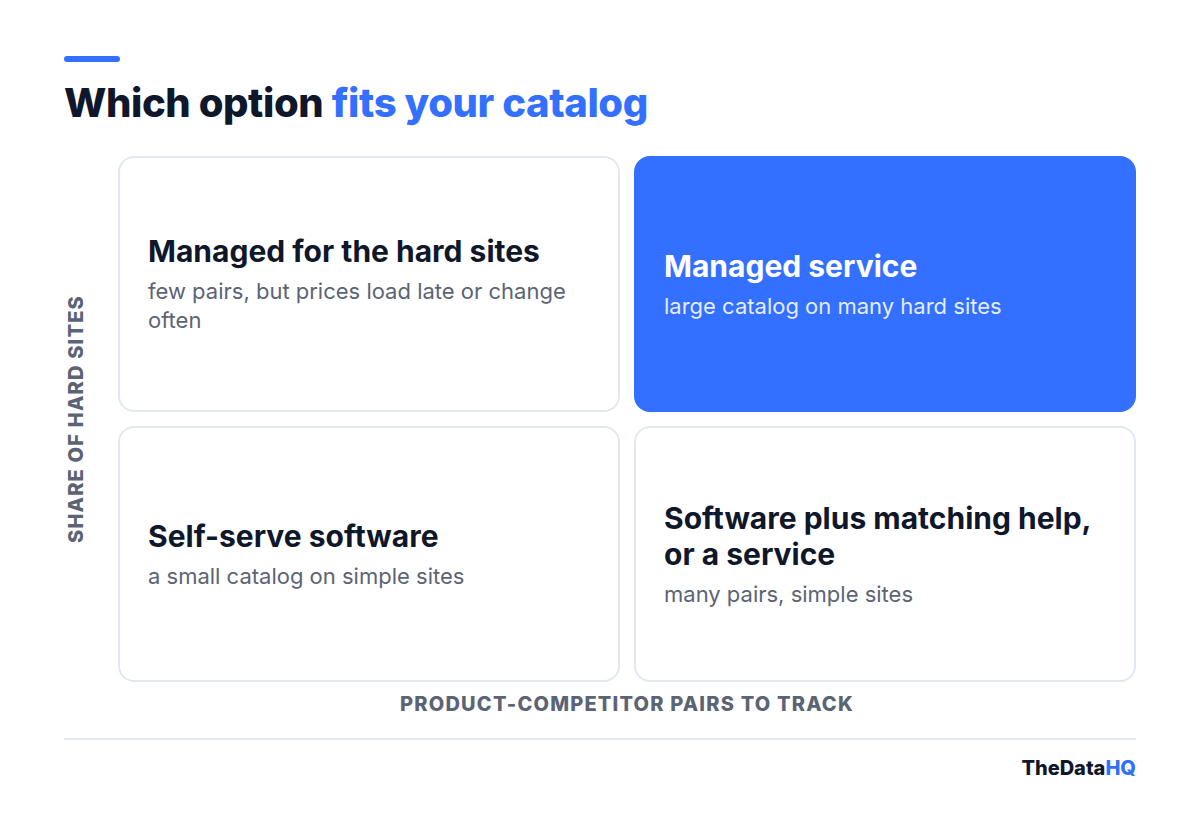
- Few pairs, simple sites: self-serve software is usually enough.
- Many pairs, simple sites: software with paid matching help, or a service.
- Few pairs, hard sites: a service for the hard sites, software for the rest.
- Many pairs, hard sites: a managed service.
What does competitor price monitoring cost in 2026?
Self-serve tools start under $100 a month for a small catalog. Enterprise platforms and managed services are quoted per client. These are the published starting points we found in October 2026:
| Option | Published starting price | What you still do | Who fixes breakages |
|---|---|---|---|
| Self-serve price tracker (Prisync) | $99/mo for up to 100 products; $399/mo for up to 5,000 (source) | Add URLs, order or do matching | Shared: tool vendor and you |
| Page monitoring tool (PageCrawl) | Free plan; $8/mo for 100 monitors; $30/mo for 500 (source) | Set up every monitor, match products | You |
| Enterprise platform (Price2Spy Premium) | Price on request, up to 8 checks a day (source) | Catalog mapping with their team | Vendor |
| Managed service (TheDataHQ) | Quoted after a free sample | Name the sites and fields | Us, included in a retainer |
Prices change often, so check each vendor's page before you budget. For a wider look at tool prices, see our guide to what MAP price monitoring costs.
What moves the price of a managed service?
Six things set a quote for ongoing price collection:
- The number of competitor sites, each with its own layout.
- How often it runs: daily, several times a day, or hourly.
- How the sites are built: plain pages, or prices loaded in the browser.
- Volume: thousands or millions of pages.
- The fields and the cleaning, including product matching across sites.
- Ongoing maintenance, which our retainers include.
Our pricing page explains the two models: a fixed price for a one-off collection, or a weekly or monthly retainer for a feed that stays current.
Should you build it in-house or outsource it?
Build it in-house only if you have a developer who will own it for years, not weeks. The first version is the easy part.
The ongoing cost is the part people miss. PageCrawl puts it plainly: "scrapers break when layouts change", and the fixes fall on your team. Each fix tends to arrive when a competitor changes its site, which is often right before a sale.
If your team does want to build its own monitor, our sister company BinaryBits wrote up how it built a real-time competitor price monitor. If you'd rather just receive the prices, outsourcing is the shorter path.
How do you evaluate competitor price monitoring services?
Ask every provider, software or service, to pass these ten checks on your own products before you sign.
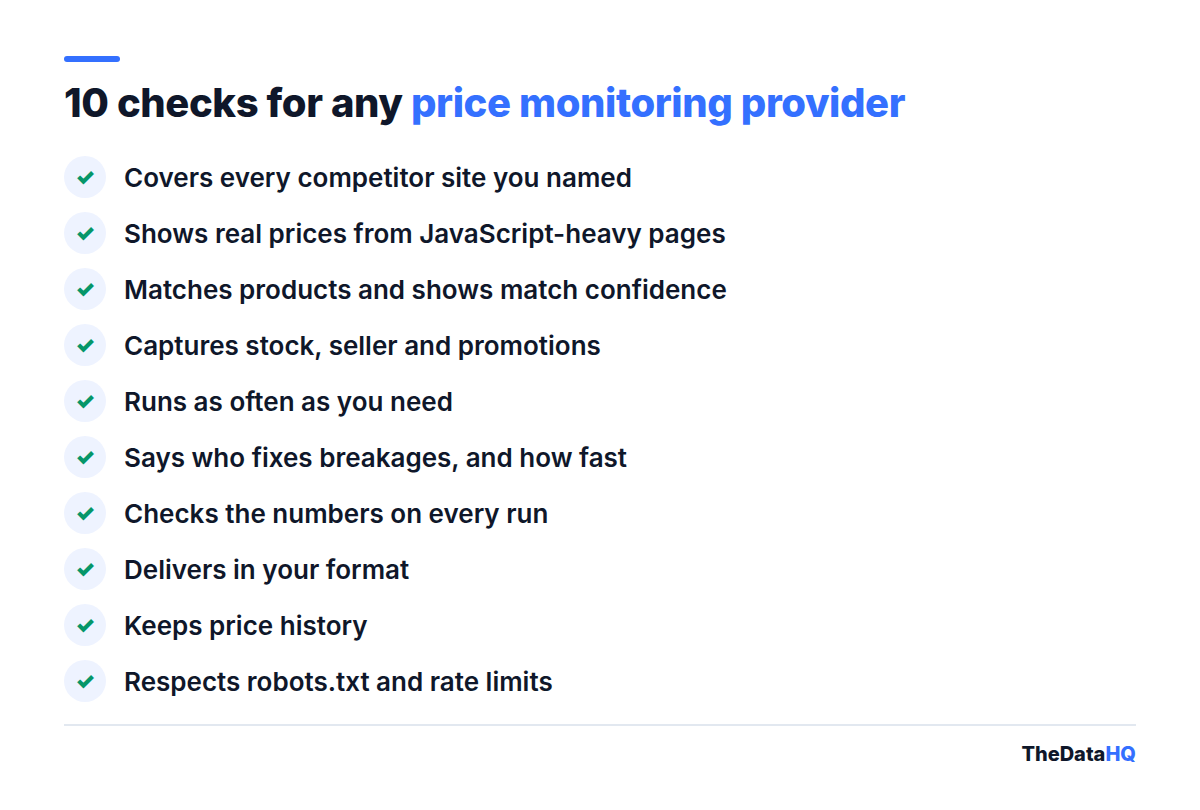
- It covers every competitor site you named, not just the big marketplaces.
- It shows real prices from pages that load prices with JavaScript.
- It matches products across sites and tells you how sure each match is.
- It captures stock, seller and promotions, not just one number.
- It runs as often as your pricing decisions need.
- It says in writing who fixes breakages, and how quickly.
- It checks the numbers on every run, for example flagging a price that jumps 90% overnight.
- It delivers in your format, so the data reaches your pricing sheet or system.
- It keeps price history, so you can see patterns before a sale.
- It respects robots.txt (a site's published crawling rules) and rate limits.
Can you be ready before Black Friday and Cyber Week?
Yes, if you choose this month. Cyber Week is when competitors move prices most, and the money at stake is large.
Adobe forecasts $275.1 billion in US online holiday sales from November 1 to December 31, 2026, with $47.5 billion in Cyber Week alone. Cyber Monday, on November 30, should be the biggest day at about $15.1 billion (Adobe, September 2026).
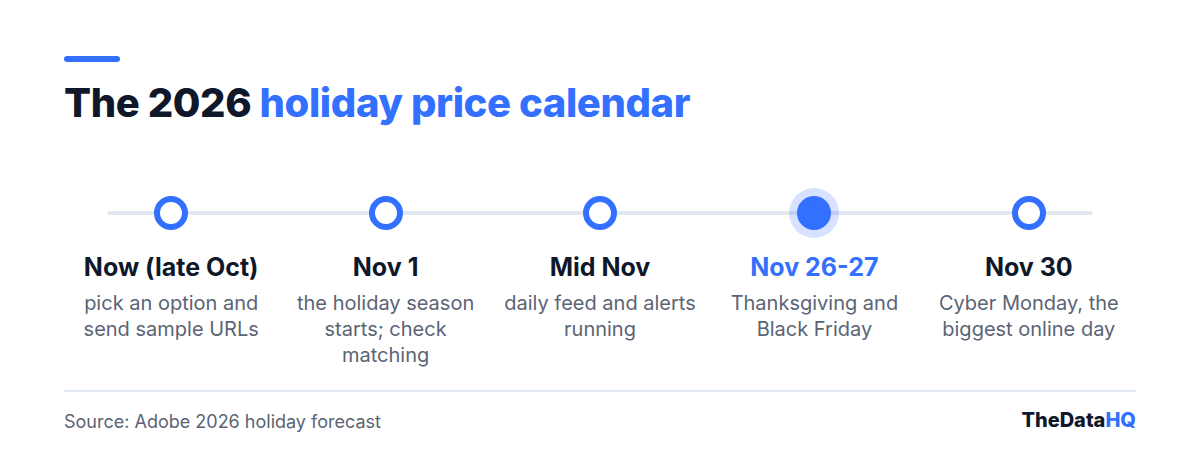
- Now (late October): pick an option and send your product list and competitor URLs for a sample.
- November 1: the season starts; check that matching is right on your best sellers.
- Mid November: the daily feed and alerts are running and trusted.
- November 26-27: Thanksgiving and Black Friday.
- November 30: Cyber Monday.
Start with your top sellers and main rivals. You can add the long tail after the sale.
What should you ask a price scraping service before you sign?
A good price scraping service answers these in plain words, in writing:
- Can I see a sample of the real output from my own competitor list first?
- What happens, and how fast, when a competitor changes its site?
- How do you match my products, and what do you do with uncertain matches?
- Is maintenance included, or billed per fix?
- What will you not collect? (Logins and paywalls should be a firm no.)
- Can I leave and keep my price history?
For our own answers, see the price scraping service page. Our case studies include an online retailer that went from a weekly manual check of a handful of competitors to a daily price refresh across 200+ competitor sites, with daily reports and alerts. That's a past result, not a promise for every catalog.
Is it legal to monitor competitor prices?
Collecting publicly listed prices is common and generally lower-risk than collecting personal data. But "it's public" isn't the whole legal test. This is not legal advice.
- Computer access law: in hiQ v. LinkedIn, a US appeals court said collecting public pages likely isn't "unauthorized access" under the CFAA, the federal anti-hacking law. hiQ still lost later on contract grounds.
- Site terms: a site's terms of use can still apply, especially if you agreed to them.
- Personal data: seller names on marketplaces can be individuals. Under the CCPA (and GDPR or UK GDPR for European sites), you need a lawful reason to keep that data.
- Good conduct: respect robots.txt and rate limits, and stay out of anything behind a login.
For other ways to compare rivals' prices, see our ecommerce competitor price comparison methods.
Want to see the data before you choose? Send us one URL and the fields you want; we'll send back a free sample of the real output, usually around 100 rows, and quickly. No charge, no commitment. Request your free sample, or read how our competitor price monitoring service works.
Frequently asked questions
What does a competitor price monitoring service do?
It collects your competitors' prices, stock and promotions from their websites on a schedule, matches each item to your own products and sends you the results as a clean file or database feed. The provider handles the setup, the quality checks and the fixes when a site changes, so your team only works with the finished data.
How much does competitor price monitoring cost?
Self-serve software starts at about $99 a month for up to 100 products at Prisync, and page monitoring tools start lower. Enterprise platforms and managed services are quoted per client. The price depends on the number of competitor sites, how often it runs, how the sites are built, the volume and how much matching and cleaning the data needs.
Should I build competitor price monitoring in-house or outsource it?
Build in-house only if a developer will own it long term, because sites change and every change needs a fix. Outsource if you want the prices without that upkeep, or if you track many products across many competitors. For a small catalog on simple sites, self-serve software is often the cheapest option and a reasonable place to start.
What's the difference between price monitoring software and a price scraping service?
Software is a tool you run: you add the product pages, match them and notice when results go wrong. A price scraping service is people plus tooling: they set up the sources, match products, check each run and fix breakages, then deliver the data to you. Both give you competitor prices; they differ in who does the ongoing work.
How often should competitor prices be checked?
Match the check to how often you can act. Daily suits most retailers and brands. Several checks a day make sense on marketplaces and in sale periods such as Cyber Week, when prices move within hours. Price2Spy's top plan, for comparison, offers up to 8 checks a day. Checking more often than you can respond mainly adds cost.
Is competitor price monitoring legal?
Collecting publicly listed prices is common, and a US appeals court in hiQ v. LinkedIn said collecting public pages likely isn't a federal hacking offence. Site terms, database rights in Europe and privacy laws such as the CCPA and GDPR can still apply, especially to seller names. Respect robots.txt, avoid logins and get advice for your case. This is not legal advice.