Store Closures 2026: The Numbers and How to Track Them
US store closures fell 44.1% by midyear 2026, and the net store loss shrank to 106. Here are the chains behind the numbers, why headlines and real store counts differ, and how to track openings and closures by chain.
By Chirag Jakhariya, Co-founder & CEO · · 11 min read
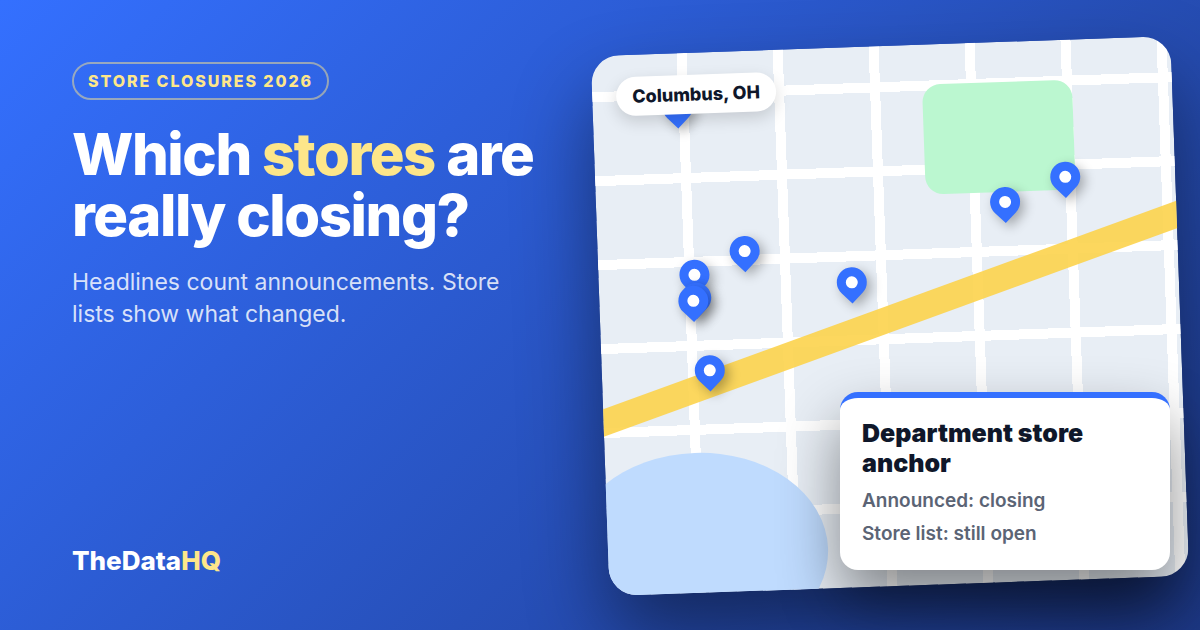
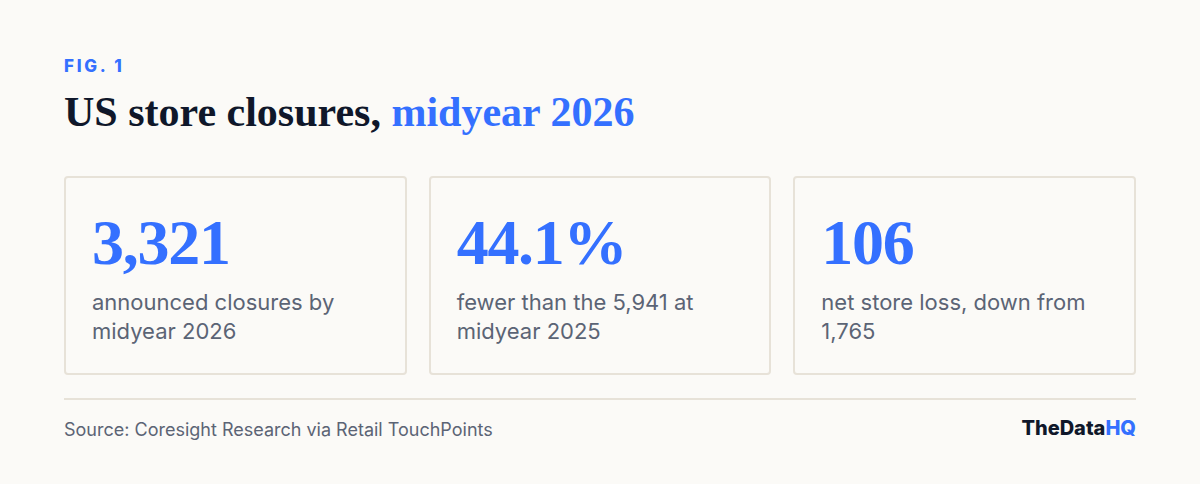
Store closures in 2026 are running well below 2025. Coresight Research counted 3,321 US closures by midyear, down 44.1% from 5,941, and the net store loss fell from 1,765 to 106 (Retail TouchPoints). Those numbers count announcements, though. A chain's real store count often moves by a different amount, at a different time.
This post sets out the 2026 numbers so far, the chains behind them, and why the headlines and the store counts disagree. It ends with how to track openings and closures chain by chain, if your work depends on it.
Store closures in 2026: how many so far?
About 3,321 US stores had announced closures by the middle of 2026, according to Coresight Research. Openings nearly matched that number, so the net loss was small.
| Measure | Midyear 2025 | Midyear 2026 | Change |
|---|---|---|---|
| Announced store closures | 5,941 | 3,321 | Down 44.1% |
| Net store loss (closures minus openings) | 1,765 | 106 | Down 94% |
| Retail bankruptcies | 32 | 10 | Down 22 |
Source for all three rows: Coresight Research's midyear 2026 review, as reported by Retail TouchPoints. Coresight's full report is for paying members.
Why are store closures slowing down?
Fewer retailers went bankrupt. Bankruptcies fell from 32 at midyear 2025 to 10 at midyear 2026, and one bankruptcy can close hundreds of stores. Rite Aid alone closed nearly 1,300 locations in 2025 as it went out of business (The National News Desk).
The slowdown was expected. At the end of 2025, Coresight was already tracking 1,118 planned openings against 566 planned closures for 2026, according to the same report.
Which retailers are closing stores in 2026?
Department stores, apparel chains and coffee shops are among the 2026 announcements. Three examples show how differently chains announce closures:
- Macy's: about 14 stores in its first fiscal quarter of 2026, part of a plan to close about 150 by the end of 2026 (FOX 5 New York).
- Starbucks: about 250 North American stores in late September 2026. The company didn't say how many are in the US and how many in Canada (AP via Boston.com).
- Carter's: 150 stores, raised from an earlier plan of 100 across 2025 and 2026. It hasn't named the stores; they close as their leases run out (Patch).
Search for "store closures 2026" and you'll find dozens of chain-by-chain lists. Most were written in January, so check the date before you rely on one.
Are more stores opening than closing in 2026?
Almost, but not quite. The net loss of 106 stores at midyear means openings nearly caught up with closures. Openings themselves slowed too, to the lowest midyear count since 2020 (Retail TouchPoints).
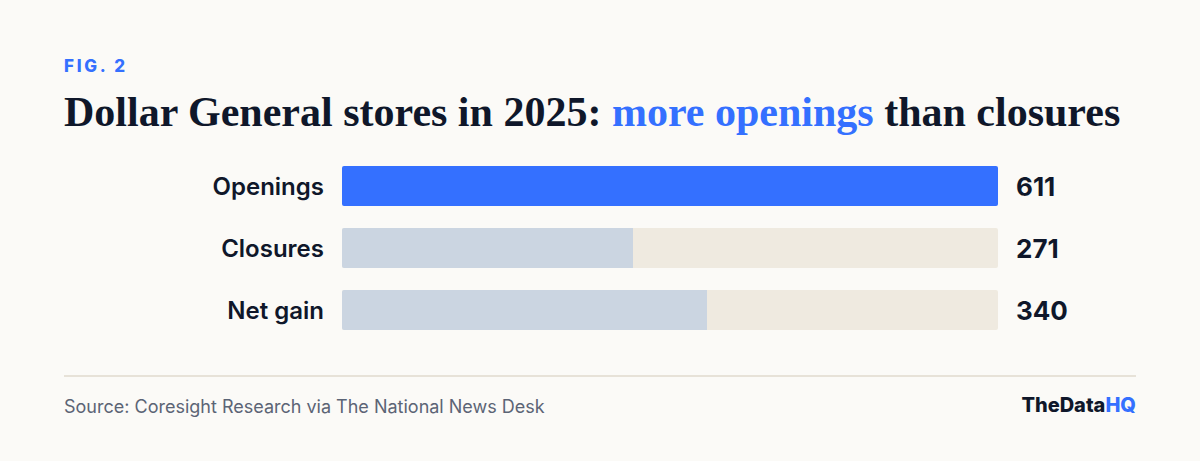
Some chains open far more than they close. In 2025 Dollar General opened 611 stores and closed 271, a net gain of 340 (The National News Desk). A "closures" headline about that chain would miss the bigger story.
Which categories are gaining or losing stores?
Value and off-price chains are growing while fashion and big-ticket chains shrink. Coresight's midyear split, via Retail TouchPoints:
- Adding stores: value-focused chains and off-price retailers. Burlington, T.J.Maxx and Ross were named as off-price chains gaining share in 2025 (The National News Desk).
- Losing stores: apparel, department stores and electronics.
Which regions are gaining or losing stores?
Central and southern states are getting the most new stores. Coastal and Midwestern markets are shrinking, according to the same Coresight midyear review.
Why don't announced store closures match real store counts?
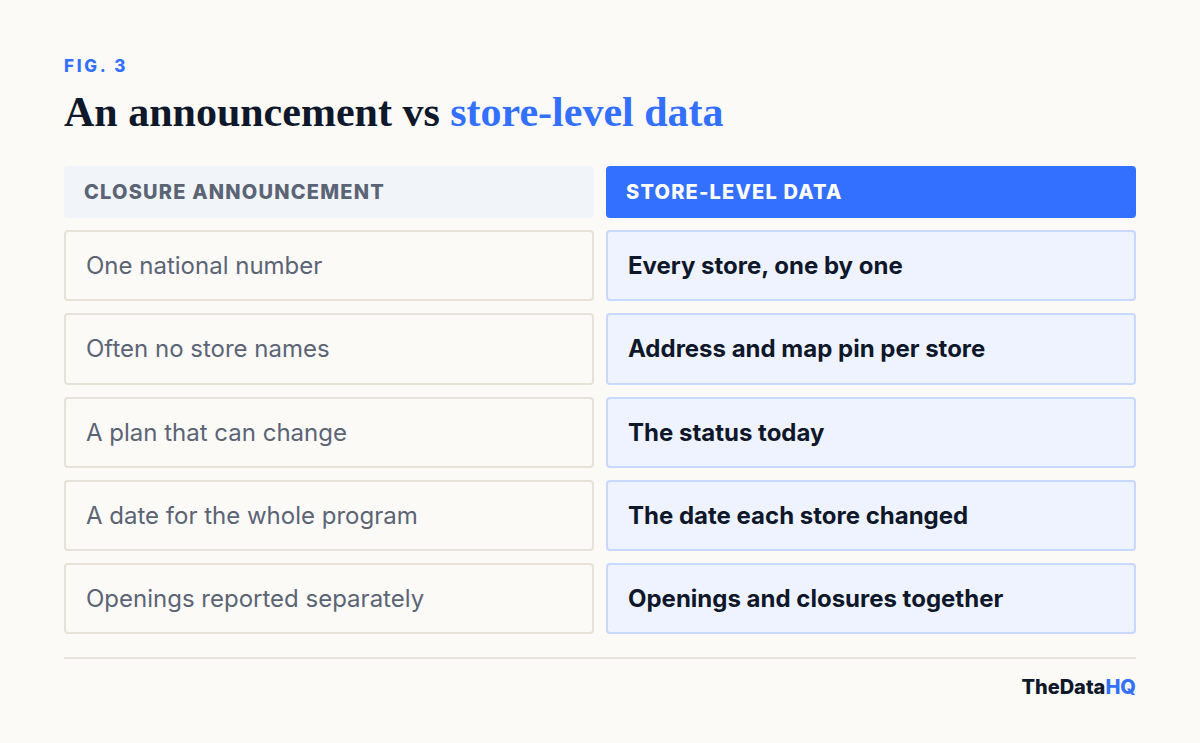
An announcement is a plan, not a list of addresses. The number in the headline and the change in a chain's store count differ for five common reasons:
- Timing. Closures roll out over months or years. Carter's closes stores as leases end, so a 2026 headline can describe a 2027 closure.
- Openings offset closures. Starbucks closed 434 North American stores in one quarter of 2025, 2.3% of its count there. Its net change for the year was 227, because it opened about 200 earlier in the year (Nation's Restaurant News).
- Mixed regions. Starbucks' September 2025 round counted 627 stores across North America and Europe, and its 2026 round has no US and Canada split.
- Moving targets. Plans get revised. Carter's went from 100 to 150, and different reports give different timelines for Macy's 150.
- No names. Many chains announce a number without saying which stores. If you need to know about one shopping center, the number doesn't help.
What does the gap mean for site selection and leasing?
It means a national number can't answer a local question. A landlord wants to know whether the anchor store in their center is on the list. A site-selection team wants the gaps a closing competitor leaves in one metro area.
Both need the store list itself, with each store's status and the date it changed.
What is store location data?
Store location data is a list of every store a chain operates, with an address and details for each one. When it's collected on a schedule, comparing two versions shows exactly which stores opened and which closed.
A typical store-level file has these fields:
| Field | What it tells you | Why it matters for closures |
|---|---|---|
| Store ID | The chain's own number for the store | Tracks one store across time, even if its name changes |
| Address and coordinates | Where it is, down to the map pin | Lets you group stores by metro area or shopping center |
| Store type and hours | Full store, outlet, pickup point | Separates a real closure from a format change |
| Status | Open, temporarily closed, gone | The answer you actually want |
| First seen and last seen | The dates the store appeared in, and dropped out of, the listing | Dates each opening and closure |
We deliver files like this as a spreadsheet, CSV or straight into a database. Our guide to getting website data into Excel or CSV shows what the formats look like.
Is store location data public?
Store addresses are published for customers, but "it's public" isn't the legal test. A site's terms of use, database rights and contract law can still apply to how you collect and reuse the data.
Store addresses are business information, not personal data. If a dataset adds store managers' names or contact details, US privacy laws such as the CCPA come in, and you need a lawful reason to hold them. We collect public pages only, respect each site's rate limits and robots.txt rules, and leave out anything behind a login. This is not legal advice.
How do you track store openings and closures by chain?
You take the same store list repeatedly and compare each version with the last. In practice it runs in six steps:
- Pick the chains, and the metro areas if you don't need the whole country.
- Agree the fields: store ID, address, type, status and dates.
- Take a first full list. This is your baseline.
- Collect again on a schedule, such as weekly or monthly.
- Compare: a new store ID is an opening, and a missing one is a possible closure.
- Confirm a closure only after it's missing twice in a row, then match it against the chain's announcements.
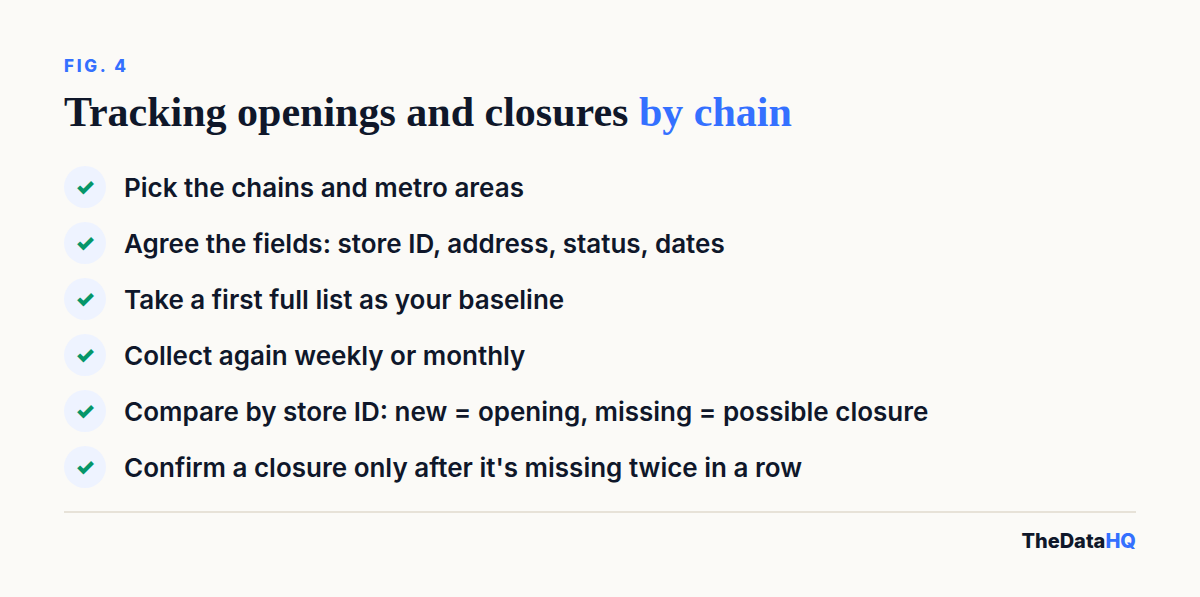
That last step matters. A store can drop out of a listing for a day during a remodel or a site update, and counting it as closed would be wrong.
How often should store data be refreshed?
Weekly suits chains in the middle of a closure program, such as the three above. Monthly is enough for a broad view of a market. Our ongoing data feeds run on whichever schedule you pick.
What can't store location data tell you?
It shows what changed, not why. A closure in the data won't tell you whether the lease ended, the store underperformed or the chain moved it across the street.
It also can't see the future. A store stays "open" in the data until the day it disappears, so pair it with announcements if you need warning. And this post is built on published numbers; it doesn't include store counts of our own.
Should you build a tracker or buy the data?
Build it if you have developers and only a chain or two to watch. If you want a custom tool of your own, our sister company BinaryBits builds software.
Buy it if you need many chains kept up to date without anyone on your side fixing things. Store pages change layout, and a change can break a tracker until someone repairs it. Our data extraction service handles that for you.
What does a store location data feed cost?
Our price is quoted after a free sample. These are the things that move it:
- How many chains, since each site has its own layout.
- How often it runs: once, weekly or monthly.
- How the store pages are built: plain pages, or loaded in the browser.
- How many stores, from a few hundred to tens of thousands.
- Which fields you need, and how much cleaning.
- Ongoing fixes, which are included in a monthly retainer.
Our pricing page explains the fixed-price and retainer options.
Get a free sample of store location data
Send us one URL and the fields you want; we'll send back a free sample of the real output. No charge, no commitment. Over 12 years we've delivered 260+ projects across 10,000+ websites. Request your free sample.
Frequently asked questions
What stores are closing in 2026?
Announced 2026 closures include about 14 Macy's stores in its first fiscal quarter, part of a plan for about 150; about 250 Starbucks stores in North America; and 150 Carter's stores as leases end. Most chains don't name every store, so check the chain's own store list or a dated tracker before you rely on a specific location.
How many stores are closing in 2026?
Coresight Research counted 3,321 announced US store closures by midyear 2026, down 44.1% from 5,941 at the same point in 2025. Openings nearly kept pace, so the net store loss was only 106. Full-year totals will be higher, because chains such as Starbucks announced more closures after midyear.
Are store closures slowing down in 2026?
Yes. Announced closures fell 44.1% between midyear 2025 and midyear 2026, mostly because retail bankruptcies dropped from 32 to 10. Openings also slowed to their lowest midyear count since 2020. The picture is a quieter market, not a booming one: fewer stores are closing and fewer are opening.
What is store closures data?
Store closures data is a record of which stores a chain has closed, with each store's address and the date it closed. There are two kinds: announcement trackers, which count what chains say they'll close, and store-level data, which compares a chain's store list over time to show which stores actually went.
How long does store closures data take?
The first store list shows where every store is today. Closures only appear once you have a second list to compare it with, so a weekly feed starts showing changes after its second run. A free sample of the first list comes before any project starts, and the timing depends on how many chains you need.
Is it legal to collect store location data?
Collecting public store addresses is generally lower risk than collecting personal data, because addresses are business information. A site's terms of use and database rights can still apply, and any names or contact details bring in privacy laws such as the CCPA. Check with a lawyer for your case; this is not legal advice.