How Big Is the Web Scraping Market? Depends Who You Ask
Seven firms priced the web scraping market in 2025, from USD 501.9 million to USD 3.2 billion. Three more priced the AI slice higher than the whole thing. Why they disagree, what the vendor lists give away, and how to pick a figure you can defend.
By Chirag Jakhariya, Co-founder & CEO · · 8 min read
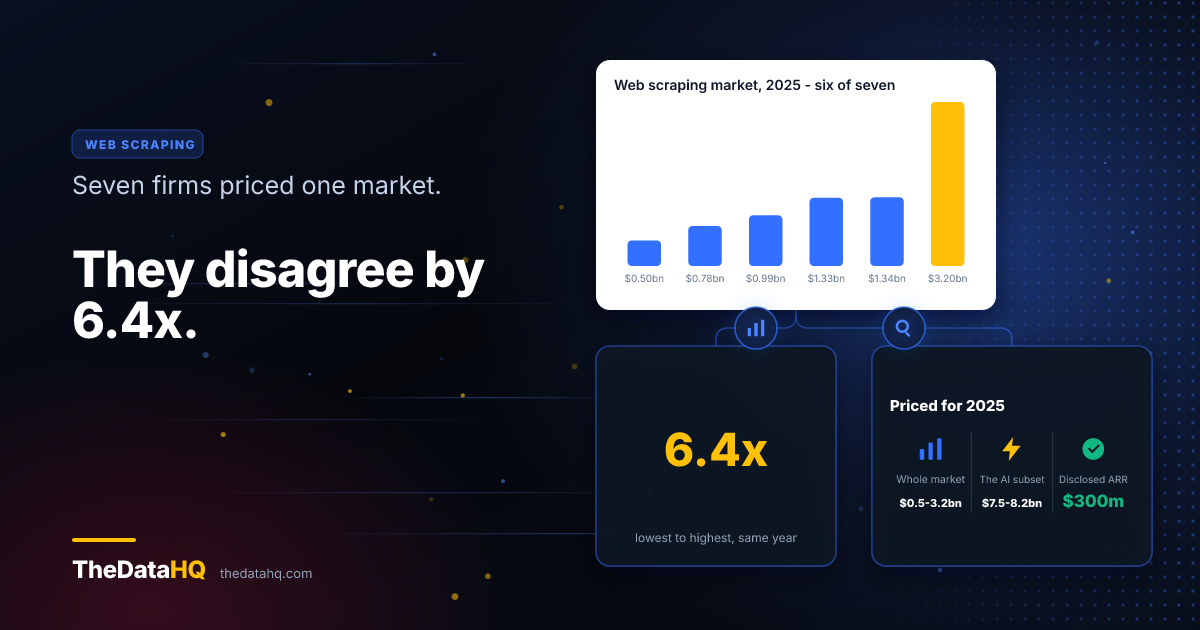
Seven Firms, One Year, Seven Answers
USD 501.9 million. USD 782.5 million. USD 814.4 million. USD 990 million. USD 1.332 billion. USD 1.34 billion. USD 3.2 billion.
Those are seven research firms pricing the web scraping market in 2025.
| Firm | Report | 2025 | Forecast |
|---|---|---|---|
| Future Market Insights | Web Scraping Software | USD 501.9M | USD 2.03B by 2035 |
| Research Nester | Web Scraping Software | USD 782.5M | USD 2.7B by 2035 |
| Straits Research | Web Scraper Software | USD 814.4M | USD 2.5B by 2034 |
| Research and Markets | Web Scraping | USD 0.99B | USD 2.28B by 2030 |
| Market Research Future | Web Scraper Software | USD 1.332B | USD 6.848B by 2035 |
| Mordor Intelligence | Web Scraping | USD 1.34B | USD 3.49B by 2031 |
| Verified Market Reports | Web Scraping Software | USD 3.2B | USD 12.5B by 2034 |
Six point four times between the smallest and the largest. Same year, and the report titles are close enough to be interchangeable.
They're 2025 figures because 2025 is the only year all seven state. Three of them - Future Market Insights, Market Research Future and Verified Market Reports - give a base year, then a number for 2034 or 2035, and nothing in between. There's no 2026 figure to quote. Every page here was checked on 10 September 2026.
If you're writing the market-size slide for a board deck or an investment memo, you've probably found two of these already and assumed the low one was out of date. It isn't. They were published within about a year of each other and they're all still on sale today - the Future Market Insights report starts at USD 5,000.
The standard explanation is scope. One counts software, another counts services. That's part of it. It doesn't get you to 6.4x, and you can show that yourself in about ten minutes without buying anything.
The Subset Is Bigger Than the Whole
Now put the AI reports next to them. Three firms priced "AI-driven web scraping" for the same year: USD 7.489 billion (Market Research Future), USD 7.79 billion (SNS Insider, whose site blocks automated checking, so that one's from their syndicated release), and USD 8.24 billion (Research and Markets).
AI-driven scraping is a slice of scraping. Every one of those numbers is bigger than every number in the table above. At the extremes, the slice is sixteen times the pie.
Scope differences can make two figures disagree. They can't make a part larger than the whole it sits in. For that, the two reports have to share no working definition of what they're counting.
One Firm Publishes Both Sides of It
You don't have to compare firms to see this. One of them does it on its own.
Market Research Future's Web Scraper Software Market report puts the market at "1.131 USD Billion in 2024", growing "from 1.332 USD Billion in 2025 to 6.848 USD Billion by 2035". Their AI Driven Web Scraping Market report values the same year at "USD 7.48 Billion", heading for "USD 38.44 Billion by 2034".
Then look at who's in each one.
| Report | Key companies listed |
|---|---|
| Web Scraper Software | Octoparse, ParseHub, Scrapy, WebHarvy, Diffbot, DataMiner, Import.io, Apify, Content Grabber |
| AI Driven Web Scraping | Scrapy, Octoparse, ParseHub, Diffbot, DataMiner, WebHarvy, Apify, Import.io |
It's the same eight companies. The second list is the first one with Content Grabber taken out and the order shuffled. One publisher, one year, one set of vendors, two numbers 5.6x apart.
That's harder to explain as two methods disagreeing. It's one method, applied twice, to the same companies.
Read the Vendor List, Not the Headline
Here's the useful part: every one of these reports publishes its key-company list free, on the landing page, outside the paywall. It's the most informative thing on the page and it's the bit nobody reads. Four checks, ten minutes.
Is the biggest company in it? Bright Data's CEO said in December 2025 that the company had crossed USD 300 million in annual recurring revenue, up 50% year on year, with USD 400 million targeted by mid-2026.
Future Market Insights doesn't list Bright Data - and their entire global market for 2025 is USD 501.9 million, so one absent company would be 60% of it. Research Nester doesn't list it either, where it'd be 38%. Nor does Verified Market Reports. Mordor Intelligence lists it first.
Straits Research doesn't list Bright Data either. It does list UiPath, whose own fiscal 2025 revenue was USD 1.43 billion - roughly 1.75 times the USD 814.4 million Straits gives for the whole market. Only a slice of UiPath is web data collection, which is fair enough. The report doesn't say what slice it counted, or whether it counted any.
Is anything on the list free? Scrapy is a key company in both Market Research Future reports. Scrapy is a Python framework, BSD-licensed, open-sourced in 2008 and maintained by Zyte. You can install it right now for nothing.
There's no licence revenue to count. DataMiner, also on both lists, is a browser extension.
Are the company names current? Verified Market Reports, badged "7th Edition 2026", lists Scrapinghub and Webhose.io. Scrapinghub became Zyte on 2 February 2021. Webhose.io became Webz.io the same year. Both names have been retired about five years.
Do the report's own figures agree with each other? Verified Market Reports headlines a 16.5% CAGR. Further down the same page it says "from 2026 to 2033, the market is projected to grow at a compound annual growth rate (CAGR) of approximately 12.3%". Both describe the same forecast.
None of that needs a subscription. It took us longer to write down than to check.
Only One of Them Says What It's Counting
Mordor Intelligence defines its market as "all commercial software platforms and managed extraction services that programmatically crawl public web pages, parse content, and deliver structured datasets or live feeds to paying clients", and excludes scripts a company runs internally for itself.
That's a definition you can test. Hold a company against it and you can say in or out. It's also the report that lists Bright Data first, and it lands at USD 1.34 billion - neither the lowest figure nor the highest.
The rest segment by cloud versus on-premise, by vertical, by company size. That tells you how the number was sliced after the fact, never what went into it. Future Market Insights comes closest, with "data extraction software used to extract structured as well as unstructured data from web pages". That still doesn't settle whether proxy bandwidth, managed services or data subscriptions are in - and for this industry, that's most of the money.
There's a loop running through it as well. X-Byte's industry report quotes Research Nester's USD 782.5 million figure. Research Nester's report lists X-Byte Enterprise Crawling as one of its key companies. Neither fact is hidden, and neither is wrong on its own.
Put together they show the shape of the genre: vendors cite the analysts, the analysts count the vendors, and a figure travels a long way without anyone recalculating it.
We're not the first to spot the disagreement. PromptCloud's 2026 report says it straight:
One report says it's a billion-dollar industry. Another swears it's worth three... Truth is, they're all measuring slightly different things.
That's right, as far as it goes. What we'd add is that the vendor list tells you which reports did the measuring.
What to Do When You Actually Need a Number
You've still got a slide to write. This is what we'd do:
- Pick the report whose scope you can test, not the one with the number you like. If a report won't say what it counts, you can't defend it when someone asks.
- Quote the scope alongside the figure. "USD 1.34 billion, counting commercial platforms and managed services, excluding in-house scripts" survives a question. A bare number doesn't.
- Cite the report you read, not the blog post quoting it. Half the figures in circulation are third-hand.
- Sanity-check from the bottom. One company is at USD 300 million ARR and growing 50% a year. Does the total you've chosen leave room for that plus everyone else? If your market is USD 501.9 million, it doesn't.
- Put an error bar on it. "Somewhere between one and three billion, depending on whether you count services" is more credible than a figure to one decimal place, and it's more honest.
If the number matters because you're costing a project rather than sizing a market, what we charge is a more useful starting point than any of these reports. Market-sizing is also a normal part of market and competitor intelligence work - and when we do it for a client, this is the method we use.
Our Own Number, and What's Wrong With It
Fair's fair. What do we think it is?
For anything matching Mordor's definition, our honest read is somewhere above USD 1 billion and below USD 4 billion for 2025, and we can't tighten it further than that. The lower bound comes from the disclosed revenue that exists - one company at USD 300 million, a handful of others plausibly in the same order - plus the services side. The upper bound is where the figures stop having any visible support underneath them.
That's a guess with a floor under it. It isn't a measurement, and we're not going to dress it up as one.
Here's what we can't see, and neither can anyone selling a report:
- In-house teams. Plenty of large retailers collect their own price data. That's real spend on real engineers and it appears in nobody's market figure, including Mordor's, which excludes it on purpose.
- The proxy layer. Bandwidth resale is a large business that sits underneath scraping without being scraping. Whether it's in or out moves the total by a lot.
- Data subscriptions. A retailer buying a finished feed is buying the output of scraping. Counted as scraping revenue, or as data? Different reports, different answers, and mostly no answer at all.
- Private companies. Almost everyone in this market is private and discloses nothing. Bright Data's figure is unusual because someone said it out loud.
A smaller, duller number is worse for us than a USD 47 billion one. We sell this work.
An industry racing to USD 47 billion by 2035 is a much better slide for our sales deck than one worth a couple of billion and growing steadily. We're publishing the duller version because it's the one we'd want if we were the ones buying.
The honest state of it: nobody knows how big this market is, the people selling the answer disagree by 6.4x, and the only figures with anything solid under them are the handful of companies that have said their own revenue out loud.
If you're sizing this for a business case and want the working rather than the headline, the questions we get asked most covers what these projects actually cost to run. Or tell us what you're trying to size, and we'll say what we know and what we'd be guessing at.