AI Training Data Services: How to Choose the Right Provider (2026 Checklist)
What an AI training data provider delivers, how pricing works, build vs buy, and a 10-point checklist for choosing the right one in 2026.
By Chirag Jakhariya, Co-founder & CEO · · 9 min read
AI training data services collect, clean, label and deliver the datasets a machine learning model learns from, so your team doesn't have to build and maintain the pipeline (the system that gathers and prepares the data) itself. To choose the right provider, check five things first: where the data comes from and whether that's lawful, how fresh it stays, how quality is measured, what format it arrives in, and what you pay per 1,000 records once refreshes are included.
Ready-made datasets are sold per record, and custom collection is quoted per project or as a retainer. Below are the deliverables, how pricing works, a 10-point checklist and the questions to ask before you sign.
Key takeaways
- Split the job in two: collection (getting raw web data) and annotation (labeling it). Many providers only do one well.
- Marketplace datasets are cheapest per record, but you get the seller's fields and sources. In-house means at least one full-time engineer plus infrastructure.
- Freshness is the criterion most buyers forget. A model trained on stale prices or listings gives confident, wrong answers.
- Ask for a free sample before you sign. We send 100 rows in 24 hours.
What does an AI training data provider deliver?
A good provider delivers clean, structured, documented data on a schedule, not just a file dump. The deliverable is a dataset plus the paperwork that lets you trust it: where each record came from, when it was collected and how it was checked.
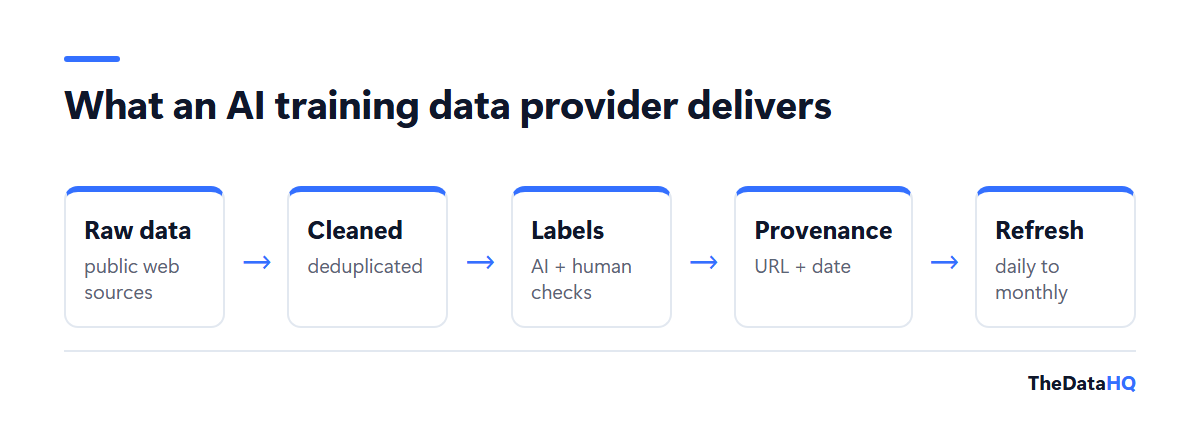
| Deliverable | What you get | Why it matters |
|---|---|---|
| Raw collected data | Text, product pages, listings, reviews or images from public sources | The material the model learns from |
| Cleaned records | Duplicates removed, encoding fixed, boilerplate stripped | Duplicates and junk text skew training |
| Labels (annotation) | Categories, sentiment, entities or bounding boxes | Needed for supervised learning and evaluation sets |
| Schema and data dictionary | Every field named, typed and explained | Your engineers can load it without guessing |
| Provenance log | Source URL, collection date and method per record | Lets you answer legal and audit questions later |
| Scheduled refresh | Daily, weekly or monthly deliveries to S3, BigQuery, Snowflake or an API | Keeps the model current |
Collection vs annotation: two different jobs
AI training data annotation means people (or models checked by people) labeling records. Collection means gathering the records in the first place, usually from the web. Labeling-only firms expect you to bring the data. Web data firms like ours bring the data and add machine labels, with human checks where accuracy matters.
If you need web data at volume, start with a collection provider such as our AI data scraping service or custom data extraction. If you already have the data and need 50,000 images boxed by hand, you want an annotation vendor.
Who needs AI training data services?
Any team training or fine-tuning a model on information that lives on the public web and changes often. That's most commercial AI outside a lab. Here's what it looks like by industry in the US.
- E-commerce and pricing: product titles, prices and reviews from retailers like Amazon, Walmart and Home Depot, used to train price-matching and product-matching models.
- PropTech: listing descriptions, photos and price history from portals like Zillow, used for valuation models and listing classifiers.
- HR tech and recruiting: job posts from boards like Indeed, normalized by role, salary and city, for job-matching and salary models.
- Travel: hotel rates, room types and reviews across cities like New York, Miami and Las Vegas, for demand forecasting.
- LLM and RAG teams: clean domain text (documentation, regulations, product manuals) for fine-tuning or for retrieval, where a model looks things up before answering.
Naming these companies describes the market, not our sources. We only collect public data, and we check each source's terms before collecting.
Build in-house vs outsource: what does it cost?
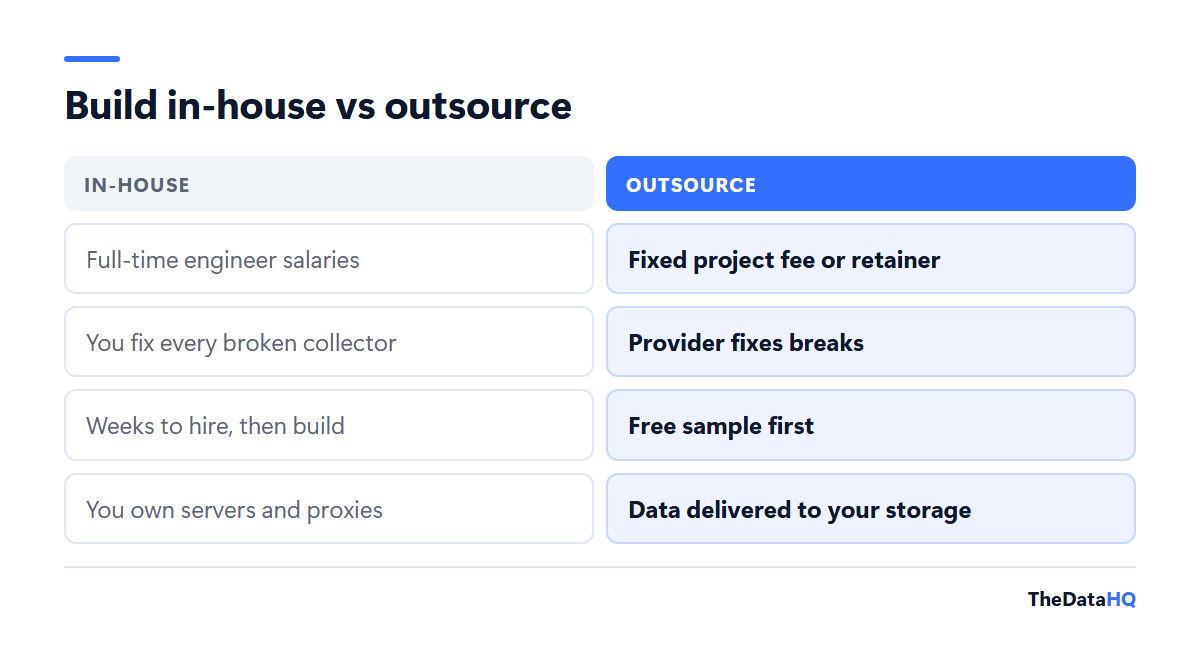
Building in-house costs at least one engineer's salary plus infrastructure, before the first clean row. Outsourcing costs a project fee or a monthly retainer, and the provider carries the maintenance. For most SMB and mid-market teams, outsourcing wins until data collection becomes a core product.
What in-house really costs
You need at least one full-time AI training data engineer with scraping experience, and that hire usually takes weeks. On top of salary you pay for:
- Servers and storage for the raw and cleaned data.
- Proxies, the rented IP addresses that spread requests politely across sources.
- The hours spent fixing collectors each time a site changes its layout.
What happens when a collector breaks?
The bigger cost is silent failure. A collector breaks, the pipeline keeps running, and the model keeps learning from old or empty data. We wrote about this in stale data in AI pipelines. A managed provider monitors volumes and field fill rates and fixes breaks as part of the service.
If collecting data is your product and you want your own engineers to own the code, a development partner like BinaryBits builds it in-house with you. If you just want the data, buy the data.
How to evaluate AI training data companies: a 10-point checklist
Score each provider on these ten points. A provider that can't answer the first three in writing isn't ready for production AI work.
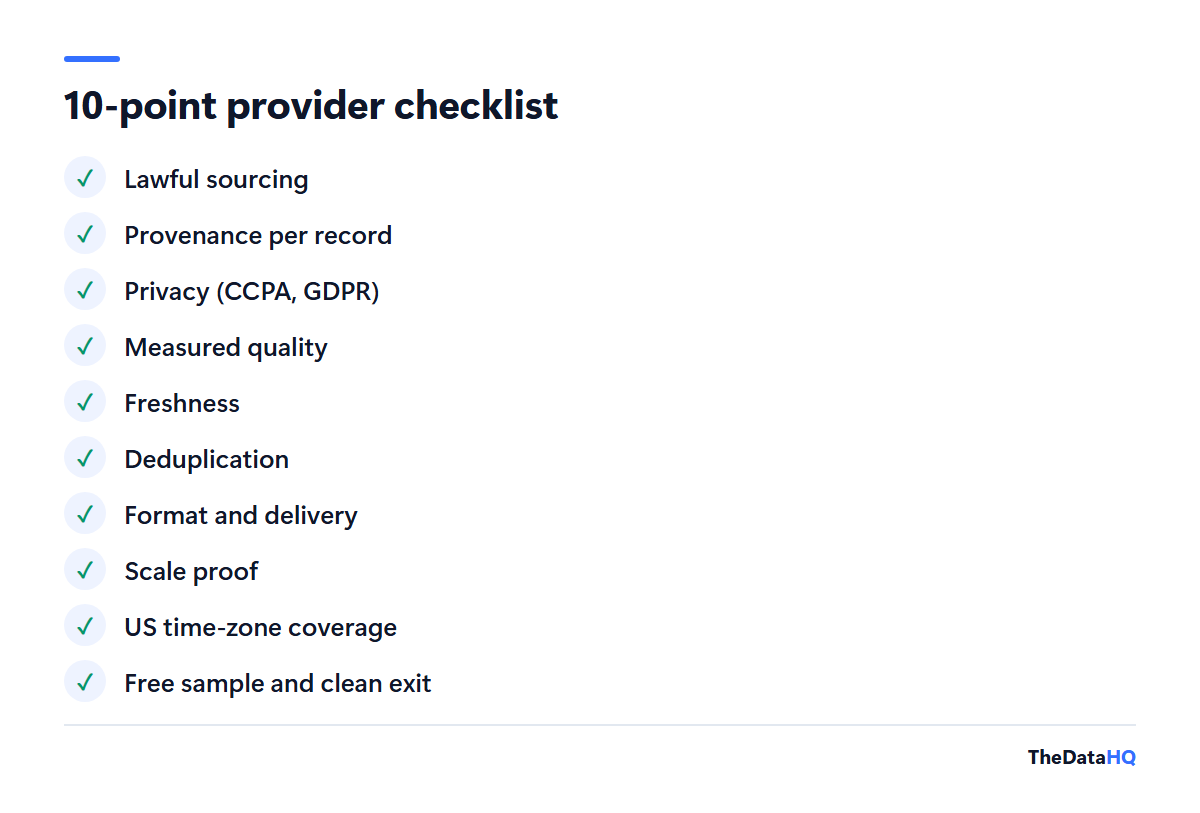
- Lawful sourcing. Public data only, terms of service checked, no collection behind logins.
- Provenance per record. Source URL and collection date on every row.
- Privacy handling. Personal data removed or minimized, in line with the CCPA and, for EU or UK people, the GDPR.
- Measured quality. A stated accuracy figure and how it was measured, such as a hand-checked sample of 500 rows.
- Freshness. How often data refreshes and how fast a broken source is fixed.
- Deduplication. Near-duplicate removal, not just exact matches.
- Format and delivery. JSONL, Parquet or CSV, delivered to your S3, BigQuery, Snowflake or API.
- Scale proof. Past projects at your volume, with numbers.
- Time-zone coverage. Support hours that overlap with your team, for US buyers ideally Eastern to Pacific.
- Free sample and clean exit. A sample before you pay, and you keep the data and the schema if you leave.
What a real project looks like
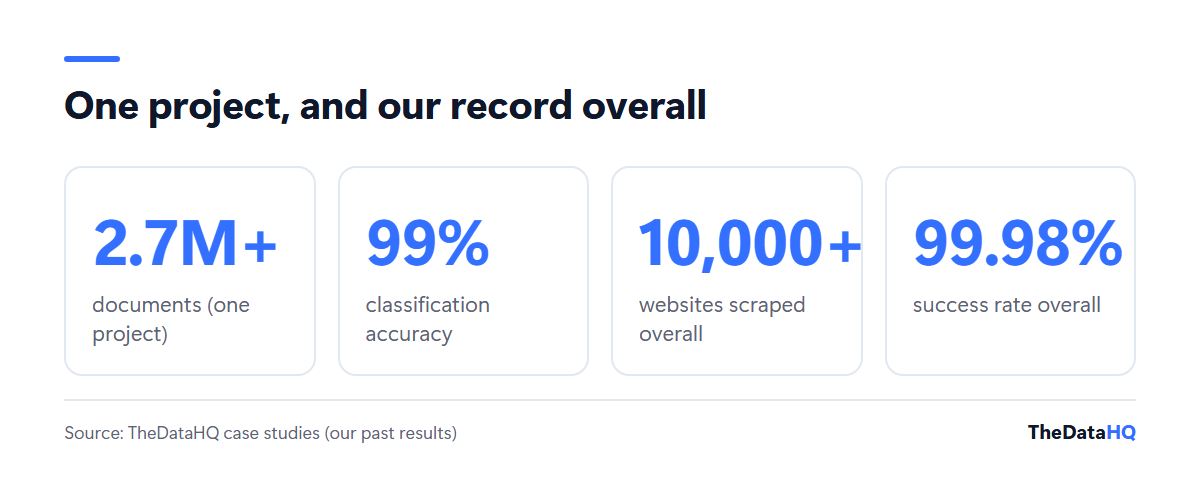
One of our AI training data projects collected more than 2.7 million documents from dynamic websites and classified them at 99% accuracy (our case studies). Across 12+ years we've run 260+ projects and scraped 10,000+ websites at a 99.98% success rate, for clients in the US, UK, Germany and Australia. Those are our past results, not a promise for every source.
AI training data services pricing and timelines
Prices fall into three models: ready-made datasets priced per record, custom collection priced per project, and recurring feeds on a monthly retainer. The cheapest per record is rarely the cheapest per usable record.
| Option | How it's priced | Timeline |
|---|---|---|
| Ready-made dataset (marketplace) | Per 1,000 records, set by the seller | Off the shelf, already collected |
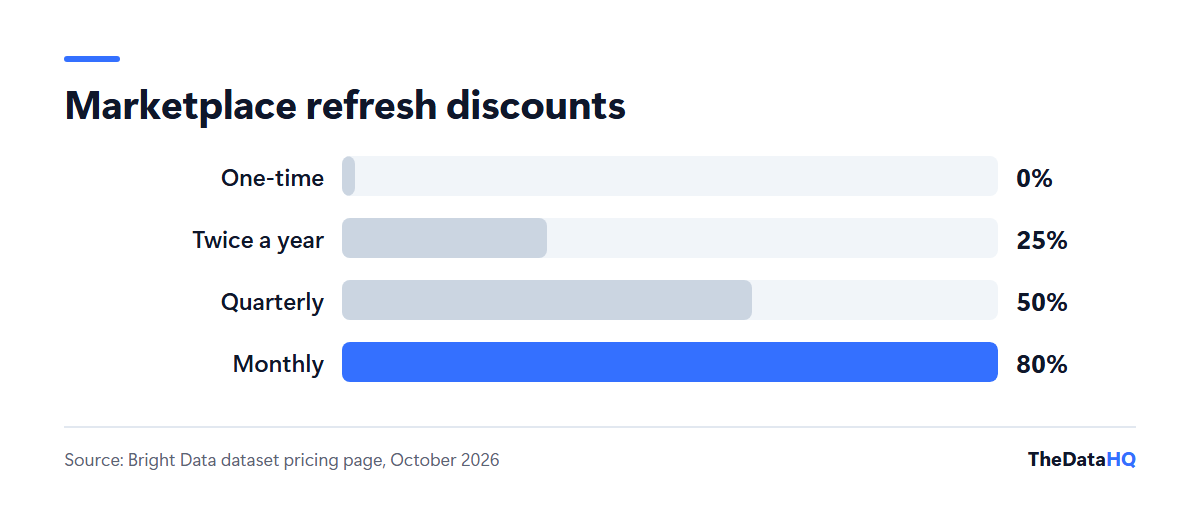
| Marketplace with monthly refresh | Up to 80% off the one-time price | Monthly |
| Custom collection project (TheDataHQ) | One fixed price for an agreed scope, quoted after a free sample | Free sample of 100 rows in 24 hours, then a quoted delivery date |
| Recurring feed on retainer (TheDataHQ) | Weekly or monthly retainer, quoted on sources and volume | Daily, weekly or monthly |
| In-house team | Full-time salaries, plus servers, storage and proxies | Weeks to hire, then build |
Marketplace prices are from Bright Data's dataset pricing page, which lists refresh discounts of 25% (twice a year), 50% (quarterly) and 80% (monthly). An AI training data marketplace is fast, but you get the fields the seller chose, from the sources the seller chose.
What moves the price
- Number of sources, and how often each one changes its layout.
- Volume and refresh frequency.
- Fields per record, and whether any need AI classification or human labels.
- Pages that load content with JavaScript or hide data in images.
Is it legal to collect web data for AI training in the US?
Collecting public web data is generally not "hacking" under the Computer Fraud and Abuse Act (CFAA). In hiQ v. LinkedIn, the Ninth Circuit held in 2022 that accessing public pages isn't "without authorization". But hiQ still lost on breach of LinkedIn's user agreement and, in a December 2022 consent judgment, agreed to stop scraping and pay $500,000 (ZwillGen's summary).
The lesson in plain English: public data is a starting point, not a free pass. Terms of service, copyright and privacy law still apply. This is not legal advice; ask your counsel about your use case.
Questions to ask before you sign
Ask these on the sales call and get the answers in the contract or statement of work.
- Which sources will you collect from, and have you checked their terms?
- What does a record look like? Can I see 100 real rows from my sources first?
- How do you measure accuracy, and what happens if a delivery falls below it?
- How fast do you fix a source that breaks, and how will I know it broke?
- Who owns the data and the schema if we stop working together?
- What support hours do you cover in US time zones, and who answers when a delivery is late?
- Can you give me a reference from a US client with a similar project?
Why the urgency around fresh, lawful data? Epoch AI estimates the stock of quality public human text at around 300 trillion tokens, which frontier labs could fully use between 2026 and 2032. Specific, current, well-documented data from your own domain is what will set your model apart.
TheDataHQ is a managed web scraping and data-as-a-service company: we run the scrapers and deliver clean data on a schedule, so you never babysit a scraper.
Next step: Request a free data sample (100 rows in 24 hours). Send us the sources and fields you need, and check the quality before you pay anything. For broader analysis, see data intelligence and web data mining.
Frequently asked questions
How is AI training data stored?
Most AI training data is stored as files in cloud object storage such as Amazon S3, Google Cloud Storage or Azure Blob. Text usually sits in JSONL or Parquet, images as files with a manifest, and each version is kept so you can retrain on the exact same set. Good providers store provenance, meaning source and collection date, next to every record.
What does an AI training data company do?
An AI training data company collects, cleans, labels and delivers the datasets that machine learning models learn from. Some only label data you supply; others, like TheDataHQ, also collect it from public websites. The deliverable is structured data with a schema, quality checks and a refresh schedule, sent to your storage or API so your team can train.
How much does AI training data cost?
It depends on the model you buy. Ready-made datasets are priced per 1,000 records on public marketplaces, often with large discounts for monthly refreshes. Custom collection is quoted per project or as a weekly or monthly retainer, based on sources, volume and labeling. Building it yourself means full-time engineers plus servers and maintenance. Ask for a free sample first.
How much training data is required for machine learning?
It depends on the task. A simple classifier fine-tuned on an existing model can work with a few thousand labeled examples, while training from scratch needs millions. Quality and coverage matter more than raw volume. Start with a sample, measure accuracy on a held-out test set, and add data where the model makes mistakes.
What is the difference between an AI training data marketplace and a custom service?
A marketplace sells ready-made AI training data sets that the seller has already collected, so it's fast and cheap per record, but you get their fields and sources. A custom service collects exactly the sources and fields you specify, on your schedule, with provenance. Choose a marketplace for general data and a custom service for niche or fast-changing data.