
AI Web Scraping Case Study: 2.7M+ Documents Classified at 99% Accuracy
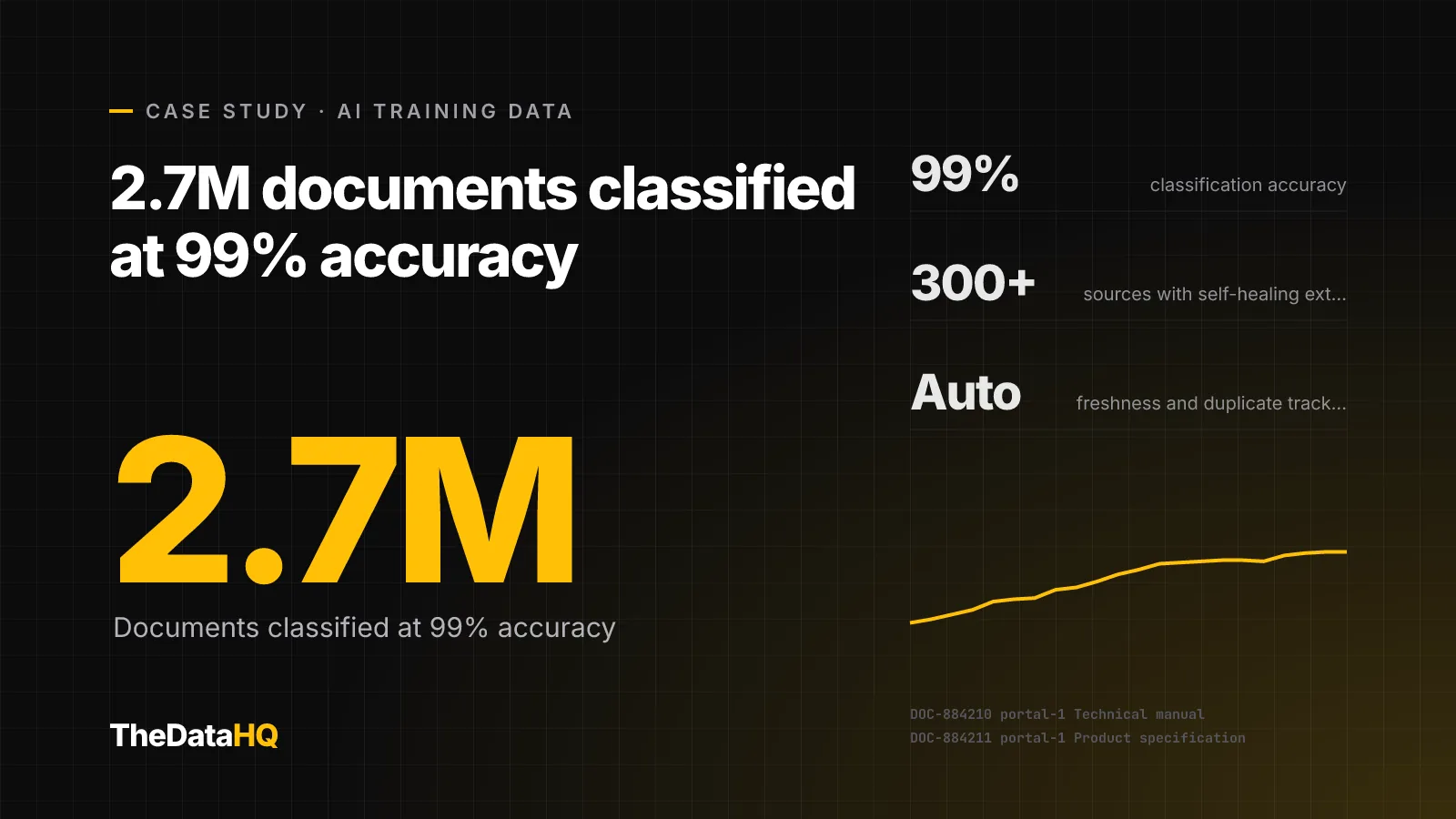
This AI web scraping case study covers a system that discovers sources through search, navigates dynamic websites with AI, and extracts and classifies documents. It has processed more than 2.7 million documents at 99% classification accuracy.
The Challenge: Finding and Sorting Millions of Documents for AI
The client needed a large, well-labelled body of documents from the open web to train and test AI models. Volume mattered, but so did quality: a mislabelled document teaches a model the wrong thing, and duplicates skew what it learns.
The sources were not known in advance. Relevant documents were spread across hundreds of websites, many of them dynamic, with content behind search forms, filters, tabs and infinite scroll. A fixed list of hand-written scrapers would have missed new sources and broken whenever a site changed.
Labelling by hand was also out of the question at this scale. Each document had to be placed into the right category automatically, with accuracy high enough that the client could trust the labels without checking each one. And the collection had to stay current, picking up new and updated documents without re-adding old ones.
What the Client Needed From AI Web Data Collection
- New sources discovered automatically, not only from a fixed list
- Dynamic websites navigated without a custom scraper for every page type
- Every document classified into the right category with very high accuracy
- Duplicates detected and fresh versions tracked over time
- Extraction that keeps working when a source changes its layout
Our Solution: Search-Led Discovery, AI Navigation and GPT-4o Classification
The pipeline starts with discovery. It runs targeted searches to find candidate sources, scores them for relevance and adds the useful ones to the crawl list. Playwright drives a real browser on each site, and an AI agent decides where to click, which filters to apply and how to page through results, so dynamic sites are handled without a hand-built script for each.
When a document is found, its content is extracted and passed to GPT-4o with a defined label set and examples. The model returns a category and a confidence score; low-confidence cases are routed for review, which keeps overall classification accuracy at 99%. Pandas and SQL handle validation, counts and reporting.
Extraction is self-healing across more than 300 sources. When a site changes, the system notices the drop in quality, re-learns where the content sits and carries on. Workers run in parallel with multiprocessing inside Docker containers, and every document is fingerprinted so duplicates are caught and updated versions replace stale ones.
| Document ID | Source | Category | Confidence | Duplicate | Last seen |
|---|---|---|---|---|---|
| DOC-884210 | portal-1 | Technical manual | 0.98 | No | 21 Nov |
| DOC-884211 | portal-1 | Product specification | 0.97 | No | 21 Nov |
| DOC-884356 | site-14 | Regulatory filing | 0.99 | No | 20 Nov |
| DOC-884402 | site-27 | Technical manual | 0.96 | Yes (newer copy kept) | 20 Nov |
| DOC-884517 | portal-3 | Research report | 0.71 | No (sent to review) | 19 Nov |
The Result: A 2.7 Million Document Dataset With Trusted Labels
The system has collected and classified more than 2.7 million documents at 99% accuracy. The client receives a dataset that is large, labelled and deduplicated, ready for model training and evaluation.
Because sources are discovered by search and extraction heals itself across 300+ sites, coverage keeps growing without a new build for each website. Freshness tracking means the dataset reflects current documents rather than a one-off snapshot.
Teams building AI products, search tools or document archives can use the same approach. We combine reliable scraping with AI navigation and classification, measure accuracy openly, and deliver data in the format your training or analytics pipeline expects.
What is AI web scraping?
It uses AI models to navigate websites and understand page content, so scrapers can handle dynamic sites and layout changes with less hand-written code.
How accurate is AI document classification?
In this project GPT-4o classification reached 99% accuracy across 2.7 million documents, with low-confidence cases sent for review.
What is a self-healing scraper?
A scraper that detects when a site has changed, re-learns where the content is and keeps extracting. Here it runs across 300+ sources.
Can you collect training data for AI models from the web?
Yes. We discover sources, extract and clean documents, label them and remove duplicates, then deliver a dataset ready for training.
How do you stop duplicate documents in a training dataset?
Every document is fingerprinted. Exact and near duplicates are flagged, and newer versions replace older ones.
Do you use GPT-4o for data extraction?
We use GPT-4o where it adds accuracy, such as classification and reading messy pages, alongside standard Python scraping for speed and cost.
More Web Scraping Case Studies
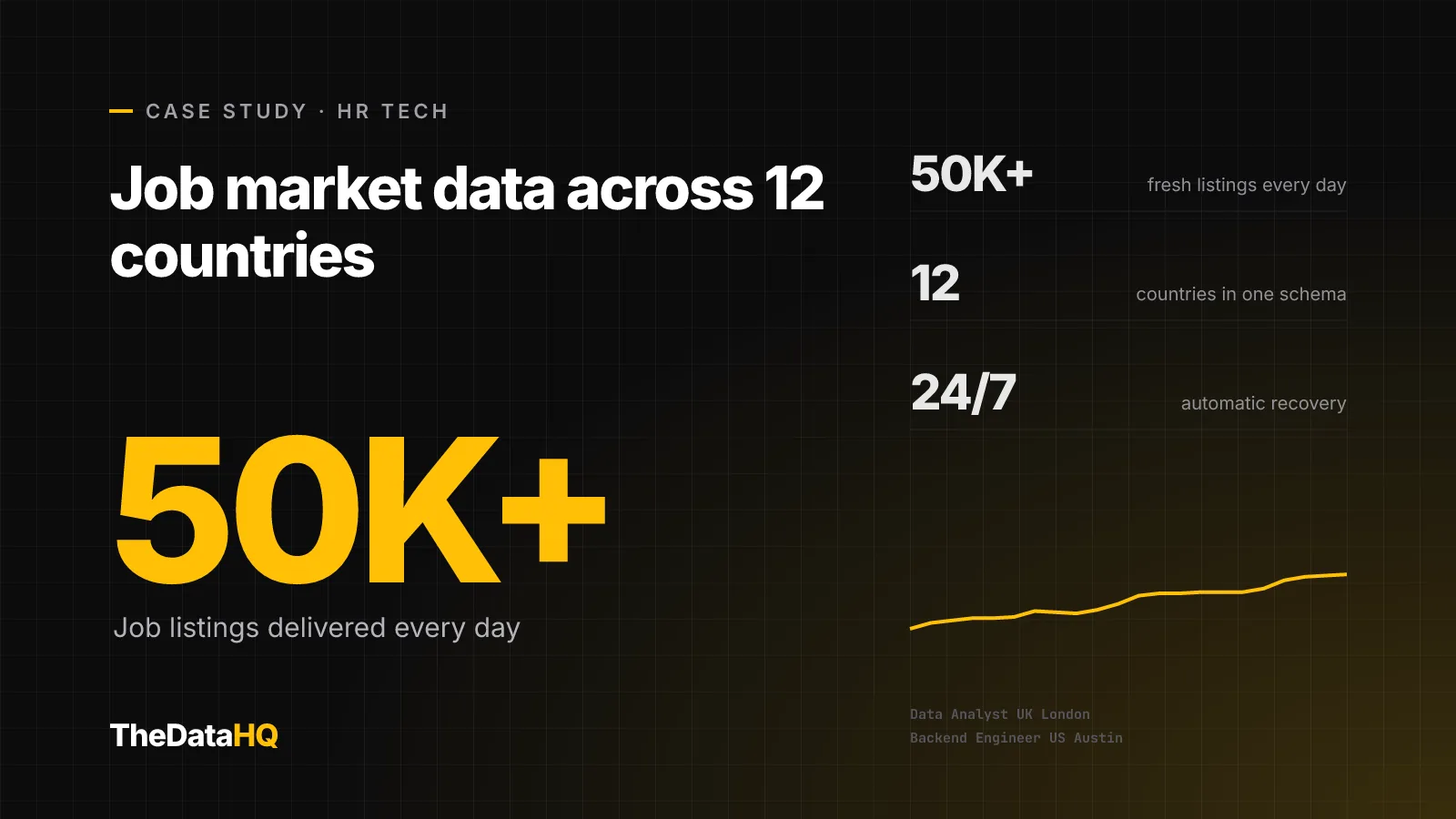 HR tech50K+
Job listings delivered every day
50,000 fresh job listings a day from 15,000+ sources for HiCounselor
Read the case study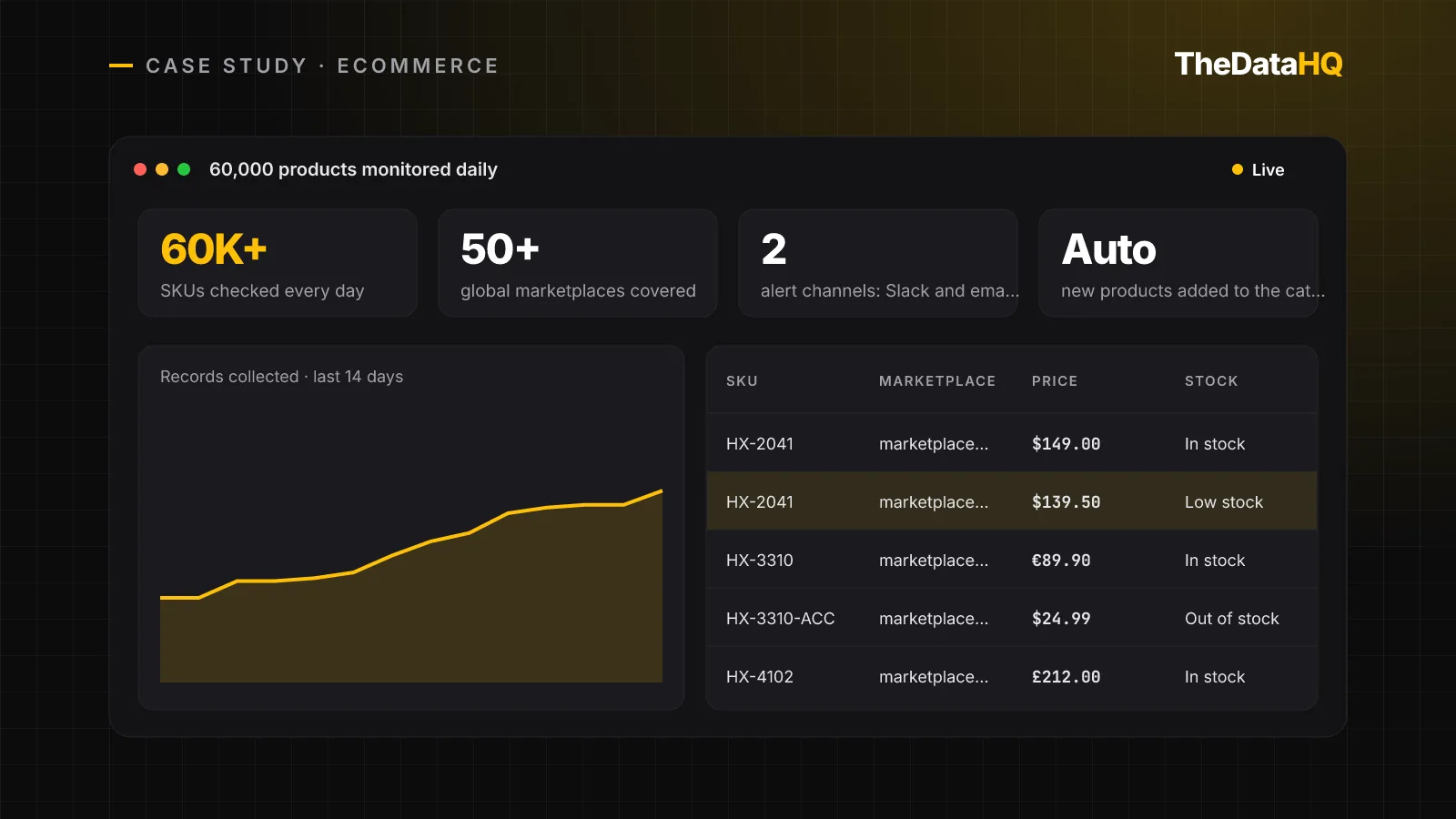 Ecommerce60K+
SKUs monitored every day
60,000+ SKUs tracked daily across 50+ marketplaces, with live alerts
Read the case study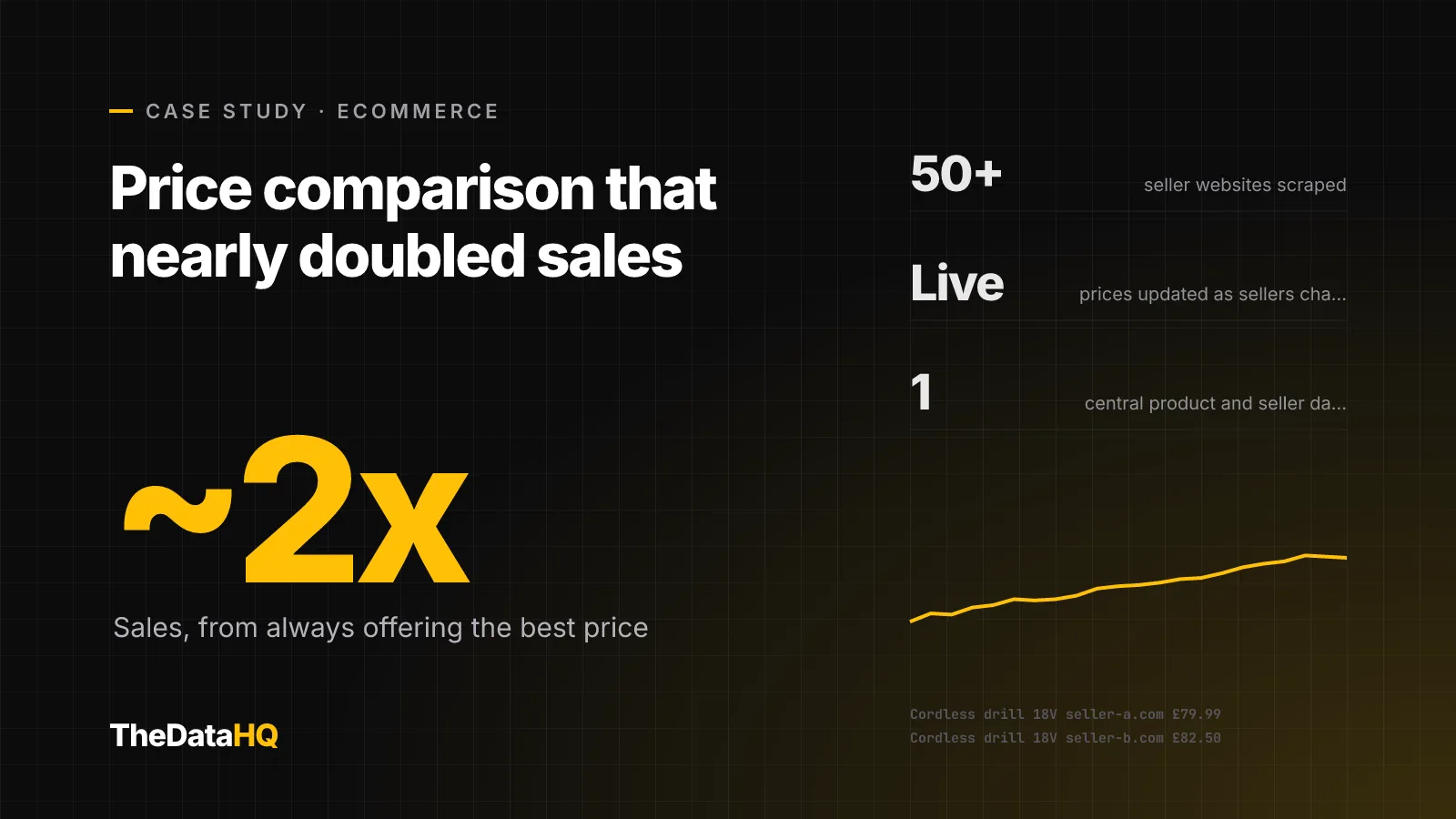 Ecommerce~2x
Sales, from always offering the best price
Live prices from 50+ seller sites helped an online seller nearly double sales
Read the case study