
Market Intelligence Data Case Study: 20M+ Publications Across 40 Sectors
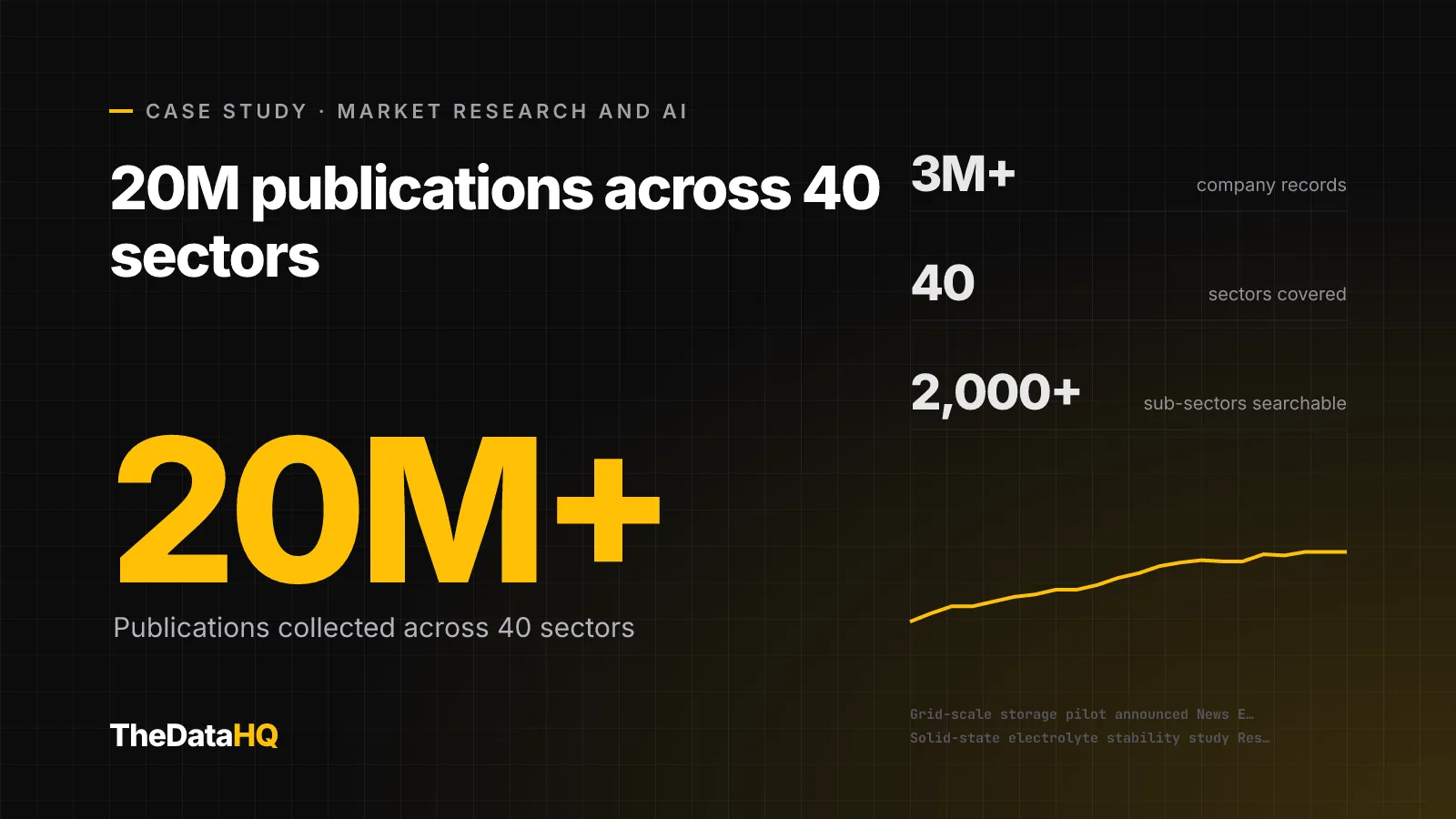
This market intelligence data case study describes a platform that collects news, blogs, research papers, patents, PDFs and company records across 40 sectors and more than 2,000 sub-sectors. It now holds 20 million+ publications and 3 million+ company records, searchable by sector.
The Challenge: Sector Research Lived in Thousands of Formats
The client sells sector-level intelligence. Its customers want to know what is happening in a market: who the companies are, what they publish, which patents they file, what the press and researchers say about them. Answering that well means reading far more than any team of analysts can.
The source material came in every shape. News articles and blog posts are HTML pages that change layout often. Research papers and reports arrive as PDFs. Patents follow their own structured formats. Company records sit in directories and registries. Some sources were large and well known; hundreds were small, niche sites that matter only to one sub-sector.
Collecting the text was only half of it. A search for a sector or company is useless if the system cannot tell that a news story, a paper and a patent all mention the same firm. The client needed the documents cleaned, normalised and tagged so that sector-wise search returned the right results.
What the Client Needed From Market Intelligence Data
- News, blogs, research papers, patents, PDFs and company records in one place
- Coverage of 40 sectors and more than 2,000 sub-sectors
- Text extracted cleanly from HTML and PDF documents alike
- Companies, people and technologies recognised inside each document
- Search by sector and sub-sector, not just by keyword
Our Solution: Hundreds of Scrapers Feeding an NER-Powered Search
We built more than 20 scrapers for the major sources and hundreds of smaller ones for niche sites, using Python with Scrapy for volume, Selenium for sites that need a browser, and BeautifulSoup for simple pages. Each document is stored in MongoDB with its source, date, type and sector tags.
Every document then passes through cleaning and normalisation. Boilerplate such as menus and adverts is stripped, PDF text is extracted and repaired, dates and titles are put into one format, and duplicates, such as the same story syndicated on several sites, are removed.
On top of that we built a named entity recognition (NER) system. It finds companies, people, products and technologies in each document and links them to the 3 million+ company records. Documents are mapped to sectors and sub-sectors, so a user can open a sub-sector and see every relevant article, paper and patent, grouped by the companies they mention.
| Document | Type | Sector | Sub-sector | Entities found | Date |
|---|---|---|---|---|---|
| Grid-scale storage pilot announced | News | Energy | Battery storage | 3 companies | 18 Nov |
| Solid-state electrolyte stability study | Research paper | Materials | Solid-state batteries | 2 institutions | 15 Nov |
| Method for cell thermal management | Patent | Automotive | EV components | 1 company | 12 Nov |
| Annual sustainability report | Logistics | Cold chain | 1 company, 4 products | 10 Nov | |
| Why vertical farms are scaling slowly | Blog | Agritech | Indoor farming | 5 companies | 09 Nov |
The Result: 20 Million Publications Searchable by Sector
The platform now holds more than 20 million publications and 3 million company records, organised across 40 sectors and 2,000+ sub-sectors. Its users search a sector and get news, research, patents and reports in one view, linked to the companies involved.
Because entities are recognised automatically, the client can build features that were out of reach before: company timelines, sector activity trends, and alerts when a tracked firm appears in a new patent or paper.
Research firms, consultancies, investors and AI teams can use the same approach to build their own knowledge base. We collect the sources you care about, turn messy pages and PDFs into structured records, and deliver them ready for search, analysis or model training.
What is market intelligence data?
It is information about a market collected from public sources, such as news, research papers, patents and company records, organised so you can analyse sectors and competitors.
Can you scrape research papers and patents?
Yes. This project collects research papers, patents, PDFs, news and blogs, and extracts clean text from each.
How do you extract text from PDF reports?
We extract the text, repair broken lines and headings, and store it with the document's source, date and sector tags.
What is named entity recognition used for in market research?
NER finds companies, people and technologies inside documents, so you can search by company or sector rather than by exact keywords.
How many sources can a market intelligence platform cover?
Here we run more than 20 scrapers for major sources and hundreds more for smaller sites, covering 40 sectors.
Can the data be used to train AI models?
Yes. Cleaned, deduplicated and tagged documents are well suited to search, analytics and AI training work.
More Web Scraping Case Studies
 HR tech50K+
Job listings delivered every day
50,000 fresh job listings a day from 15,000+ sources for HiCounselor
Read the case study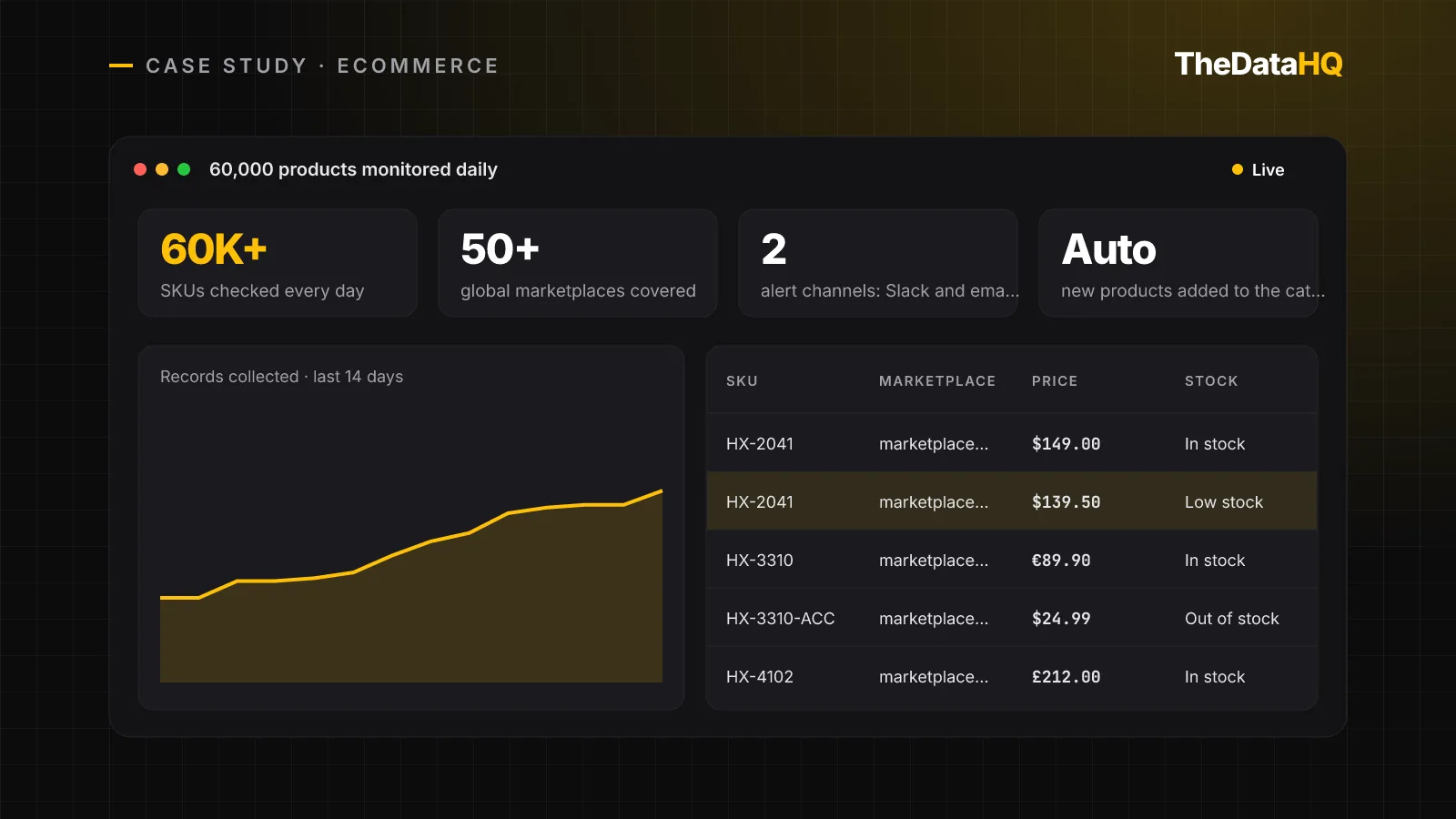 Ecommerce60K+
SKUs monitored every day
60,000+ SKUs tracked daily across 50+ marketplaces, with live alerts
Read the case study Ecommerce~2x
Sales, from always offering the best price
Live prices from 50+ seller sites helped an online seller nearly double sales
Read the case study