
In-House vs Managed Web Scraping, an Honest Build-or-Buy Guide
The in-house vs managed web scraping decision comes down to one question: is collecting web data part of what makes your product different, or is it plumbing you need to work? This guide sets out the real costs on both sides, the risks people underestimate, and the cases where we would tell you to build it yourself.
What Is the Difference Between In-House and Managed Web Scraping?
In-house web scraping means your own developers write the scrapers, rent the servers, buy the proxies, schedule the jobs and fix them when they break. You own every line of code and every decision. Managed web scraping means an outside team does all of that and hands you the finished data on a schedule, as files, database rows or an API.
Both produce the same thing in the end: rows of data. The difference is who carries the ongoing work and the risk. With in-house, a site redesign at midnight is your problem. With a managed service, it is the provider's problem, and the contract should say how quickly they fix it. That shift of responsibility is what you are really paying for, so it is worth pricing honestly on both sides.
In-House vs Managed Web Scraping Compared
| Option | Build in-house | In-house plus scraping tools | Managed by TheDataHQ |
|---|---|---|---|
| Upfront effort | Hire or reassign developers, set up infrastructure | Learn the tool, configure each site | A scoping call and a field list |
| Ongoing cost shape | Salaries plus servers and proxies, mostly fixed | Seats plus usage fees, rises with volume | Hourly, monthly or fixed price, agreed up front |
| Control over code | Full | Partial, limited by the tool | We run the code; the data and field definitions are yours |
| Who fixes breakages | Your developers, pulled off other work | Your staff, inside the tool | Our engineers, usually the same day |
| Scaling to new sources | Each one is a new mini-project | Fine for simple sites, hard for complex ones | Added to the plan, often within days |
| Key-person risk | High if one developer owns it all | Medium | Low; a team covers every feed |
What Does In-House Web Scraping Really Cost?
Building a robust scraper for one complex site takes days, not hours. Then someone must own it. Even a small portfolio of sources tends to absorb a meaningful share of a developer's week, every week.
Many sites limit repeated requests, so production scrapers need request infrastructure, pacing that stays inside those limits and careful retry logic. This is a recurring bill that grows with volume.
JavaScript-heavy sites need real browsers, which use far more memory and compute than simple requests. Scheduling, storage and logging add further hosting costs.
Websites change layouts, move data behind scripts and rename fields without notice. Every change is unplanned work, and the more sources you run, the more often something is broken.
A scraper that silently returns empty fields is worse than one that crashes. Building checks, alerts and backfills is its own project that in-house teams often skip until bad data reaches a report.
Is It Cheaper to Build Web Scrapers In-House?
Sometimes. Write down the full list: developer hours to build, developer hours per month to maintain, proxy spend, hosting, and the cost of the other work that developer is not doing. The last line is the one most budgets leave out, and it is often the largest. A product engineer spending two days a week fixing scrapers is a product engineer shipping three days a week of features.
Then compare it with an outside quote. Our engineers work from $15 an hour, a dedicated engineer costs from $2,400 a month, and fixed-price projects are quoted up front, with proxies, servers and monitoring included. For a handful of stable sources refreshed weekly, in-house can be cheaper, especially if you already run similar infrastructure. Once you pass a few dozen sources, need daily or hourly data, or track sites that redesign often, the managed side usually wins on cost as well as reliability.
Whichever way you lean, price the second year, not just the first. Build costs fall away; maintenance does not. A fair comparison sets twelve months of upkeep against twelve months of a service fee.
When Is In-House Web Scraping the Right Choice?
We would rather lose a deal than sell a service you do not need. Build it yourself when most of these are true.
- Web data collection is the heart of your product, and your edge depends on how you do it
- You already employ engineers with scraping experience and spare capacity
- You only need a few stable, simple sites, refreshed weekly or less
- Strict internal rules forbid any outside party from handling the data
- You need to change extraction logic many times a day as an experiment
Warning signs you have outgrown it
- Feeds break more than once a month and nobody notices for days
- One developer is the only person who understands the scrapers
- Proxy and server bills are climbing faster than data volume
- Product work keeps slipping because scrapers need fixing
When Does Managed Web Scraping Make More Sense?
A managed service is usually the better call when the data matters to the business but the scraping itself does not set you apart.
- You need data from dozens, hundreds or thousands of websites
- Freshness matters, such as daily prices or same-day listings
- Target sites are JavaScript-heavy, change often or limit requests
- Your team is analysts or product people, not scraping engineers
- You want a clean, checked dataset rather than raw pages
- You need to start in days, not after a hiring round
What Are the Risks of Each Approach?
In-house risk is mostly concentration. Scraping knowledge tends to sit with one or two people, and when they leave, the scrapers become code nobody dares touch. Quality risk is the other one: without dedicated checks, a layout change can fill a column with blanks for weeks before an analyst spots a strange dip in a chart.
Managed risk is mostly dependency. You rely on a provider's responsiveness and its future. Reduce that by agreeing written field definitions, a fix-time expectation, delivery into your own storage so history stays with you, and the option to take over the code if you part ways. With us, data lands in your bucket or database, not only ours, and we reply within 4 business hours.
Compliance risk applies to both. Collect only public data, avoid personal data, respect access controls and review each site's terms. A provider who refuses some jobs is a good sign, not a bad one.
How Do You Move From In-House Scrapers to a Managed Service?
- 01
List your feeds (day 0)
Share the sites, fields, schedules and current output format. Existing code helps but is not required.
- 02
Run in parallel (week 1)
We produce the same feeds alongside yours so you can compare rows and spot any differences.
- 03
Cut over (about week 2)
Once outputs match, your systems read from our delivery and your scrapers are switched off.
- 04
Free your team
Your developers return to product work. We maintain, monitor and extend the feeds from here.
How Much Does Managed Web Scraping Cost?
No minimum project size. Small fixes and big builds are both welcome.
Can You Combine In-House and Managed Web Scraping?
Yes, and many teams do. A common split is to keep the two or three sources closest to your product in-house, where you want full control, and hand the long tail of other sites to a managed provider. Another is to have us build and run the scrapers while your engineers own the data model and everything downstream.
We have built more than 15,000 scrapers across 10,000+ websites since 2015, for clients in 10+ countries worldwide. If you want a second opinion on your current setup, we will review it and tell you honestly whether it is worth changing. You can also read about our hosted web crawling, our Python and Scrapy consulting for teams that want to keep building, or how a managed project runs.
Should I build or buy a web scraper?
Build if scraping is core to your product and you have experienced engineers with spare time. Buy a managed service if you mainly need reliable data and would rather your team worked on other things.
How much does it cost to run web scraping in-house?
Add developer time to build and maintain, proxy spend, servers and the product work your developers are not doing. Maintenance is ongoing and usually larger than the first build.
How much does managed web scraping cost?
With us, engineers start from $15 an hour, dedicated engineers from $2,400 a month, and fixed-price projects are quoted up front. Proxies, servers and monitoring are included, and the first sample is free.
Is outsourcing web scraping safe?
It can be, if the provider only collects public data, delivers into storage you control and agrees written field definitions and fix times. Ask how they handle site terms and personal data before you sign.
What should a managed web scraping contract include?
Written field definitions, refresh schedule, delivery format, an expected fix time when a site changes, and delivery into storage you own. Those five points protect you whichever provider you choose.
How long does it take to switch from in-house scrapers?
Usually about two weeks: one week running both side by side to compare outputs, then a cut-over once the rows match.
What is the main reason in-house scraping projects fail?
Maintenance. Scrapers work on launch day, then sites change and the person who wrote them is busy elsewhere, so data quality slips without anyone noticing.
Can we take the scrapers in-house later?
Yes. If you decide to run collection yourselves, we hand over the scraper code, the field definitions and a short runbook at the end of the engagement, and can stay on call while your team takes over.
In-house vs managed web scraping guides
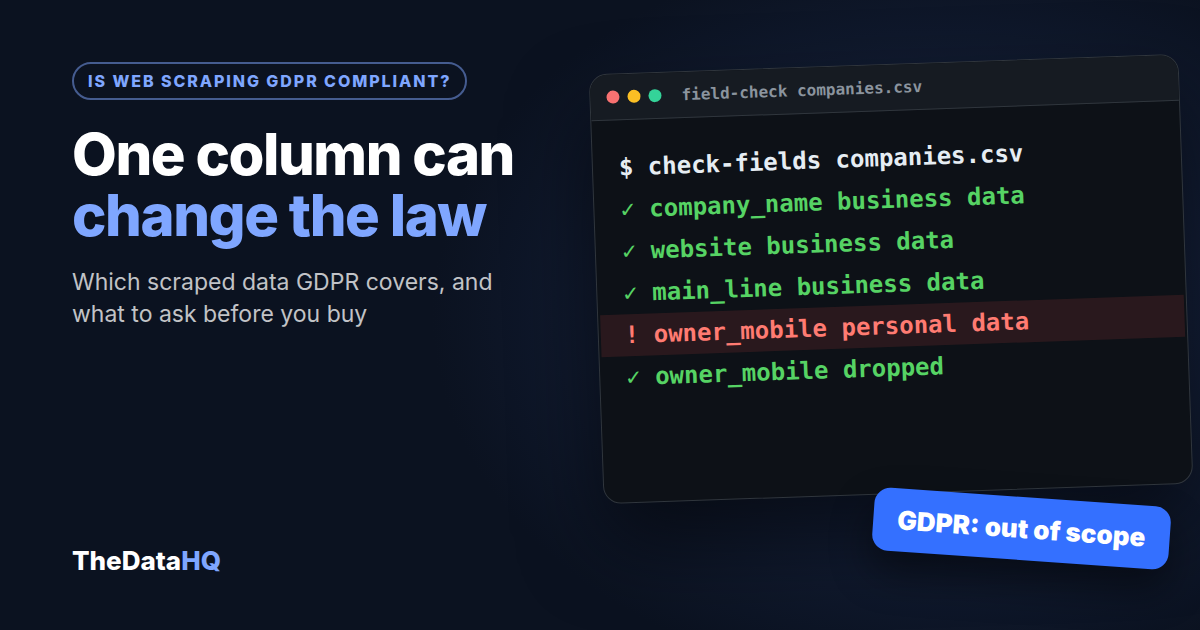
Is Web Scraping GDPR Compliant When You Buy the Data?
GDPR only applies when scraped data identifies a person. Which data is in scope, who is responsible when you buy it, what the EDPB draft…
Read the guide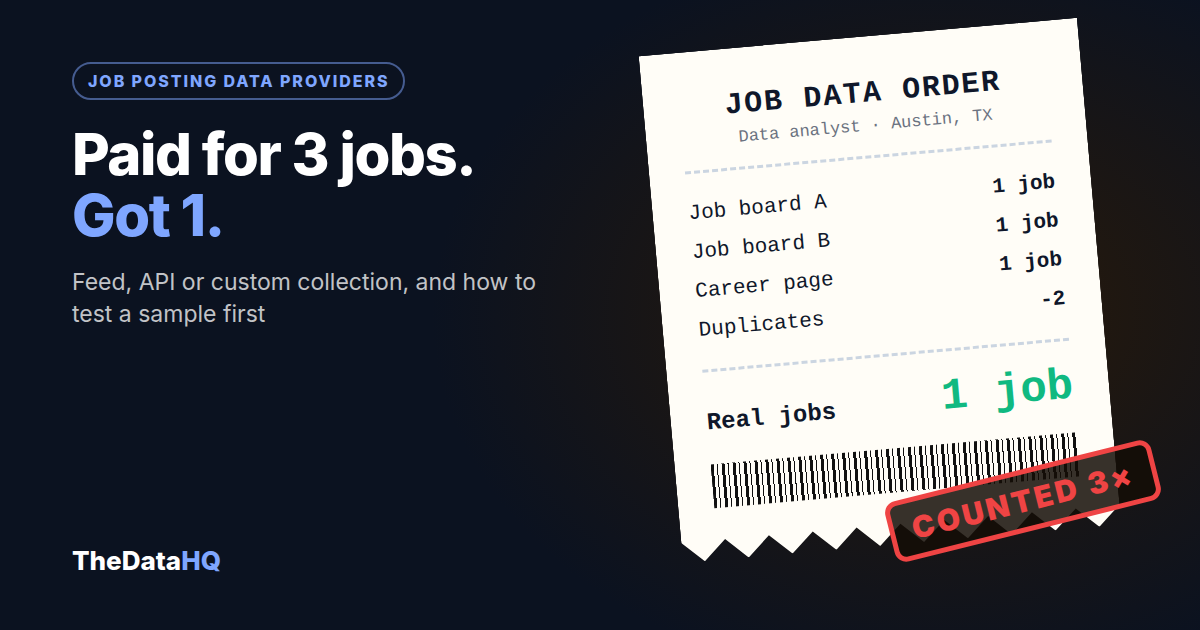
Job Posting Data Providers Compared: Feed, API or Scrape
Job posting data comes as a ready dataset, a pay-per-record API or a custom collection of named sites. Named providers with their…
Read the guide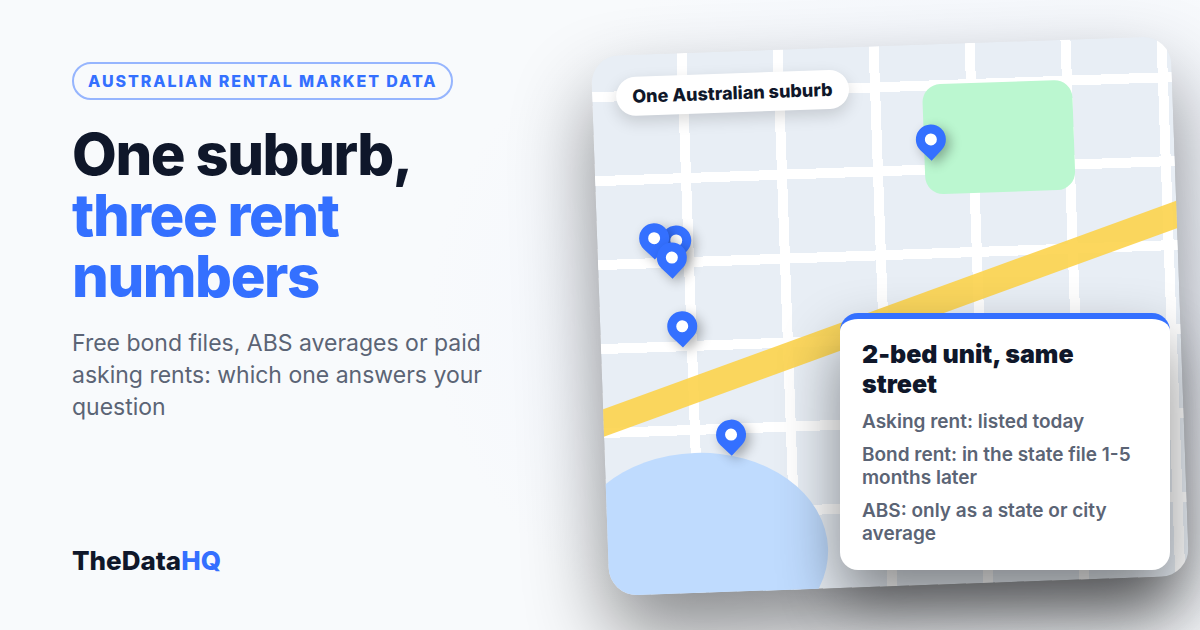
Rental Market Dataset Australia: Free vs Paid Sources
Australian rent data comes from free state bond files (suburb medians, months late), ABS averages, and paid asking-rent data from…
Read the guide